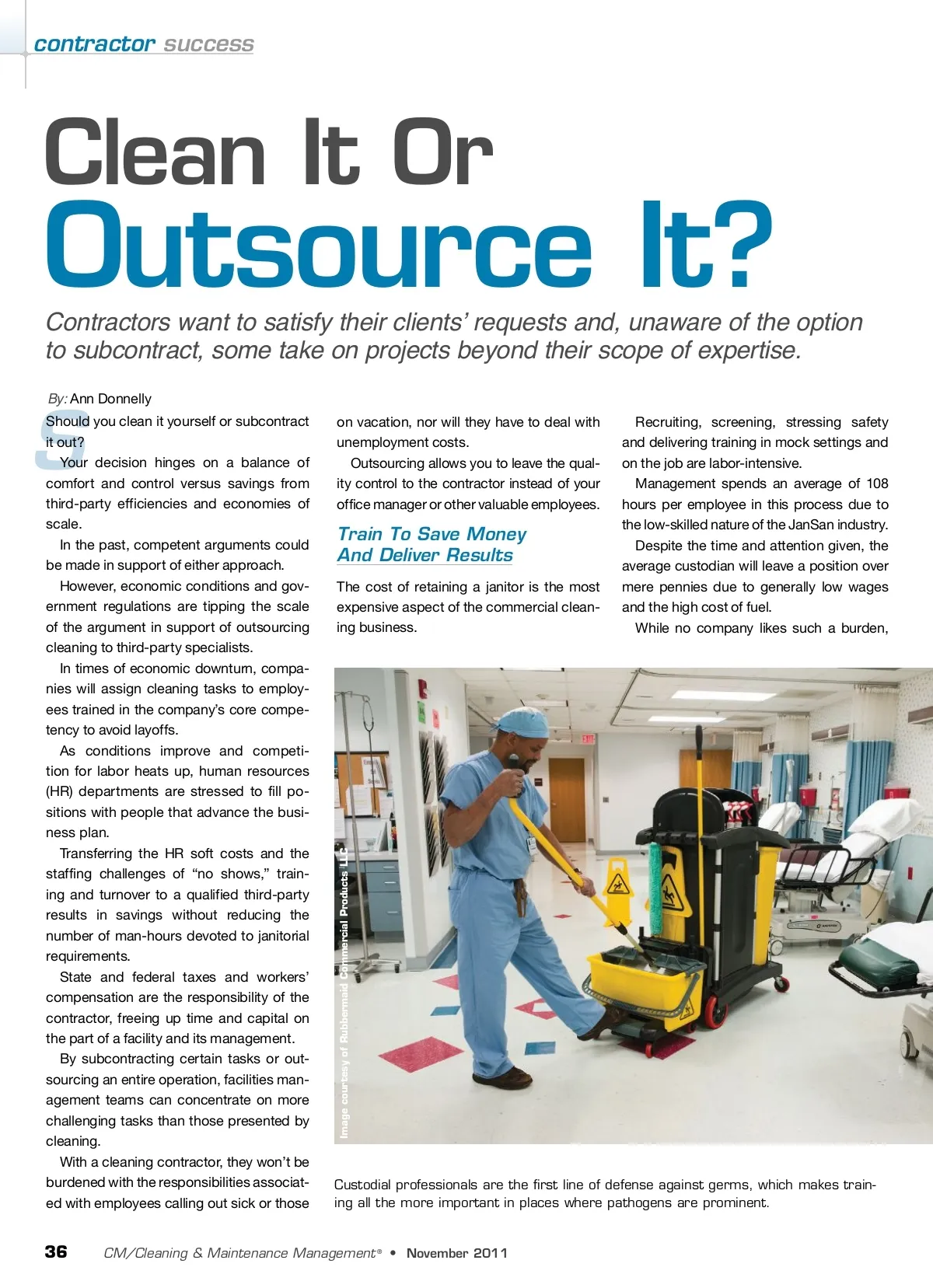
contractor success Clean It Or By: Ann Donnelly Outsource It? S Should you clean it yourself or subcontract it out? Your decision hinges on a balance of comfort and control versus savings from third-party efficiencies and economies of scale. In the past, competent arguments could be made in support of either approach. However, economic conditions and gov-ernment regulations are tipping the scale of the argument in support of outsourcing cleaning to third-party specialists. In times of economic downturn, compa-nies will assign cleaning tasks to employ-ees trained in the company’s core compe-tency to avoid layoffs. As conditions improve and competi-tion for labor heats up, human resources (HR) departments are stressed to fill po-sitions with people that advance the busi-ness plan. Transferring the HR soft costs and the staffing challenges of “no shows,” train-ing and turnover to a qualified third-party results in savings without reducing the number of man-hours devoted to janitorial requirements. State and federal taxes and workers’ compensation are the responsibility of the contractor, freeing up time and capital on the part of a facility and its management. By subcontracting certain tasks or out-sourcing an entire operation, facilities man-agement teams can concentrate on more challenging tasks than those presented by cleaning. With a cleaning contractor, they won’t be burdened with the responsibilities associat-ed with employees calling out sick or those on vacation, nor will they have to deal with unemployment costs. Outsourcing allows you to leave the qual-ity control to the contractor instead of your office manager or other valuable employees. Contractors want to satisfy their clients’ requests and, unaware of the option to subcontract, some take on projects beyond their scope of expertise. Recruiting, screening, stressing safety and delivering training in mock settings and on the job are labor-intensive. Management spends an average of 108 hours per employee in this process due to the low-skilled nature of the JanSan industry. Despite the time and attention given, the average custodian will leave a position over mere pennies due to generally low wages and the high cost of fuel. While no company likes such a burden, Train To Save Money And Deliver Results The cost of retaining a janitor is the most expensive aspect of the commercial clean-ing business. Custodial professionals are the first line of defense against germs, which makes train-ing all the more important in places where pathogens are prominent. 36 CM/Cleaning & Maintenance Management ® • November 2011 Image courtesy of Rubbermaid Commercial Products LLC
CMM – Archives Nov 2012: 36