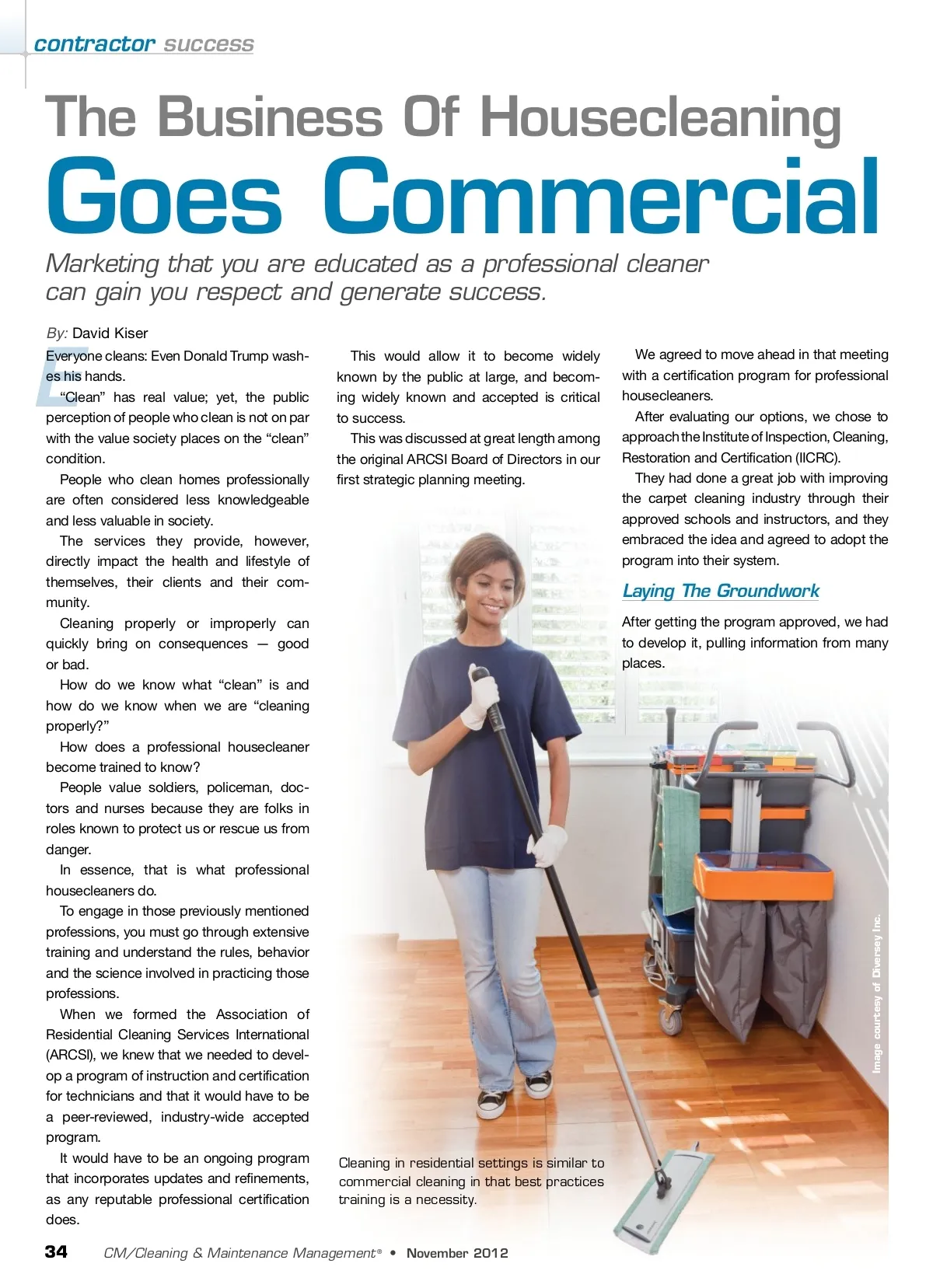
Regarding health and hygiene, the Cleaning Industry Research Institute (CIRI) was very helpful. Several members of their Technical Advisory Board steered us to information that documented hygienic cleaning practices. One noteworthy resource recommend-ed was the International Forum on Home, Health and Hygiene. We also relied on existing programs that the IICRC had in place, such as Fire and Smoke Restoration, Carpet Cleaning Technician and many approved standards to use as reference material. To have the interest, cooperation and con-tribution of world-renowned microbiologists, industrial hygienists, textile engineers and, most of all, people who clean homes made the project more of an exciting adventure than a burden. After three and one-half years, we finally got an approved IICRC House Cleaning Technician (HCT) program on the map. Now, we needed a way to teach it. The ARCSI Board of Directors conferred and decided they did not have the resources to open a school and retain instructors; it would require developing a curriculum with annotations and having it approved by the IICRC. Then, instructors would have to be select-ed, vetted and approved by the IICRC. It would be at least one to two years, and that was optimistic because the IICRC Certification Council only meets twice a year. Bruce Vance, the HCT Committee chair, discussed the options with me, Tom Stewart, who is also a committee member, and Derek Christian, who sat on the ARCSI Board. We did not want to see a gem for our industry die or become irrelevant, so we decided to take the risk and move ahead with writing a referenced manual and setting up a school. As it produced fruit, we wanted ARCSI to benefit because the program would not exist except for the association. They agreed to sponsor six classes the first year. This is what we are observing: In just a handful of classes, there are over 100 who have completed the course. Of those attending, all the top franchises have been represented by their home offices and have stated their praise for the program. The graduates are also seeing how to use the HCT program as a strong marketing tool in making the role of the professional house-cleaner one to be valued. Represented businesses are attracting and capturing more clients at higher price points. Taking the book on a sales call and refer-ring to it when a customer suggests using something inappropriate makes you differ-ent and more valuable in the mind of the consumer. Showing your IICRC card as part of the sales process designates you a true profes-sional. It makes the customer consider you valu-able and trustworthy, knowing you care about doing a great job for them. You have invested in yourself, and your knowledge makes you the expert. The IICRC HCT course is designed to assist residential cleaning services make their standard operating procedures better. The HCT course is not prescriptive; rather, it focuses on the end result. There are absolutes in the course, specifi-cally those related to the science of cleaning and safety. For example, using upright vacuums, can-isters or backpacks is a personal choice notwithstanding certification. everyone does it — and most value cleanli-ness. People who clean professionally have generally not been taught very well. They may be taught one way in one com-pany and another way somewhere else. It is entirely possible that everything they have been taught is incorrect. Now, there is a way for those engaged in the profession of cleaning homes to proudly hold their heads up and say, “I know how to care for this home.” These are the kinds of employees you are looking for, and the same goes for custom-ers and potential clients. What’s Behind The Acronyms? The Association of Residential Cleaning Services International (ARCSI) was founded in 2004 to “unify, develop and promote” the world’s best residential cleaning services. Today, there are over 550 member com-panies. The Annual ARCSI Convention is always scheduled and produced in concert with the ISSA/INTERCLEAN trade show. The Institute of Inspection, Cleaning, Restoration and Certification (IICRC) has done more to professionalize the carpet cleaning industry than any other single thing. With a history going back to 1972, the IICRC is now a standard development organization accredited by the American National Standards Institute (ANSI). The IICRC has over 53,000 technicians around the world certified in over 22 vari-ous disciplines from carpet cleaning and color dying to mold remediation and hard surface floor care. Now, there is also the House Cleaning Technician (HCT) designation. CM Marketing Your Knowledge While the program is designed primarily to educate the individual and prepare them for an examination, it also gives business own-ers tools to improve their business and their marketing efforts. The Internet is a great tool for education, and we are working on ways to help compa-nies keep education and professional devel-opment costs in line while adding immense value in the form of knowledge and skill development. We have hopes to release an online pro-gram that is designed to be an orientation for new employees. In summary, people generally don’t respect those who clean. However, when you think about cleaning, Schooling Housecleaners The name of the school is the Institute for Service Excellence (ISE), and we have already had four of the six ARCSI-sponsored classes and a few private classes. David Kiser is a founding member and the first president of ARCSI. He also served as the first chair of the ARCSI Certification Committee and the IICRC HCT Committee. Kiser and his wife Carrie started Champagne Services, a professional housecleaning service, 30 years ago. Kiser is also a principal in the Institute for Service Excellence (ISE). You can learn more about him at www. ISEToday.com. www.cmmonline.com 35
CMM – Archives Nov 2012: 35