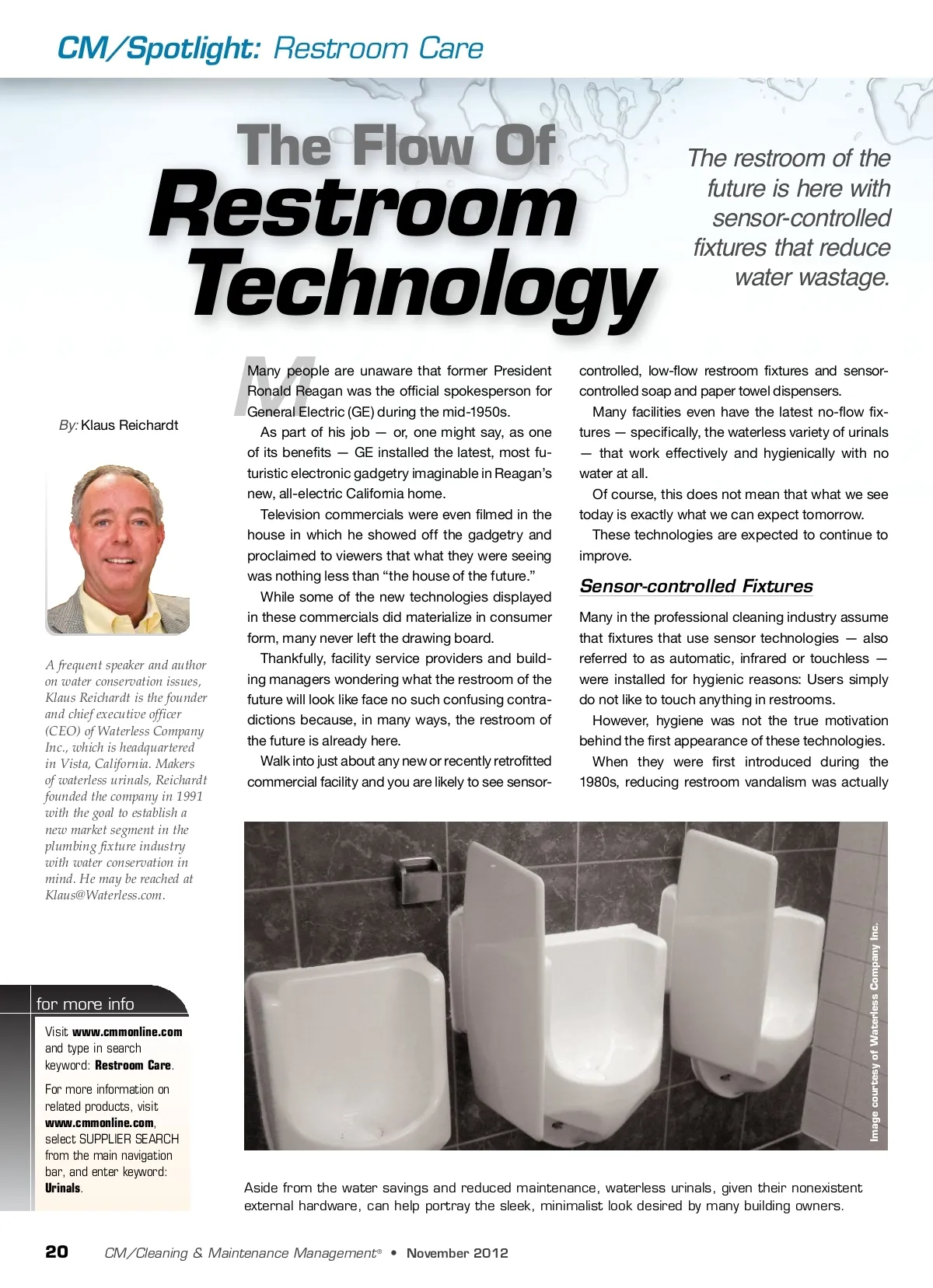
one of the key reasons for the installation of these systems. Over time, however, hygiene evolved to become the key reason for installing these fixtures. In larger facilities, for example, restrooms are now typically designed so that users touch as few surfaces as possible. Today, of course, green and environmen-tal issues are becoming another key reason for installing sensor technologies and low-flow restroom fixtures. Water conservation is becoming a priority in North America and, indeed, throughout most of the world. Studies indicate that sensor-controlled fixtures can reduce water consumption by as much as 30 percent. This is because water is turned on by these fixtures only when needed and turns off when the user walks away. When you consider that the standard lavatory faucet is mandated to flow at 2.2 gallons per minute (GPM), it is easy to see that reducing water use at a faucet by even 30 percent can result in significant savings. Many sensor-controlled restroom faucets save water by operating on 10-second in-tervals: After 10 seconds, if no user is de-tected, the system turns the water off. And, installing aerators in commercial faucets can reduce the amount of water used even further, from 1.5 GPM to as little as .5 GPM. Powering The Future Of Restrooms Some early touchless systems were direct-ly wired to facility power sources. But, this meant that, if the power was turned off in the building, the sensor-oper-ated fixtures would not work. Because of this issue, most of today’s sensor-operated fixtures get their power from batteries. However, many sensor systems are expected to be solar powered in the near future. Touchless Toilets And Urinals Sensor-controlled toilets are not new; what is new and growing in popularity, however, are sensor-controlled dual-flush toilets. Dual-flush systems use approximately 1.6 gallons of water per flush to remove solid waste and about one gallon per flush to re-move liquid waste. This typically averages out to about 1.28 gallons per flush. When you consider that older toilets use as much as three gallons per flush, there is a huge potential for water savings. Many of these dual-flush systems proudly display two flush buttons, one indicating a full flush and the other specifying a smaller, less water-consuming flush. Many facilities prefer that their toilets have these buttons in order to showcase their green sensibilities to users. However, when these toilets are operated by a sensor, any decision making regarding the type of flush is eliminated. When the sensor detects that the fixture has been used for roughly 60 seconds, it uses the smaller flush; if it is used for lon-ger than 60 seconds, the full 1.6 gallons are dispensed. Some sensor-controlled urinal systems are also programmable and designed to flush intermittently rather than after each use — a further savings. Of course, no-water varieties, which require no flush controls or sensors, are the biggest water savers when it comes to urinals. In a typical facility, they can save as much as 40,000 gallons of water a year. Although some facility service provid-ers and building managers have concerns about the possibility that no-flow urinals may cause odor problems, this has proven not to be an issue as long as the fixtures are properly maintained. It can be as simple as adding the sealing liquid necessary with most systems. In fact, some studies indicate that tradi-tional urinals have more odor problems than no-water systems. This is because the water used in a flush uri-nal allows bacteria to grow — and it is growing bacteria that actually cause urinal odors. In some cases, it costs more for water utilities to gather, store, treat, deliver and re-move water from a facility than they charge their end customers. Facility service providers and building managers should expect this to change rap-idly in the near future. Water demand is growing, while water supplies from rain and runoff are dwindling. It’s basic economics: As demand grows on an increasingly finite resource, the costs will escalate. Added to this is the fact that many utility companies have put off improving their wa-ter infrastructure for as long as possible. Between now and 2035, the American Water Works Association (AWWA) believes it will cost at least $1 trillion to overhaul the aging water systems in the U.S. — and, the bulk of that amount will have to be paid by consumers. Unlike Ronald Reagan’s “house of the fu-ture,” when it comes to water usage in com-mercial restrooms, the future is here today. Modern technologies such as sensor-controlled sinks and toilets, dual-flush toi-lets and waterless urinals are already sig-nificantly reducing water consumption and related costs. These technologies will be further refined in years to come, allowing facility service providers and building managers to use wa-ter even more efficiently — and save money in the process. CM What Do You Know About Low-flow? Test your knowledge and complete a quick, eight-question quiz developed by Klaus Reichardt to ensure retention of the main points from this article. Take the quiz regarding the content you have just read at www.CMMOnline. com/articles/229589-what-do-you-know-about-low-flow. The Cost Factor No discussion of water-conserving rest-room fixtures is complete without exploring the costs related to water. In many parts of the U.S. and Canada, water is the last true bargain. www.cmmonline.com 21
CMM – Archives Nov 2012: 21