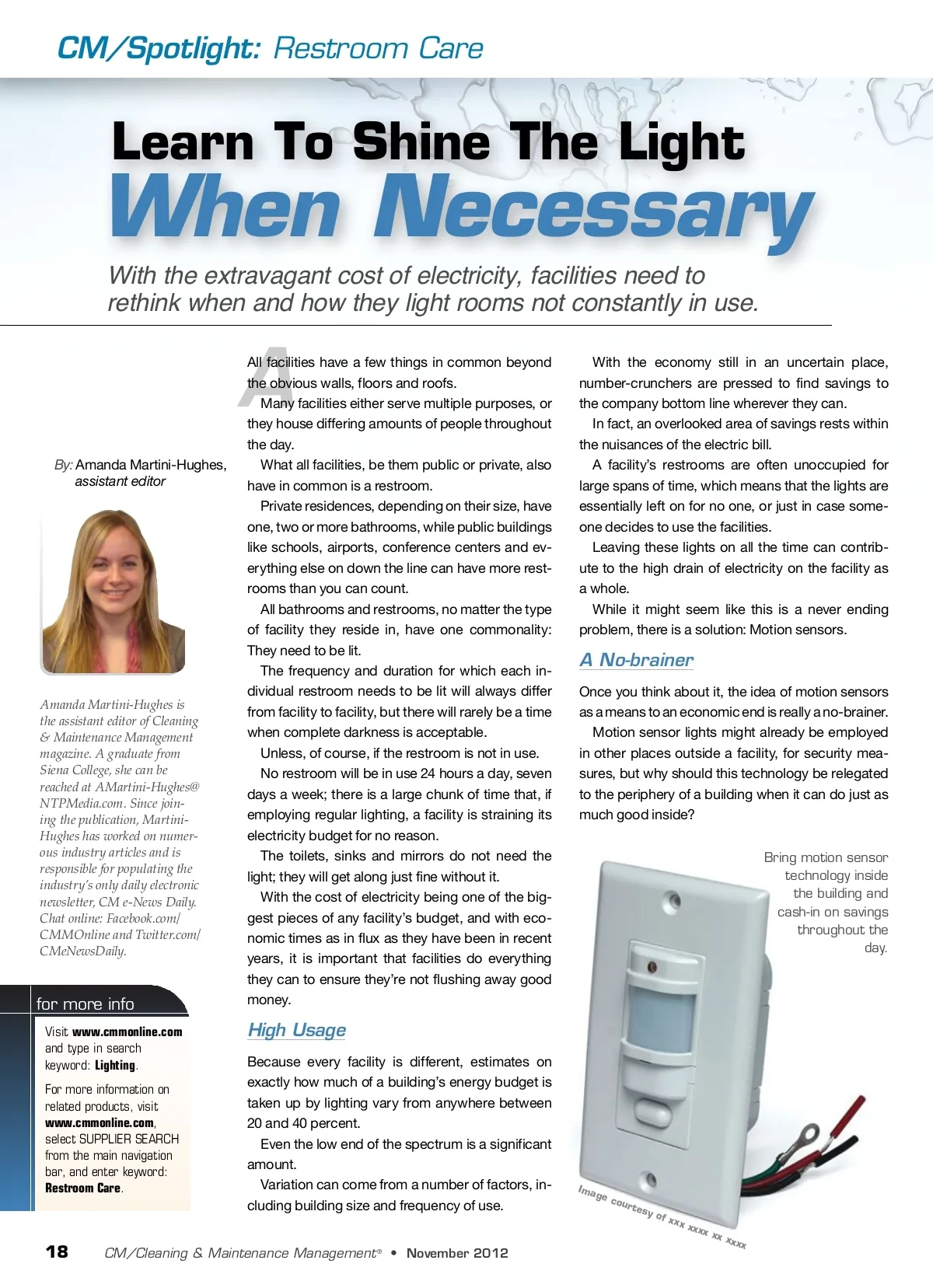
Where motion sensors in security lighting are intended to turn on in order to scare off any would-be intruders and alert those in charge or on guard of their presence, light-ing with motion sensors in rooms that aren’t used at a constant rate are intended to go off. When the restroom is not occupied for a certain amount of time, which can be set to a specific period, the lights in the restroom will turn off. The next time the sensor detects any sort of movement, the lights will turn back on. How It Works In technical terms, the “motion sensing” fea-ture on most lights is typically a passive sys-tem that is used to detect infrared energy. Therefore, the sensors in a motion sens-ing lighting unit are known as passive infra-red (PIR) detectors or “pyroelectric sensors.” In order to make a sensor that can detect the motion of a human, the sensor must be sensitive to the temperature of a human body. Humans, having a dermal temperature of about 93 degrees Fahrenheit, radiate infra-red energy with a wavelength between nine and 10 micrometers. Therefore, the sensors are typically sensi-tive in the range of 8 to 12 micrometers. It doesn’t take a lot of movement for the sensors to detect that someone has entered and is moving about the room; however, if the interval after which the lights are set to turn off is too short, patrons who need a little extra time might suddenly find themselves in the dark. The sensor is sensitive to motion, but not to a person who is sitting or standing still because the electronic component of the sensor is searching for a rapid change in the amount of infrared energy it is detecting. A person walking into the room gives the sensor what it is looking for to switch the lights back on; a stationary individual does not. In offices that have motion sensors em-ployed, this doesn’t often pose too much of a problem, as the occupant is generally close enough to the sensor to trip it again. Restroom occupants who are busy or oth-erwise indisposed might not have such luxu-ries, making it of great importance to ensure that there are sensors placed in areas that occupants can trigger with the simple wave of a hand, or set the “lights-out” timer to a decent interval. Significant Savings Wasting energy makes as much sense as wasting money. With the state of the economy and the ever present worry that the Earth’s natural resources, which we depend on to pow-er almost everything, may not always be something we can count on, we all need to do our part. The simple solution of installing a motion sensor that can, without anyone else need-ing to think about it, regulate the usage of electricity in restrooms makes good finan-cial sense. And, it will help your facility operate in a manner that is more green and sustainable, two things that need to be on everyone’s mind in order to lessen the impact we have on the Earth. CM Product Information no. 210 on page 24 www.cmmonline.com 19
CMM – Archives Nov 2012: 19