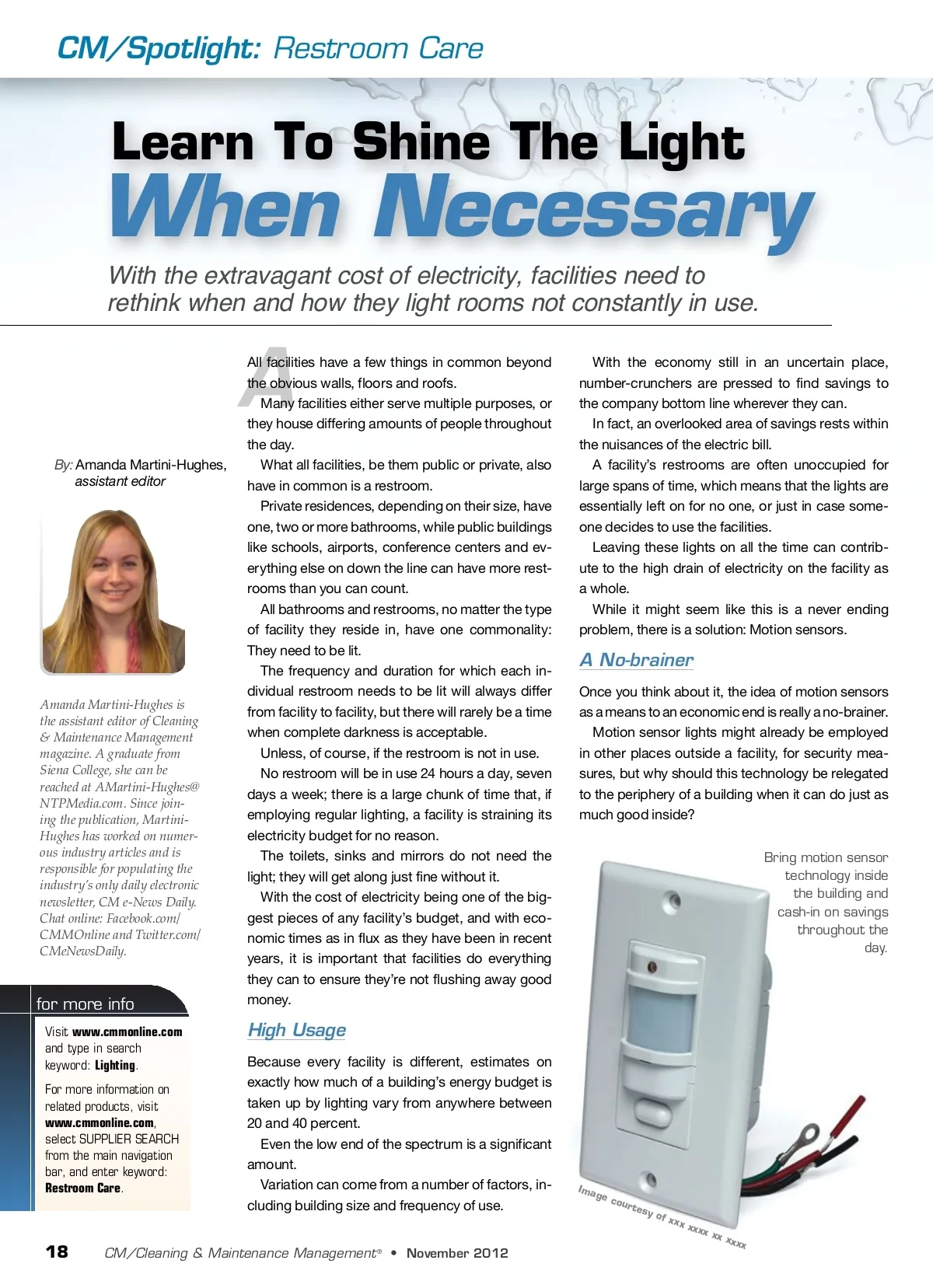
CM/Spotlight: Restroom Care Learn To Shine The Light When Necessary With the extravagant cost of electricity, facilities need to rethink when and how they light rooms not constantly in use. A By: Amanda Martini-Hughes, assistant editor Amanda Martini-Hughes is the assistant editor of Cleaning & Maintenance Management magazine. A graduate from Siena College, she can be reached at AMartini-Hughes@ NTPMedia.com. Since join-ing the publication, Martini-Hughes has worked on numer-ous industry articles and is responsible for populating the industry’s only daily electronic newsletter, CM e-News Daily. Chat online: Facebook.com/ CMMOnline and Twitter.com/ CMeNewsDaily. for more info Visit www.cmmonline.com and type in search keyword: Lighting . For more information on related products, visit www.cmmonline.com , select SUPPLIER SEARCH from the main navigation bar, and enter keyword: Restroom Care . All facilities have a few things in common beyond the obvious walls, floors and roofs. Many facilities either serve multiple purposes, or they house differing amounts of people throughout the day. What all facilities, be them public or private, also have in common is a restroom. Private residences, depending on their size, have one, two or more bathrooms, while public buildings like schools, airports, conference centers and ev-erything else on down the line can have more rest-rooms than you can count. All bathrooms and restrooms, no matter the type of facility they reside in, have one commonality: They need to be lit. The frequency and duration for which each in-dividual restroom needs to be lit will always differ from facility to facility, but there will rarely be a time when complete darkness is acceptable. Unless, of course, if the restroom is not in use. No restroom will be in use 24 hours a day, seven days a week; there is a large chunk of time that, if employing regular lighting, a facility is straining its electricity budget for no reason. The toilets, sinks and mirrors do not need the light; they will get along just fine without it. With the cost of electricity being one of the big-gest pieces of any facility’s budget, and with eco-nomic times as in flux as they have been in recent years, it is important that facilities do everything they can to ensure they’re not flushing away good money. With the economy still in an uncertain place, number-crunchers are pressed to find savings to the company bottom line wherever they can. In fact, an overlooked area of savings rests within the nuisances of the electric bill. A facility’s restrooms are often unoccupied for large spans of time, which means that the lights are essentially left on for no one, or just in case some-one decides to use the facilities. Leaving these lights on all the time can contrib-ute to the high drain of electricity on the facility as a whole. While it might seem like this is a never ending problem, there is a solution: Motion sensors. A No-brainer Once you think about it, the idea of motion sensors as a means to an economic end is really a no-brainer. Motion sensor lights might already be employed in other places outside a facility, for security mea-sures, but why should this technology be relegated to the periphery of a building when it can do just as much good inside? Bring motion sensor technology inside the building and cash-in on savings throughout the day. High Usage Because every facility is different, estimates on exactly how much of a building’s energy budget is taken up by lighting vary from anywhere between 20 and 40 percent. Even the low end of the spectrum is a significant amount. Variation can come from a number of factors, in-cluding building size and frequency of use. Image courtesy of xxx xxxx xx xxxx 18 CM/Cleaning & Maintenance Management ® • November 2012
CMM – Archives Nov 2012: 18