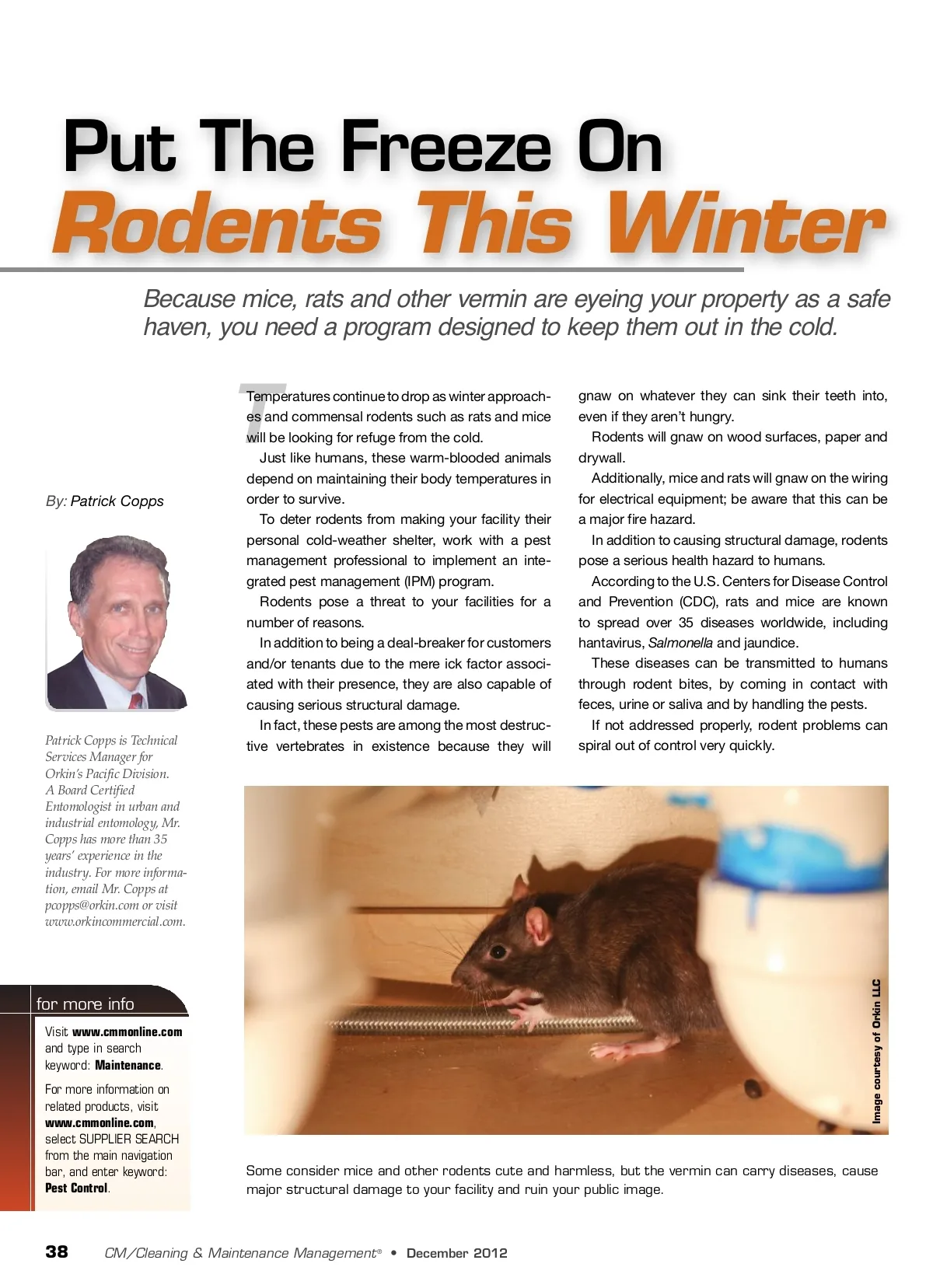
These animals are prolific breeders, espe-cially mice. In just one year, a female mouse can pro-duce up to 10 litters, birthing approximately six or more mice in each litter. The pups in those litters only need 35 days to reach sexual maturity and will repeat the entire process all over again. A Plan For Pests To keep rodents away from your building and, most importantly, to protect your bot-tom line and reputation, work with a pest management professional to implement or reassess your IPM program. IPM uses a combination of proactive man-agement methods such as stringent sanita-tion and facility maintenance to help prevent problems before they occur. Work with your pest management profes-sional to incorporate the following rodent management tactics into your IPM program: ■ Properly prune Trim back any vegetation from the building that can serve as a hiding spot for rodents. Also, consider installing a 30-inch-wide gravel strip around the entire exterior of the building. Since rodents feel vulnerable out in the open, this buffer can help discourage them from approaching your facility. ■ Dehumidify Eliminate moisture and water sources in and around the facility. Leaky heating, ventilation and air condi-tioning (HVAC) units, standing water and even overflowing ice machines in the break room serve as excellent water sources for rodents. ■ Weatherproof Seal all unnecessary holes and cracks in your building’s exterior with a weather-resistant sealant. Concentrate on potential points of entry for rodents, such as the areas around utility penetrations. For extra protection, add copper or steel mesh to the mixture to prevent rodents from gnawing through the sealant. Remember, mice can enter your building through a hole no bigger than a dime, and rats only need a hole the size of a quarter to enter. ■ Bait and wait Consider placing tamper-resistant bait stations around the exterior of your building. These stations can be used as trap sta-tions or for rodent baits where necessary. Baits need to be enclosed in weatherproof stations that are kept away from public areas. ■ Stand guard Keep doors closed whenever possible. In addition to sneaking into your facility through holes, rodents also can enter via received goods. If necessary, install plastic strip curtains, auto-closers or double doors for frequently used entrances. ■ Clean and sanitize Focus on hygiene-related cleaning tasks. Cleanup spills immediately and ensure employee break rooms are clear of any food remnants. Cover garbage cans tightly and clean waste disposal areas frequently. And, finally, keep dumpsters as far away from the building as possible. ■ Chewed bait If you already monitor for rodents using a bait station, chewed bait is another indicator of rodent activity. Be On The Lookout Other pests you may spot in your build-ing this winter include cockroaches, small flies and stink bugs. Be on the lookout for signs that indi-cate you may have an infestation and work with your pest management pro-fessional to correct the issue. ■ Cockroaches Cockroaches carry an average of 25 different bacteria, and dusts created by cockroach feces and cast skins can trigger allergic reactions and asthma in many people. Look for cast skins and live or dead cockroaches. How to address: 1. Install glue boards to help monitor cockroach activity 2. Remove trash on a regular basis 3. Vacuum, sweep and mop public, multi-use areas daily. ■ Small flies Among the filthiest of all pests, small flies carry billions of germs, and a female can produce up to 1,000 eggs in seven to 10 days. Look for live or dead flies and fly larvae. How to address: 1. Install insect light traps to monitor fly activity 2. Regularly inspect potential breeding sites like garbage collection areas or floor drains 3. Install air curtains at entrances and exits. ■ Stink bugs Stink bugs are largely harmless, but they produce an obnoxious odor when they sense danger or are crushed. Look for live or dead stink bugs. How to address: 1. Caulk cracks and crevices 2. Repair torn window and vent screens 3. Apply weather stripping to help seal gaps under exterior doors. CM Telltale Signs In addition to implementing these preven-tative tactics, it’s important to monitor for signs of an existing rodent infestation. Remember, a rodent infestation can spiral out of control very quickly. Heat up your pest management program this winter by working with a pest manage-ment professional to implement the proper preventive and monitoring tactics at your facility. If you spot any of the following, contact your pest management professional imme-diately: ■ Droppings A strong indicator of an infestation is vis-ible rodent droppings. Mouse droppings are about the size of a grain of rice, and rat droppings are the size of a raisin. ■ Gnaw marks Since rodents can chew through small openings, inspect any openings in the build-ing that appear to be chewed or gnawed at the edges. ■ Rub markings Look for greasy markings along walls or near pipe and cable runs inside your facility. Rodents feel protected when they can crawl along a wall, so rub markings often indicate that a rodent is regularly traveling along the same path. www.cmmonline.com 39
CMM – Archives Dec 2012: 39