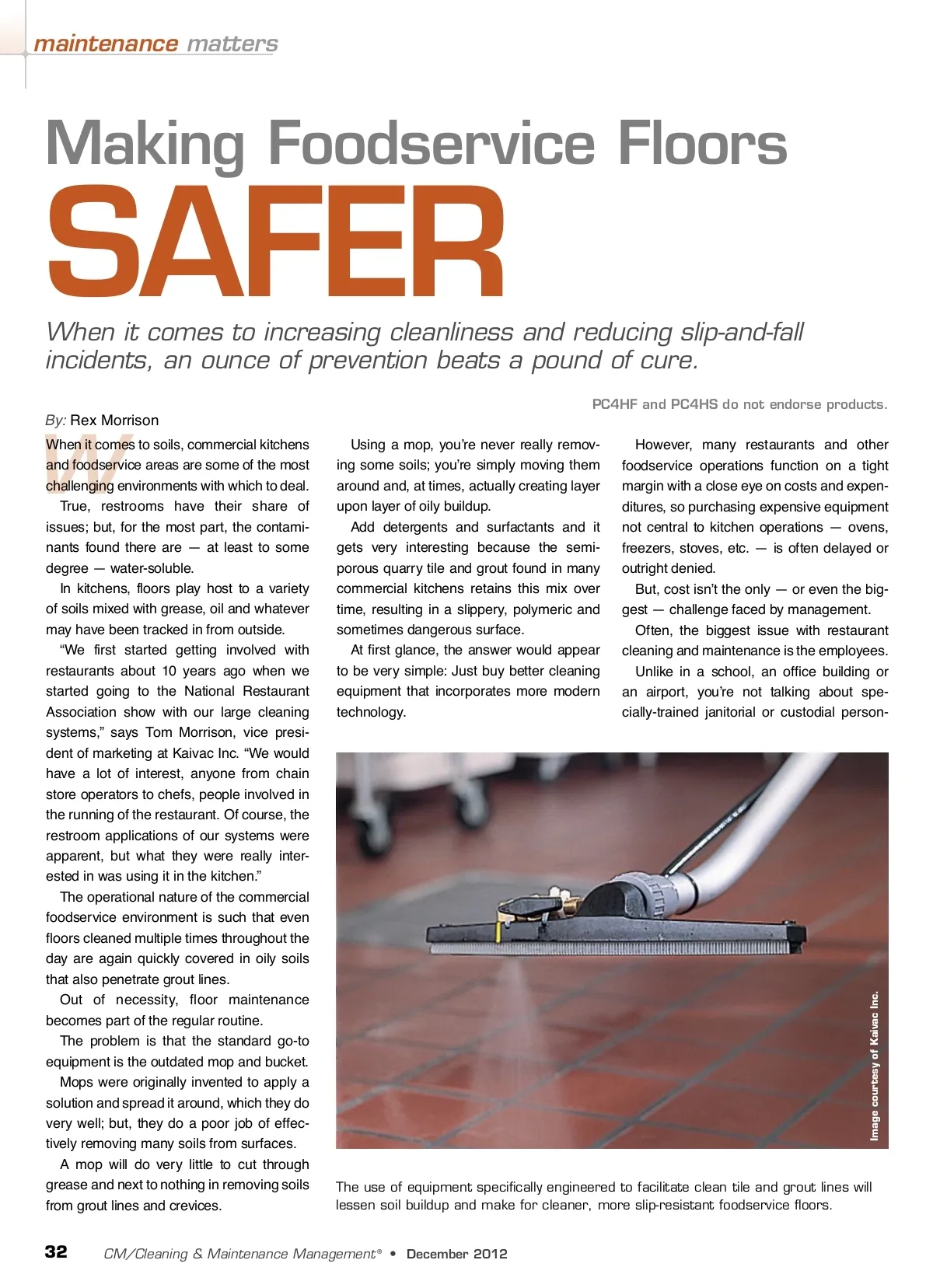
nel; you’re talking about people who, just moments before cleaning floors, were mak-ing French fries, for example, and are now suddenly responsible for cleaning a highly-soiled kitchen. Generally speaking, you have lower clean-ing skill levels, little to no budget and time for training and high turnover, so deploying complex cleaning equipment effectively by such employees can be a challenge. Enter dispense-and-vacuum, a crossover cleaning system concept employing the technology and efficacy of larger cleaning systems with the simplicity and ease of use necessary in a competitive, fast-paced and high-turnover foodservice environment. With the addition of a modular wet/dry vacuum, a touchless cleaning system trans-forms into a high-performance dispense-and-vacuum system. The operator opens the spigot to apply fresh cleaning solution to the floor, spreads and lightly brushes it into grout lines with the two-in-one squeegee head brush and then vacuum the soils and liquid away. The result: Floors emerge clean and dry. But, that’s just half the battle. Show And Tell Beyond becoming familiar with the products and equipment, employees must learn how critical they are to kitchen floor maintenance. Recognizing and rewarding — or, at the very least, acknowledging — employees for efforts that go above and beyond the minimum required leads to increased morale and greater job satisfaction for all parties. To reinforce the importance of remov-ing soils quickly, efficiently and completely, management also needs to compile a com-prehensive, written cleaning and mainte-nance procedures guide that lists in detail the required steps for cleaning proficiency. Such documents lead to improved safety and health for both employees and custom-ers alike. The restaurant or other foodservice oper-ation itself will see an improvement in health as well: Financial health. “Perpetually wet floors are unnecessary, and they’re also dangerous; they’re one of the biggest liabilities you can have. They’re like an open invitation to a lawsuit,” states Morrison. “If you’re using a cotton mop, you’re look-ing at a dry time of four, maybe five minutes or more. And, if you’re in a busy area, you don’t have time for that,” continues Morrison. “Even if no one slips and falls, you still have people walking over it and leaving on it whatever they’ve got on their shoes, largely negating cleaning.” The rapid drying offered by a dispense-and-vacuum system, combined with extremely clean surfaces, means almost immediate availability and reduced slip-and-fall accidents. In fact, some systems have been certified by the National Floor Safety Institute (NFSI) as providing high traction when evaluated for wet slip resistance. The benefit of independent, third-party certification is that tools, systems and chem-icals have been tested using scientific prin-ciples and equipment. “In environments with typical soils, and especially in commercial kitchens, products with NFSI certification make floors safer,” asserts Morrison. Data often relied upon by the NFSI includes coefficient of friction (COF) traction measurements using a state-of-the-art bina-ry output tribometer (BOT), which indicates much better cleaning and slip-resistance results using crossover dispense-and-vac-uum units versus mop-and-bucket systems. “Many liability issues can be prevented with wise expenditures on crossover tech-nology,” adds Morrison. “Typically, when someone falls, there may be a quick set-tlement of perhaps $10,000 to $20,000, which would be unnecessary with the proper cleaning tools and preventative processes in place. Cleaning for health doesn’t need to just be for infectious disease; preventing slips and falls should be an integral part of it.” The working commercial kitchen will always be a dangerous environment: The combination of tight spaces, fast-moving personnel, red-hot broilers, ovens and stove tops, the ubiquitous grill, razor-sharp knives, hot oil and — in many cases — hectic and demanding “busy times” make the possibility of an incident more “when” than “if.” But, in areas that can be controlled, such as floor maintenance, employing proper preventive measures will go far in eliminating serious problems down the road. CM Rex Morrison is president of the nonprofit Process Cleaning for Healthy Facilities (PC4HF). Formerly the housekeeping training coordinator for the Washoe County School District, Morrison is an ISSA Certification Expert (ICE). Product Information no. 209 on page 24 www.cmmonline.com 33
CMM – Archives Dec 2012: 33