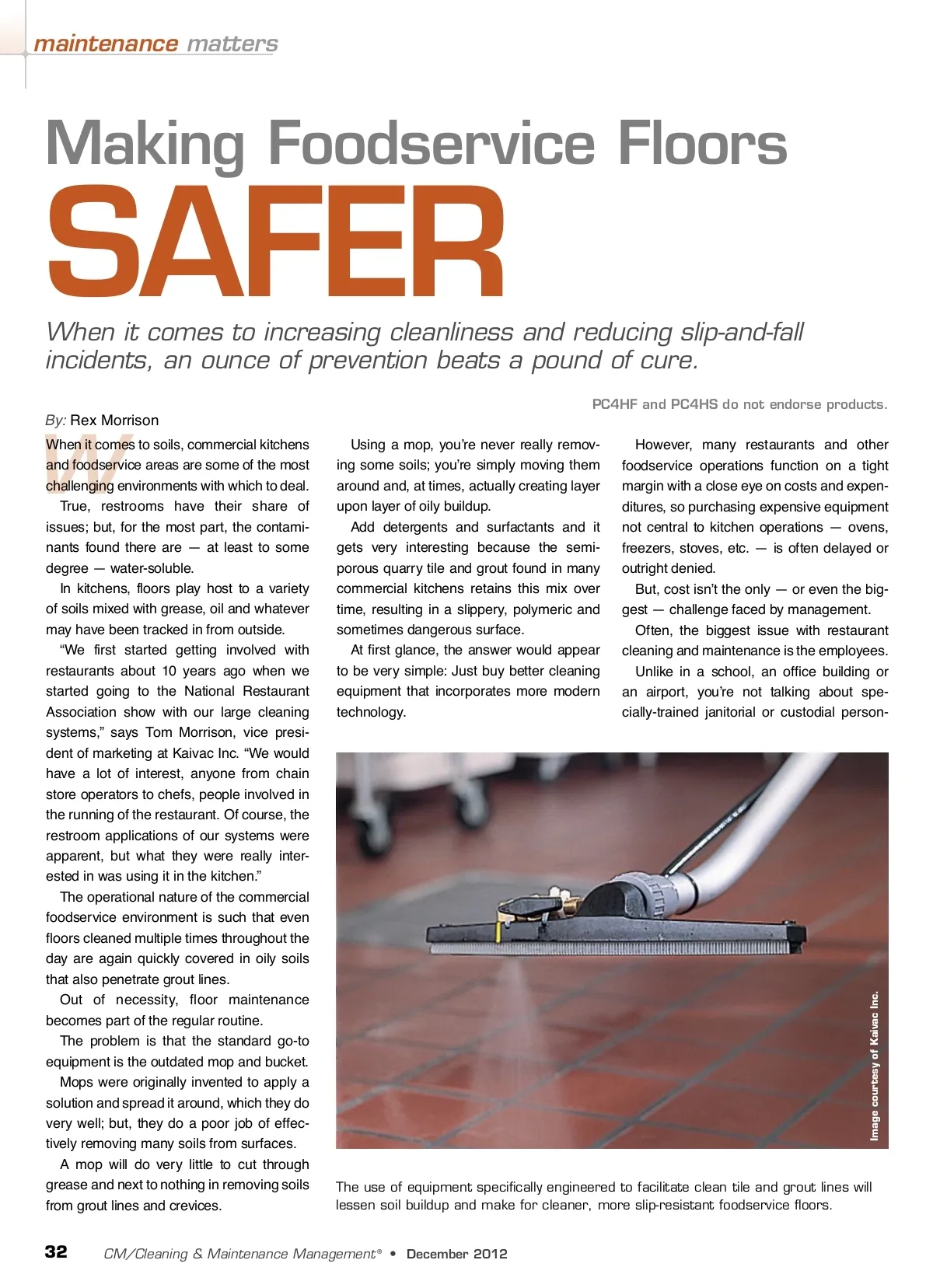
maintenance matters Making Foodservice Floors SAFER By: Rex Morrison When it comes to increasing cleanliness and reducing slip-and-fall incidents, an ounce of prevention beats a pound of cure. PC4HF and PC4HS do not endorse products. W When it comes to soils, commercial kitchens and foodservice areas are some of the most challenging environments with which to deal. True, restrooms have their share of issues; but, for the most part, the contami-nants found there are — at least to some degree — water-soluble. In kitchens, floors play host to a variety of soils mixed with grease, oil and whatever may have been tracked in from outside. “We first started getting involved with restaurants about 10 years ago when we started going to the National Restaurant Association show with our large cleaning systems,” says Tom Morrison, vice presi-dent of marketing at Kaivac Inc. “We would have a lot of interest, anyone from chain store operators to chefs, people involved in the running of the restaurant. Of course, the restroom applications of our systems were apparent, but what they were really inter-ested in was using it in the kitchen.” The operational nature of the commercial foodservice environment is such that even floors cleaned multiple times throughout the day are again quickly covered in oily soils that also penetrate grout lines. Out of necessity, floor maintenance becomes part of the regular routine. The problem is that the standard go-to equipment is the outdated mop and bucket. Mops were originally invented to apply a solution and spread it around, which they do very well; but, they do a poor job of effec-tively removing many soils from surfaces. A mop will do very little to cut through grease and next to nothing in removing soils from grout lines and crevices. Using a mop, you’re never really remov-ing some soils; you’re simply moving them around and, at times, actually creating layer upon layer of oily buildup. Add detergents and surfactants and it gets very interesting because the semi-porous quarry tile and grout found in many commercial kitchens retains this mix over time, resulting in a slippery, polymeric and sometimes dangerous surface. At first glance, the answer would appear to be very simple: Just buy better cleaning equipment that incorporates more modern technology. However, many restaurants and other foodservice operations function on a tight margin with a close eye on costs and expen-ditures, so purchasing expensive equipment not central to kitchen operations — ovens, freezers, stoves, etc. — is often delayed or outright denied. But, cost isn’t the only — or even the big-gest — challenge faced by management. Often, the biggest issue with restaurant cleaning and maintenance is the employees. Unlike in a school, an office building or an airport, you’re not talking about spe-cially-trained janitorial or custodial person-The use of equipment specifically engineered to facilitate clean tile and grout lines will lessen soil buildup and make for cleaner, more slip-resistant foodservice floors. 32 CM/Cleaning & Maintenance Management ® • December 2012 Image courtesy of Kaivac Inc.
CMM – Archives Dec 2012: 32