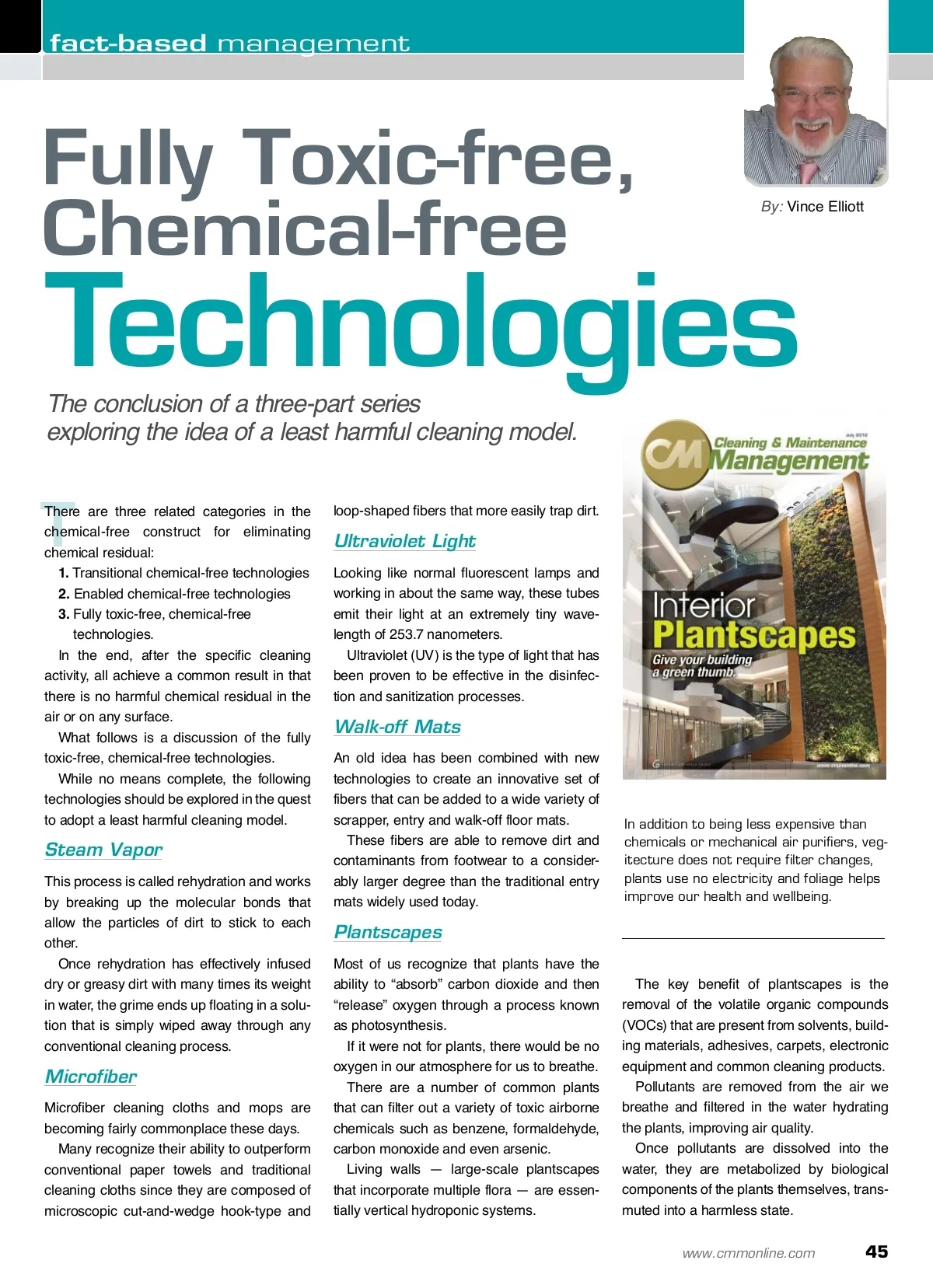
fact-based management Fully Toxic-free, Chemical-free The conclusion of a three-part series exploring the idea of a least harmful cleaning model. By: Vince Elliott Technologies loop-shaped fibers that more easily trap dirt. T There are three related categories in the chemical-free construct for eliminating chemical residual: 1. Transitional chemical-free technologies 2. Enabled chemical-free technologies 3. Fully toxic-free, chemical-free technologies. In the end, after the specific cleaning activity, all achieve a common result in that there is no harmful chemical residual in the air or on any surface. What follows is a discussion of the fully toxic-free, chemical-free technologies. While no means complete, the following technologies should be explored in the quest to adopt a least harmful cleaning model. Ultraviolet Light Looking like normal fluorescent lamps and working in about the same way, these tubes emit their light at an extremely tiny wave-length of 253.7 nanometers. Ultraviolet (UV) is the type of light that has been proven to be effective in the disinfec-tion and sanitization processes. Walk-off Mats An old idea has been combined with new technologies to create an innovative set of fibers that can be added to a wide variety of scrapper, entry and walk-off floor mats. These fibers are able to remove dirt and contaminants from footwear to a consider-ably larger degree than the traditional entry mats widely used today. Steam Vapor This process is called rehydration and works by breaking up the molecular bonds that allow the particles of dirt to stick to each other. Once rehydration has effectively infused dry or greasy dirt with many times its weight in water, the grime ends up floating in a solu-tion that is simply wiped away through any conventional cleaning process. In addition to being less expensive than chemicals or mechanical air purifiers, veg-itecture does not require filter changes, plants use no electricity and foliage helps improve our health and wellbeing. Plantscapes Most of us recognize that plants have the ability to “absorb” carbon dioxide and then “release” oxygen through a process known as photosynthesis. If it were not for plants, there would be no oxygen in our atmosphere for us to breathe. There are a number of common plants that can filter out a variety of toxic airborne chemicals such as benzene, formaldehyde, carbon monoxide and even arsenic. Living walls — large-scale plantscapes that incorporate multiple flora — are essen-tially vertical hydroponic systems. The key benefit of plantscapes is the removal of the volatile organic compounds (VOCs) that are present from solvents, build-ing materials, adhesives, carpets, electronic equipment and common cleaning products. Pollutants are removed from the air we breathe and filtered in the water hydrating the plants, improving air quality. Once pollutants are dissolved into the water, they are metabolized by biological components of the plants themselves, trans-muted into a harmless state. www.cmmonline.com Microfiber Microfiber cleaning cloths and mops are becoming fairly commonplace these days. Many recognize their ability to outperform conventional paper towels and traditional cleaning cloths since they are composed of microscopic cut-and-wedge hook-type and 45
CMM – Archives Jan 2013: 45