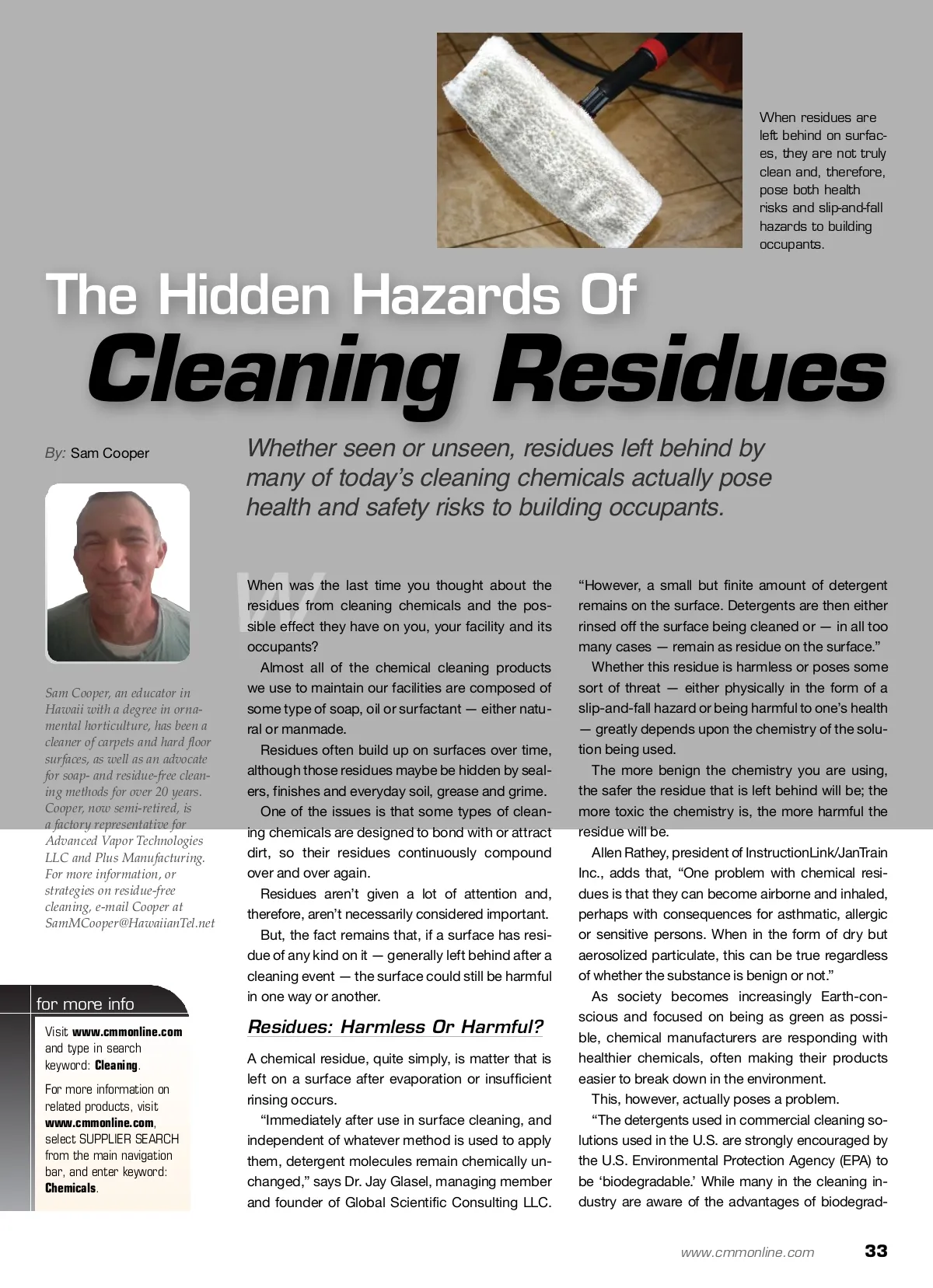
When residues are left behind on surfac-es, they are not truly clean and, therefore, pose both health risks and slip-and-fall hazards to building occupants. The Hidden Hazards Of Cleaning Residues By: Sam Cooper Whether seen or unseen, residues left behind by many of today’s cleaning chemicals actually pose health and safety risks to building occupants. W Sam Cooper, an educator in Hawaii with a degree in orna-mental horticulture, has been a cleaner of carpets and hard floor surfaces, as well as an advocate for soap-and residue-free clean-ing methods for over 20 years. Cooper, now semi-retired, is a factory representative for Advanced Vapor Technologies LLC and Plus Manufacturing. For more information, or strategies on residue-free cleaning, e-mail Cooper at [email protected] for more info Visit www.cmmonline.com and type in search keyword: Cleaning . For more information on related products, visit www.cmmonline.com , select SUPPLIER SEARCH from the main navigation bar, and enter keyword: Chemicals . When was the last time you thought about the residues from cleaning chemicals and the pos-sible effect they have on you, your facility and its occupants? Almost all of the chemical cleaning products we use to maintain our facilities are composed of some type of soap, oil or surfactant — either natu-ral or manmade. Residues often build up on surfaces over time, although those residues maybe be hidden by seal-ers, finishes and everyday soil, grease and grime. One of the issues is that some types of clean-ing chemicals are designed to bond with or attract dirt, so their residues continuously compound over and over again. Residues aren’t given a lot of attention and, therefore, aren’t necessarily considered important. But, the fact remains that, if a surface has resi-due of any kind on it — generally left behind after a cleaning event — the surface could still be harmful in one way or another. Residues: Harmless Or Harmful? A chemical residue, quite simply, is matter that is left on a surface after evaporation or insufficient rinsing occurs. “Immediately after use in surface cleaning, and independent of whatever method is used to apply them, detergent molecules remain chemically un-changed,” says Dr. Jay Glasel, managing member and founder of Global Scientific Consulting LLC. “However, a small but finite amount of detergent remains on the surface. Detergents are then either rinsed off the surface being cleaned or — in all too many cases — remain as residue on the surface.” Whether this residue is harmless or poses some sort of threat — either physically in the form of a slip-and-fall hazard or being harmful to one’s health — greatly depends upon the chemistry of the solu-tion being used. The more benign the chemistry you are using, the safer the residue that is left behind will be; the more toxic the chemistry is, the more harmful the residue will be. Allen Rathey, president of InstructionLink/JanTrain Inc., adds that, “One problem with chemical resi-dues is that they can become airborne and inhaled, perhaps with consequences for asthmatic, allergic or sensitive persons. When in the form of dry but aerosolized particulate, this can be true regardless of whether the substance is benign or not.” As society becomes increasingly Earth-con-scious and focused on being as green as possi-ble, chemical manufacturers are responding with healthier chemicals, often making their products easier to break down in the environment. This, however, actually poses a problem. “The detergents used in commercial cleaning so-lutions used in the U.S. are strongly encouraged by the U.S. Environmental Protection Agency (EPA) to be ‘biodegradable.’ While many in the cleaning in-dustry are aware of the advantages of biodegrad-www.cmmonline.com 33
CMM – Archives Jan 2013: 33