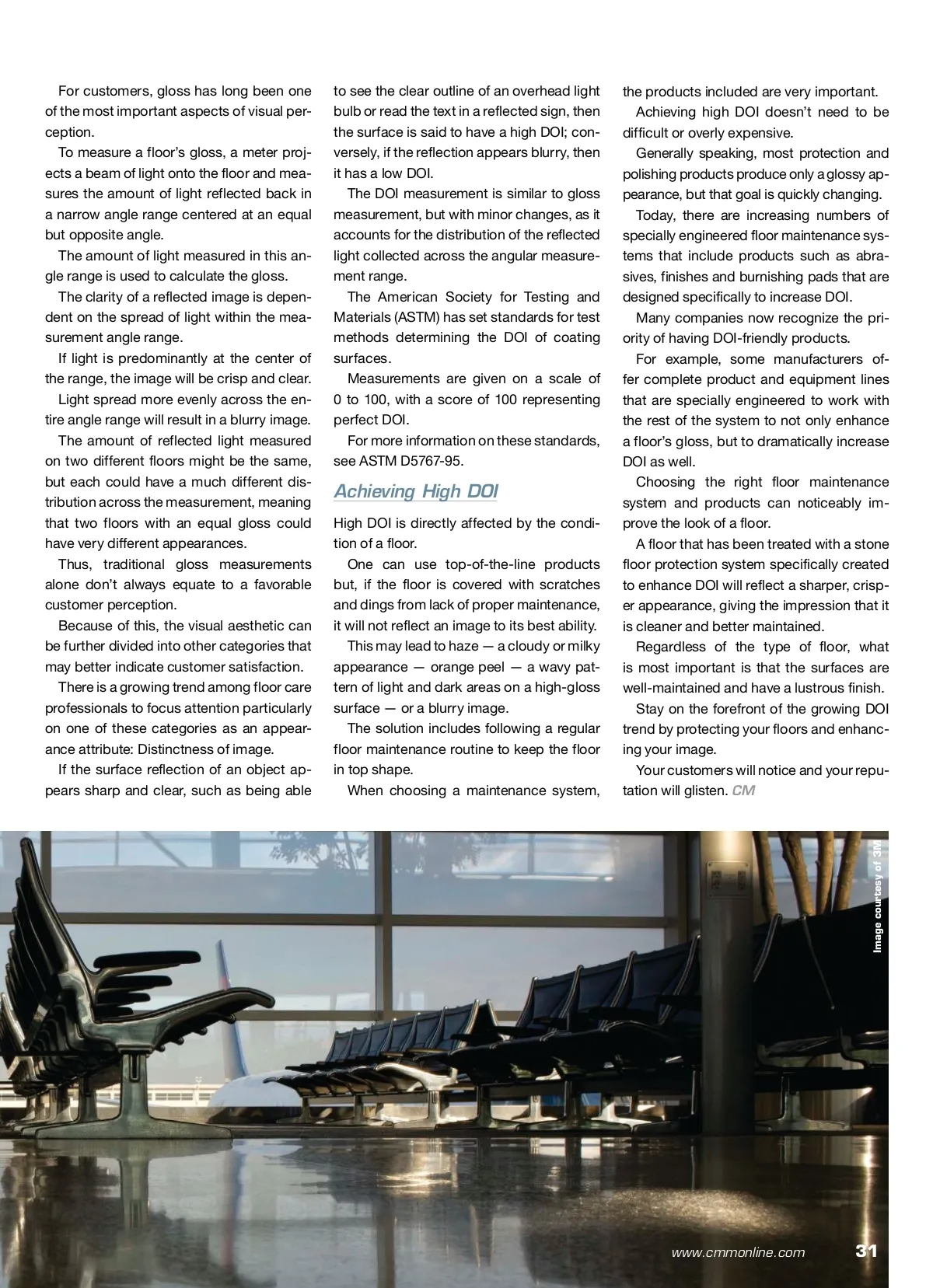
For customers, gloss has long been one of the most important aspects of visual per-ception. To measure a floor’s gloss, a meter proj-ects a beam of light onto the floor and mea-sures the amount of light reflected back in a narrow angle range centered at an equal but opposite angle. The amount of light measured in this an-gle range is used to calculate the gloss. The clarity of a reflected image is depen-dent on the spread of light within the mea-surement angle range. If light is predominantly at the center of the range, the image will be crisp and clear. Light spread more evenly across the en-tire angle range will result in a blurry image. The amount of reflected light measured on two different floors might be the same, but each could have a much different dis-tribution across the measurement, meaning that two floors with an equal gloss could have very different appearances. Thus, traditional gloss measurements alone don’t always equate to a favorable customer perception. Because of this, the visual aesthetic can be further divided into other categories that may better indicate customer satisfaction. There is a growing trend among floor care professionals to focus attention particularly on one of these categories as an appear-ance attribute: Distinctness of image. If the surface reflection of an object ap-pears sharp and clear, such as being able to see the clear outline of an overhead light bulb or read the text in a reflected sign, then the surface is said to have a high DOI; con-versely, if the reflection appears blurry, then it has a low DOI. The DOI measurement is similar to gloss measurement, but with minor changes, as it accounts for the distribution of the reflected light collected across the angular measure-ment range. The American Society for Testing and Materials (ASTM) has set standards for test methods determining the DOI of coating surfaces. Measurements are given on a scale of 0 to 100, with a score of 100 representing perfect DOI. For more information on these standards, see ASTM D5767-95. Achieving High DOI High DOI is directly affected by the condi-tion of a floor. One can use top-of-the-line products but, if the floor is covered with scratches and dings from lack of proper maintenance, it will not reflect an image to its best ability. This may lead to haze — a cloudy or milky appearance — orange peel — a wavy pat-tern of light and dark areas on a high-gloss surface — or a blurry image. The solution includes following a regular floor maintenance routine to keep the floor in top shape. When choosing a maintenance system, the products included are very important. Achieving high DOI doesn’t need to be difficult or overly expensive. Generally speaking, most protection and polishing products produce only a glossy ap-pearance, but that goal is quickly changing. Today, there are increasing numbers of specially engineered floor maintenance sys-tems that include products such as abra-sives, finishes and burnishing pads that are designed specifically to increase DOI. Many companies now recognize the pri-ority of having DOI-friendly products. For example, some manufacturers of-fer complete product and equipment lines that are specially engineered to work with the rest of the system to not only enhance a floor’s gloss, but to dramatically increase DOI as well. Choosing the right floor maintenance system and products can noticeably im-prove the look of a floor. A floor that has been treated with a stone floor protection system specifically created to enhance DOI will reflect a sharper, crisp-er appearance, giving the impression that it is cleaner and better maintained. Regardless of the type of floor, what is most important is that the surfaces are well-maintained and have a lustrous finish. Stay on the forefront of the growing DOI trend by protecting your floors and enhanc-ing your image. Your customers will notice and your repu-tation will glisten. CM www.cmmonline.com 31 Image courtesy of 3M
CMM – Archives Jan 2013: 31