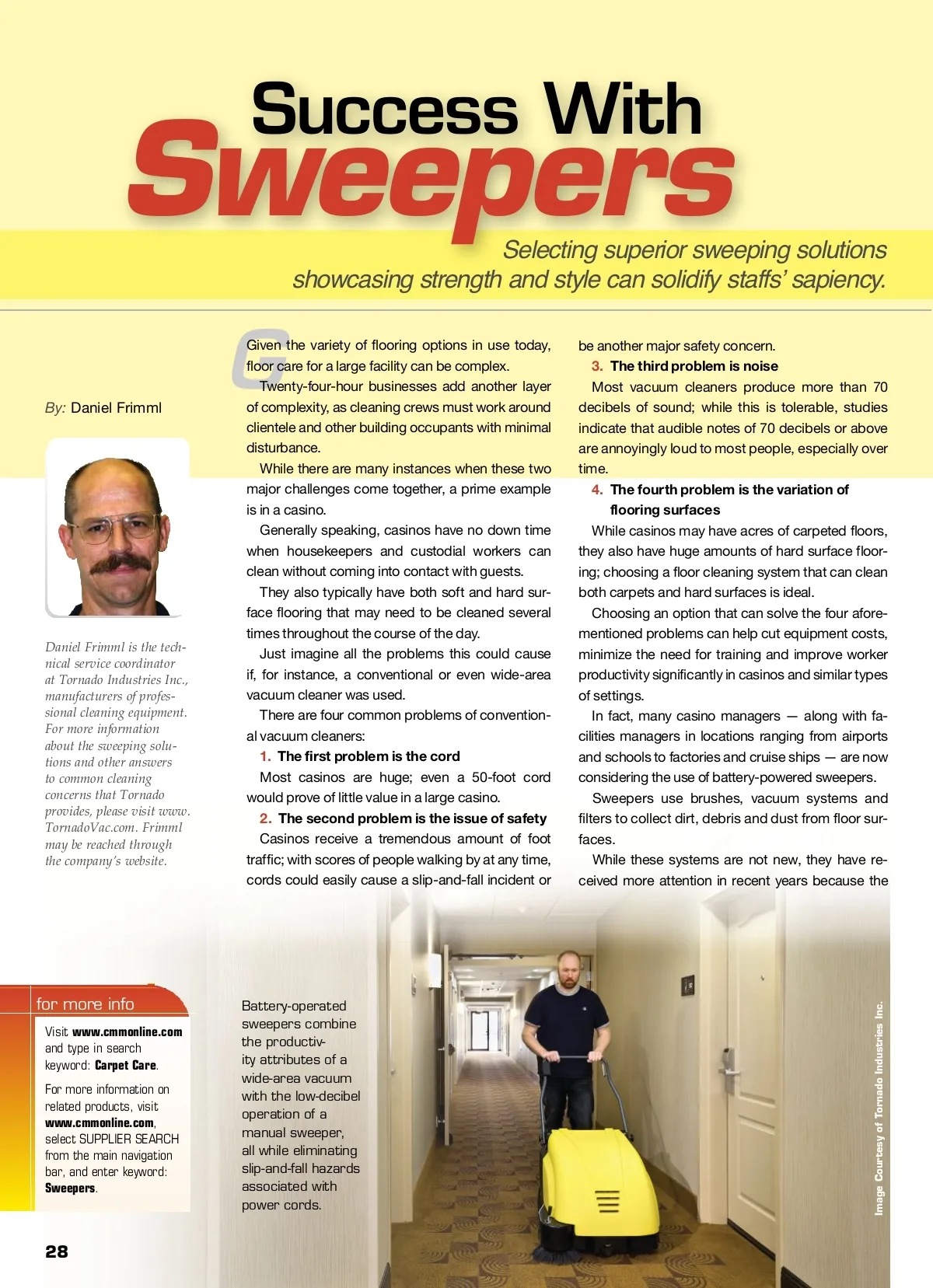
new generation of systems are getting qui-eter, more effective, more versatile, easier to use and are considered greener than sys-tems developed just a few years ago. Specifications For Selecting A Sweeper Sweepers are far less complicated machines than carpet extractors or autoscrubbers; but, this does not mean they are all alike. Some sweepers are ride-on systems, some have more features than others, some are easier to use than others, some are more versatile and some are better for use in cer-tain types of settings — an industrial location versus a retail store, for example. The first thing buyers need to ascertain when choosing a sweeper is where the ma-chine will be used, what types of surfaces it will need to clean and what types of soils will be encountered. Sweepers work well to remove items such as paper, dust, sand, popcorn, paper clips, food crumbs and so on from carpeting and hard surface floors. These versatile machines can often handle debris and objects that would be too large for a typical vacuum cleaner to safely and effec-tively remove. Purchasers should next consider whether they would be better served by a ride-on model or a walk-behind offering. While walk-behind sweepers typically serve most purposes, ride-on sweepers can improve worker productivity when used in appropriate settings. Cleaning experts often suggest using a ride-on sweeper if the area to be cleaned is larger than 50,000 square feet. However, there are other variables that must also be considered. In most cases, a walk-behind sweeper is more appropriate when cleaning aisles or walkways that are less than six feet wide. This is because ride-on systems may not be compact or nimble enough to maneuver through such areas, especially when furni-ture, fixtures or people are also present. Supplements For Structured Sweeping In addition to being less complicated than extractors or autoscrubbers, sweepers tend to have fewer components; but, making sure you have the right components can make a big difference in how versatile and effective the machine is. For instance, when selecting a walk-be-hind system, users should look for machines that offer: ■ A side brush that increases the clean-ing width of the machine and facilitates cleaning under furniture, allows for edge and corner cleaning and assists in pulling and collecting debris to be deposited into the collection bin ■ A cylindrical brush — what some call a main broom — to grab and pitch debris into the collection bin as the vacuum system draws in dust and finer particulates ■ Dust control filters to protect indoor air quality (IAQ) and promote an overall healthier indoor environment ■ A top-loading debris collector — as opposed to a front-loading debris col-lector — that can minimize dumping frequencies and help improve worker productivity ■ An on-board battery charger to mini-mize down time and help increase productivity ■ Manual height adjustment, which allows the machine to tackle different flooring types and a variety of debris. ■ The correct cleaning width, as a machine that is too wide will be difficult to maneu-ver and one that is too small will require additional passes to clean the floor area, hampering worker productivity. Another consideration, regardless of whether you’re selecting a walk-behind sweeper or a ride-on system, is the ma-chine’s noise level. Over long periods of time, noise can be fatiguing and annoying, which can impact worker morale and output. Further, when used in a 24-hour facility or in day cleaning situations, quieter machines are always better. Some sweepers produce noise levels less than that of a typical conversation, making them relatively quiet and largely nondisrup-tive; these models should be considered first when noise issues are a concern. and care is generally minimal; but, this does not mean that they are maintenance-free. The waste container should be dumped after each use. If liquids or moist debris have been col-lected, the container should be wiped clean using an all-purpose cleaner and a microfiber cloth. The side brush and the main cylindrical brush should always be checked after each use to make sure no debris is hindering the movement of the brushes because work more effectively when clean. Some sweepers are designed with rela-tively easy access to their batteries and mo-tor, making it less difficult to service the sys-tem’s components and allowing for quicker and less costly repairs. As to a sweeper’s power source, some of these systems now use absorbed glass mat (AGM) batteries. AGM varieties require little or no mainte-nance and are considered safer and more environmentally responsible than conven-tional batteries. Is That A Sweeper, A Scrubber, A Buffer Or A Burnisher? Sweepers should not be confused with floor scrubbers, buffers, burnishers or autoscrubbers. A floor scrubber employs a pad or a brush and may include a liquid dispensing system to loosen and remove soils, grease and debris from hard surface floors. Autoscrubbers take this a step further by loosening and then removing soils and moisture from the floor in one pass via vacuum suction. Although autoscrubbers have a vacuum component, they are not used to vacuum carpeted floors. The width of sweeping, scrubbing, buff-ing and burnishing machines can have a direct impact on how many square feet of floor space they can clean per hour. In most cases, a machine with a 26-inch cleaning path can clean about 26,000 square feet per hour and is generally con-sidered the ideal size to marry efficiency and maneuverability. CM The Simplicity Of Servicing Sweepers Because walk-behind sweepers are not complicated machines, their maintenance www.cmmonline.com 29
CMM – Archives Jan 2013: 29