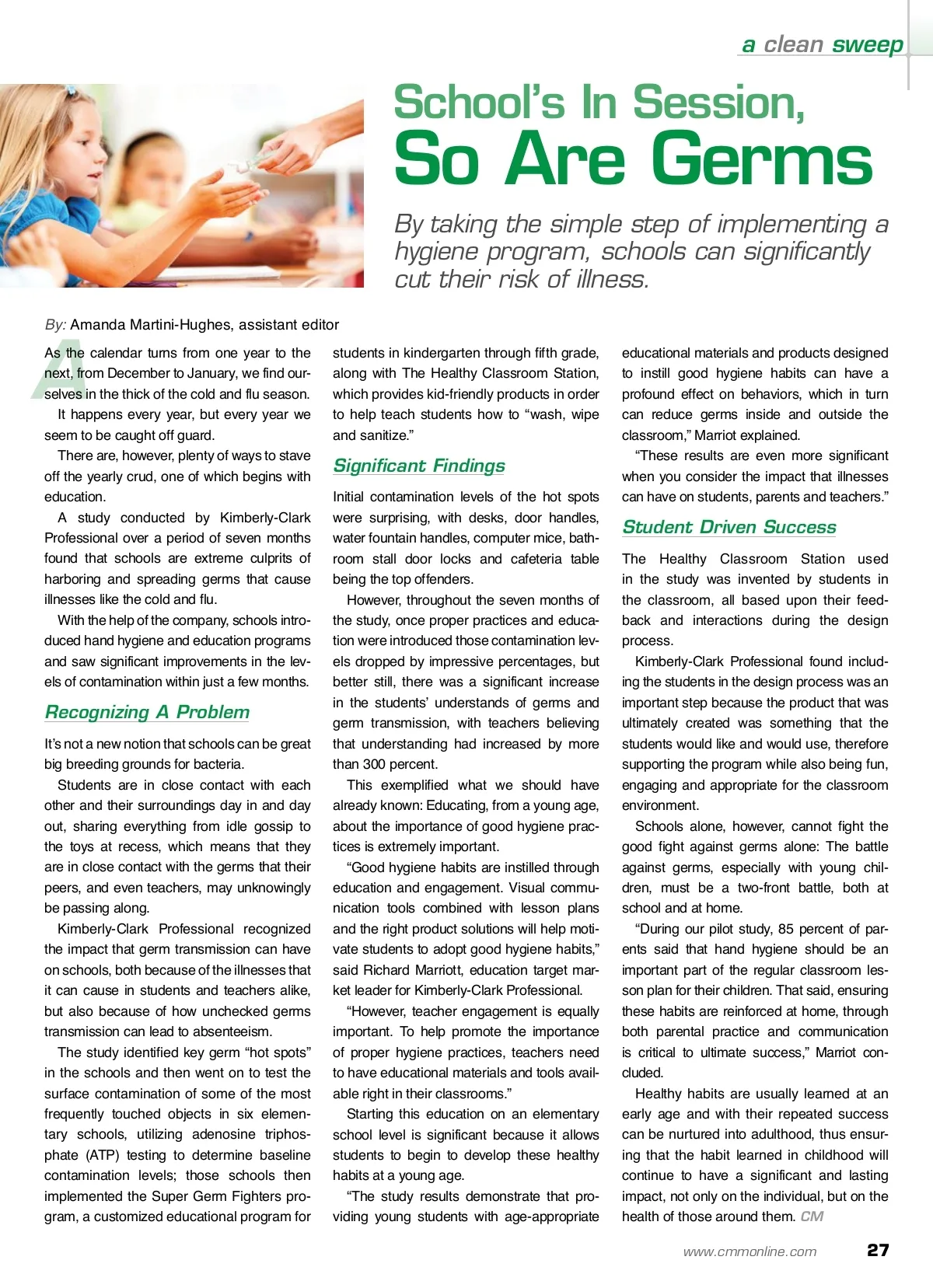
a clean sweep School’s In Session, So Are Germs By taking the simple step of implementing a hygiene program, schools can significantly cut their risk of illness. By: Amanda Martini-Hughes, assistant editor A As the calendar turns from one year to the next, from December to January, we find our-selves in the thick of the cold and flu season. It happens every year, but every year we seem to be caught off guard. There are, however, plenty of ways to stave off the yearly crud, one of which begins with education. A study conducted by Kimberly-Clark Professional over a period of seven months found that schools are extreme culprits of harboring and spreading germs that cause illnesses like the cold and flu. With the help of the company, schools intro-duced hand hygiene and education programs and saw significant improvements in the lev-els of contamination within just a few months. students in kindergarten through fifth grade, along with The Healthy Classroom Station, which provides kid-friendly products in order to help teach students how to “wash, wipe and sanitize.” Significant Findings Initial contamination levels of the hot spots were surprising, with desks, door handles, water fountain handles, computer mice, bath-room stall door locks and cafeteria table being the top offenders. However, throughout the seven months of the study, once proper practices and educa-tion were introduced those contamination lev-els dropped by impressive percentages, but better still, there was a significant increase in the students’ understands of germs and germ transmission, with teachers believing that understanding had increased by more than 300 percent. This exemplified what we should have already known: Educating, from a young age, about the importance of good hygiene prac-tices is extremely important. “Good hygiene habits are instilled through education and engagement. Visual commu-nication tools combined with lesson plans and the right product solutions will help moti-vate students to adopt good hygiene habits,” said Richard Marriott, education target mar-ket leader for Kimberly-Clark Professional. “However, teacher engagement is equally important. To help promote the importance of proper hygiene practices, teachers need to have educational materials and tools avail-able right in their classrooms.” Starting this education on an elementary school level is significant because it allows students to begin to develop these healthy habits at a young age. “The study results demonstrate that pro-viding young students with age-appropriate educational materials and products designed to instill good hygiene habits can have a profound effect on behaviors, which in turn can reduce germs inside and outside the classroom,” Marriot explained. “These results are even more significant when you consider the impact that illnesses can have on students, parents and teachers.” Student Driven Success The Healthy Classroom Station used in the study was invented by students in the classroom, all based upon their feed-back and interactions during the design process. Kimberly-Clark Professional found includ-ing the students in the design process was an important step because the product that was ultimately created was something that the students would like and would use, therefore supporting the program while also being fun, engaging and appropriate for the classroom environment. Schools alone, however, cannot fight the good fight against germs alone: The battle against germs, especially with young chil-dren, must be a two-front battle, both at school and at home. “During our pilot study, 85 percent of par-ents said that hand hygiene should be an important part of the regular classroom les-son plan for their children. That said, ensuring these habits are reinforced at home, through both parental practice and communication is critical to ultimate success,” Marriot con-cluded. Healthy habits are usually learned at an early age and with their repeated success can be nurtured into adulthood, thus ensur-ing that the habit learned in childhood will continue to have a significant and lasting impact, not only on the individual, but on the health of those around them. CM www.cmmonline.com Recognizing A Problem It’s not a new notion that schools can be great big breeding grounds for bacteria. Students are in close contact with each other and their surroundings day in and day out, sharing everything from idle gossip to the toys at recess, which means that they are in close contact with the germs that their peers, and even teachers, may unknowingly be passing along. Kimberly-Clark Professional recognized the impact that germ transmission can have on schools, both because of the illnesses that it can cause in students and teachers alike, but also because of how unchecked germs transmission can lead to absenteeism. The study identified key germ “hot spots” in the schools and then went on to test the surface contamination of some of the most frequently touched objects in six elemen-tary schools, utilizing adenosine triphos-phate (ATP) testing to determine baseline contamination levels; those schools then implemented the Super Germ Fighters pro-gram, a customized educational program for 27
CMM – Archives Jan 2013: 27