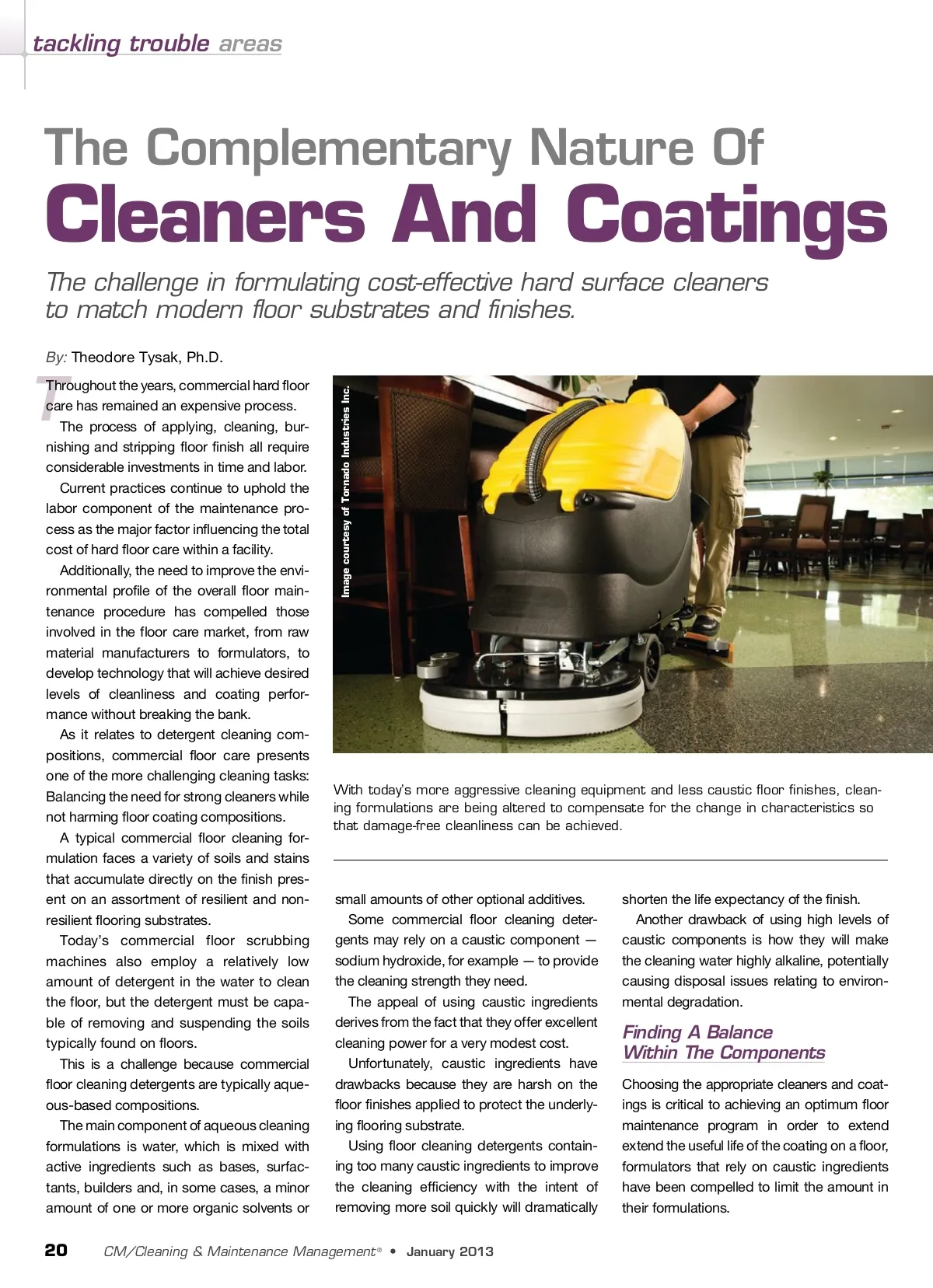
In the past, minimizing the use of caustic components posed no concerns because cleaning operations were performed at a reduced frequency and involved less aggres-sive techniques such mopping instead of cleaning with an autoscrubber. Now, the use of surfactants and, in some instances, solvents could be added to for-mulations to raise the level of cleaning per-formance. These surfactants and solvents offer an exceptional ability to aid in solubilizing soils and stains, while significantly enhanc-ing a caustic-based detergent’s capacity to remove soils and other foreign materials from the floor that had been deposited during exposure to pedestrian traffic. With the advent of commercial equip-ment like autoscrubbers and high-speed burnishers to maintain floors, cleaning and maintenance has become more aggressive and more frequent. Particular attention must be paid to formu-lating balanced cleaners that are effective at cleaning, mitigate damage to the finish and strive to be environmentally sound. Conventional detergents are typically for-mulated from a limited number of ingredients designed to function together and provide efficacy under a variety of water and use conditions. Builders may occasionally be incorporated into formulations to boost cleaning power in order to compensate for possible hard water. Other ingredients like phosphates — espe-cially the alkali pyrophosphates like tetra-sodium pyrophosphate and tetra-potassium pyrophosphate — had been used many years ago and performed well as detergent builders, but the use of phosphates today has been reduced or eliminated for environ-mental reasons. In some instances, chelants have been used as formulation additives to replace the sequestering power of phosphates and pro-vide effective benefits to cleaning capability. The process of designing a cleaner should occur in parallel to the design of the floor coating because each should synergistically work together. The detergent must be able to effectively clean the floor coating by removing soils and other foreign materials while minimizing damage. Today, formulators are also confronted by a general trend to use more environmentally friendly ingredients in detergents due to con-cerns of wastewater discharge into municipal sewers. As a result, formulators have been com-pelled to find other ways to obtain the perfor-mance required for cleaning and maintaining floors, but with more environmentally sound chemistries. With the demand for sustainable cleaning technologies on the rise, formulators now have more options to help them meet various regulatory standards. Surfactants and solvents are two key material classes formulators can incorporate to design cleaning compositions. ■ Surfactants Currently, there is a strong market prefer-ence for surfactants that are readily biode-gradable and environmentally acceptable. While alkylphenol ethoxylates (APEs) are widely recognized as outstanding surfac-tants in a broad variety of applications — including hard surface cleaning, paints and coatings and emulsification — they do suffer from a poor public perception of their envi-ronmental compatibility. APE-replacement surfactants generally have good performance profiles in select applications and need to be chosen carefully to meet desired cleaning properties. For example, some biodegradable linear primary alcohol ethoxylates work well in laun-dry, but may perform poorly in other applica-tions such as hard surface cleaning or freeze-thaw stabilization for paints and coatings. The newer generation of biodegradable surfactants based on ethylene oxide/pro-pylene oxide alcohol alkoxylates and bio-renewable surfactants based on alkyl poly-gucosides are designed for use in hard surface cleaning applications with exten-sions into all-purpose and bucket-dilutable cleaners. These surfactants have recently been accepted for inclusion in the CleanGredients Database, the U.S. Environmental Protection Agency’s (EPA) Design for the Environment (DfE) screening criteria developed in partner-ship with the GreenBlue Institute. Products approved by CleanGredients meet strict requirements for aquatic toxicity and biodegradation. ■ Solvents Key criteria for solvent selection should be the effective removal of soils that impact the appearance of floor finishes. The solvents should have a low vapor toxicity profile so that, when incorporated into cleaning formulations, they can be safely used in confined areas with normal ventila-tion. The solvents should also be nonflammable and, when incorporated, should not cause the product to become combustible. Additionally, solvent options should not soften or destroy the floor coating or sur-rounding surfaces such as shelving, furniture and advertisement stands. Solvents selected should have a “sol-vency” profile that permits easy cleaning of grease and dirt from floors, yet comply with volatile organic compound (VOC) emission regulations. More importantly, autoscrubbers should be able to readily remove the formulations containing these solvents through their vacu-um components or via manual squeegeeing. Recently, several solvents that are based on propylene glycol ethers have met the EPA’s DfE solvent screening criteria and will eventually be included in the CleanGredients Database. These solvents, along with the listed sur-factants, can serve as a powerful toolbox in assembling effective cleaners for hard floor cleaning and maintenance applications. Making The Right Choice Chemical formulators are becoming increas-ingly aware of the need to match floor clean-ers to floor finishes. A cleaner should not impact appearance properties such as gloss and clarity, while a coating should be resistant to damage from detergents. The availability of key formulating ingre-dients to manufacturers provides for the development of an effective system where the design of a cleaner and coating composi-tion can occur in a parallel fashion. Choosing the appropriate cleaning com-positions for the coatings present will ensure the best outcome for your floor maintenance process. CM Dr. Theodore Tysak is a technology manager for the floor and surface care business at The Dow Chemical Company. For more information concerning this article, Tysak may be reached at [email protected]. www.cmmonline.com 21
CMM – Archives Jan 2013: 21