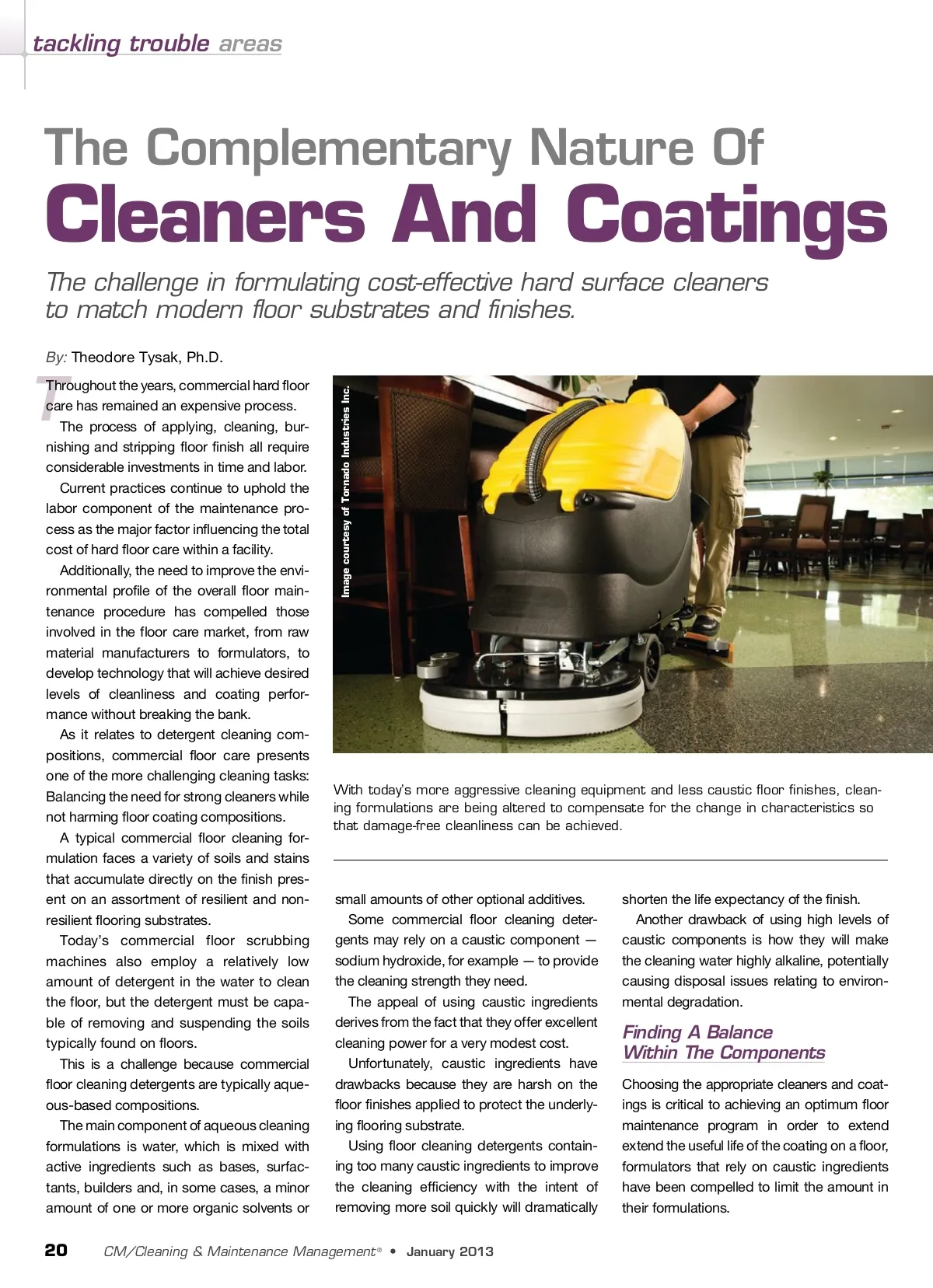
tackling trouble areas The Complementary Nature Of Cleaners And Coatings The challenge in formulating cost-effective hard surface cleaners to match modern floor substrates and finishes. By: Theodore Tysak, Ph.D. Image courtesy of Tornado Industries Inc. T Throughout the years, commercial hard floor care has remained an expensive process. The process of applying, cleaning, bur-nishing and stripping floor finish all require considerable investments in time and labor. Current practices continue to uphold the labor component of the maintenance pro-cess as the major factor influencing the total cost of hard floor care within a facility. Additionally, the need to improve the envi-ronmental profile of the overall floor main-tenance procedure has compelled those involved in the floor care market, from raw material manufacturers to formulators, to develop technology that will achieve desired levels of cleanliness and coating perfor-mance without breaking the bank. As it relates to detergent cleaning com-positions, commercial floor care presents one of the more challenging cleaning tasks: Balancing the need for strong cleaners while not harming floor coating compositions. A typical commercial floor cleaning for-mulation faces a variety of soils and stains that accumulate directly on the finish pres-ent on an assortment of resilient and non-resilient flooring substrates. Today’s commercial floor scrubbing machines also employ a relatively low amount of detergent in the water to clean the floor, but the detergent must be capa-ble of removing and suspending the soils typically found on floors. This is a challenge because commercial floor cleaning detergents are typically aque-ous-based compositions. The main component of aqueous cleaning formulations is water, which is mixed with active ingredients such as bases, surfac-tants, builders and, in some cases, a minor amount of one or more organic solvents or With today’s more aggressive cleaning equipment and less caustic floor finishes, clean-ing formulations are being altered to compensate for the change in characteristics so that damage-free cleanliness can be achieved. small amounts of other optional additives. Some commercial floor cleaning deter-gents may rely on a caustic component — sodium hydroxide, for example — to provide the cleaning strength they need. The appeal of using caustic ingredients derives from the fact that they offer excellent cleaning power for a very modest cost. Unfortunately, caustic ingredients have drawbacks because they are harsh on the floor finishes applied to protect the underly-ing flooring substrate. Using floor cleaning detergents contain-ing too many caustic ingredients to improve the cleaning efficiency with the intent of removing more soil quickly will dramatically shorten the life expectancy of the finish. Another drawback of using high levels of caustic components is how they will make the cleaning water highly alkaline, potentially causing disposal issues relating to environ-mental degradation. Finding A Balance Within The Components Choosing the appropriate cleaners and coat-ings is critical to achieving an optimum floor maintenance program in order to extend extend the useful life of the coating on a floor, formulators that rely on caustic ingredients have been compelled to limit the amount in their formulations. 20 CM/Cleaning & Maintenance Management ® • January 2013
CMM – Archives Jan 2013: 20