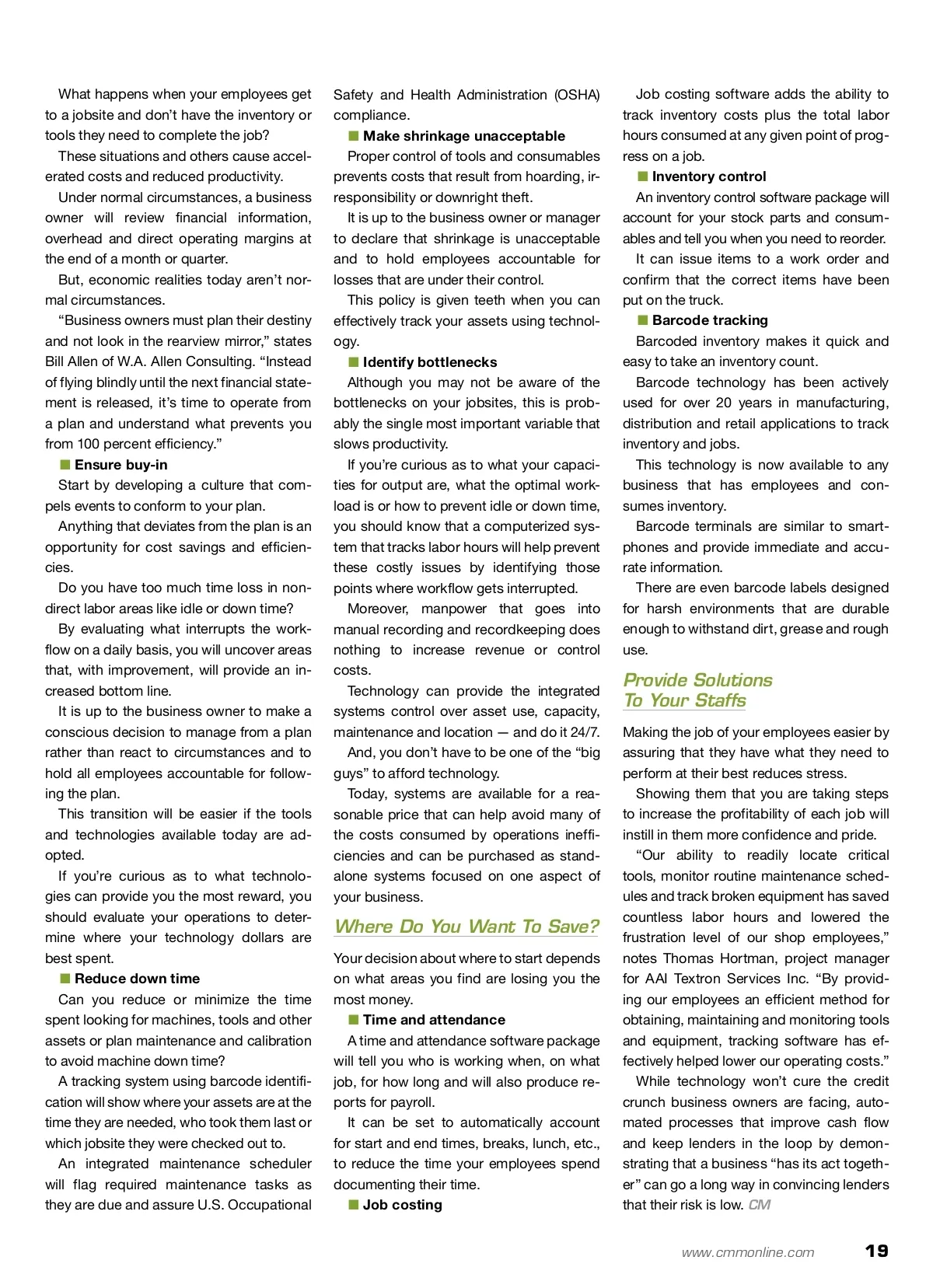
What happens when your employees get to a jobsite and don’t have the inventory or tools they need to complete the job? These situations and others cause accel-erated costs and reduced productivity. Under normal circumstances, a business owner will review financial information, overhead and direct operating margins at the end of a month or quarter. But, economic realities today aren’t nor-mal circumstances. “Business owners must plan their destiny and not look in the rearview mirror,” states Bill Allen of W.A. Allen Consulting. “Instead of flying blindly until the next financial state-ment is released, it’s time to operate from a plan and understand what prevents you from 100 percent efficiency.” ■ Ensure buy-in Start by developing a culture that com-pels events to conform to your plan. Anything that deviates from the plan is an opportunity for cost savings and efficien-cies. Do you have too much time loss in non-direct labor areas like idle or down time? By evaluating what interrupts the work-flow on a daily basis, you will uncover areas that, with improvement, will provide an in-creased bottom line. It is up to the business owner to make a conscious decision to manage from a plan rather than react to circumstances and to hold all employees accountable for follow-ing the plan. This transition will be easier if the tools and technologies available today are ad-opted. If you’re curious as to what technolo-gies can provide you the most reward, you should evaluate your operations to deter-mine where your technology dollars are best spent. ■ Reduce down time Can you reduce or minimize the time spent looking for machines, tools and other assets or plan maintenance and calibration to avoid machine down time? A tracking system using barcode identifi-cation will show where your assets are at the time they are needed, who took them last or which jobsite they were checked out to. An integrated maintenance scheduler will flag required maintenance tasks as they are due and assure U.S. Occupational Safety and Health Administration (OSHA) compliance. ■ Make shrinkage unacceptable Proper control of tools and consumables prevents costs that result from hoarding, ir-responsibility or downright theft. It is up to the business owner or manager to declare that shrinkage is unacceptable and to hold employees accountable for losses that are under their control. This policy is given teeth when you can effectively track your assets using technol-ogy. ■ Identify bottlenecks Although you may not be aware of the bottlenecks on your jobsites, this is prob-ably the single most important variable that slows productivity. If you’re curious as to what your capaci-ties for output are, what the optimal work-load is or how to prevent idle or down time, you should know that a computerized sys-tem that tracks labor hours will help prevent these costly issues by identifying those points where workflow gets interrupted. Moreover, manpower that goes into manual recording and recordkeeping does nothing to increase revenue or control costs. Technology can provide the integrated systems control over asset use, capacity, maintenance and location — and do it 24/7. And, you don’t have to be one of the “big guys” to afford technology. Today, systems are available for a rea-sonable price that can help avoid many of the costs consumed by operations ineffi-ciencies and can be purchased as stand-alone systems focused on one aspect of your business. Job costing software adds the ability to track inventory costs plus the total labor hours consumed at any given point of prog-ress on a job. ■ Inventory control An inventory control software package will account for your stock parts and consum-ables and tell you when you need to reorder. It can issue items to a work order and confirm that the correct items have been put on the truck. ■ Barcode tracking Barcoded inventory makes it quick and easy to take an inventory count. Barcode technology has been actively used for over 20 years in manufacturing, distribution and retail applications to track inventory and jobs. This technology is now available to any business that has employees and con-sumes inventory. Barcode terminals are similar to smart-phones and provide immediate and accu-rate information. There are even barcode labels designed for harsh environments that are durable enough to withstand dirt, grease and rough use. Provide Solutions To Your Staffs Making the job of your employees easier by assuring that they have what they need to perform at their best reduces stress. Showing them that you are taking steps to increase the profitability of each job will instill in them more confidence and pride. “Our ability to readily locate critical tools, monitor routine maintenance sched-ules and track broken equipment has saved countless labor hours and lowered the frustration level of our shop employees,” notes Thomas Hortman, project manager for AAI Textron Services Inc. “By provid-ing our employees an efficient method for obtaining, maintaining and monitoring tools and equipment, tracking software has ef-fectively helped lower our operating costs.” While technology won’t cure the credit crunch business owners are facing, auto-mated processes that improve cash flow and keep lenders in the loop by demon-strating that a business “has its act togeth-er” can go a long way in convincing lenders that their risk is low. CM www.cmmonline.com Where Do You Want To Save? Your decision about where to start depends on what areas you find are losing you the most money. ■ Time and attendance A time and attendance software package will tell you who is working when, on what job, for how long and will also produce re-ports for payroll. It can be set to automatically account for start and end times, breaks, lunch, etc., to reduce the time your employees spend documenting their time. ■ Job costing 19
CMM – Archives Jan 2013: 19