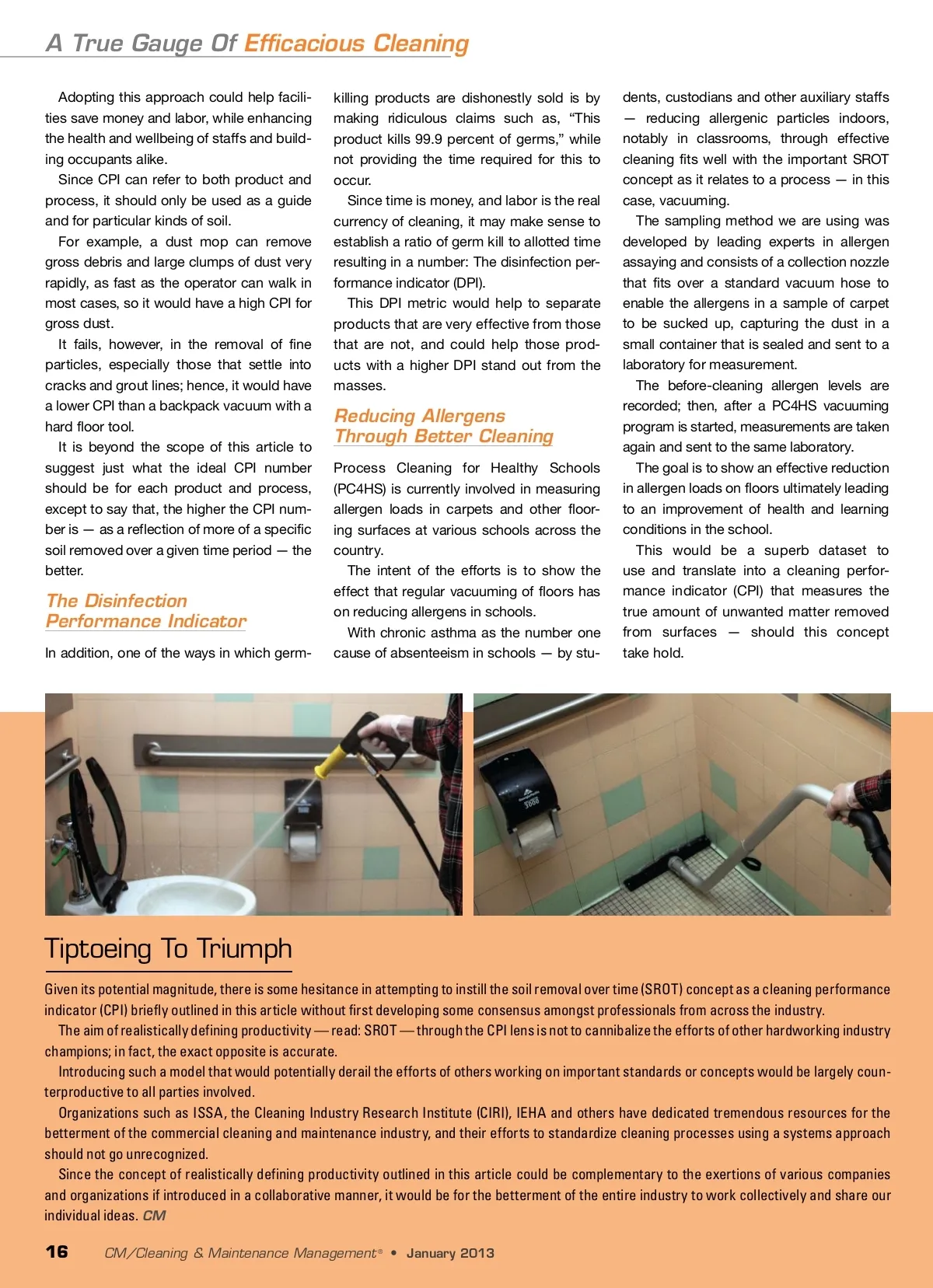
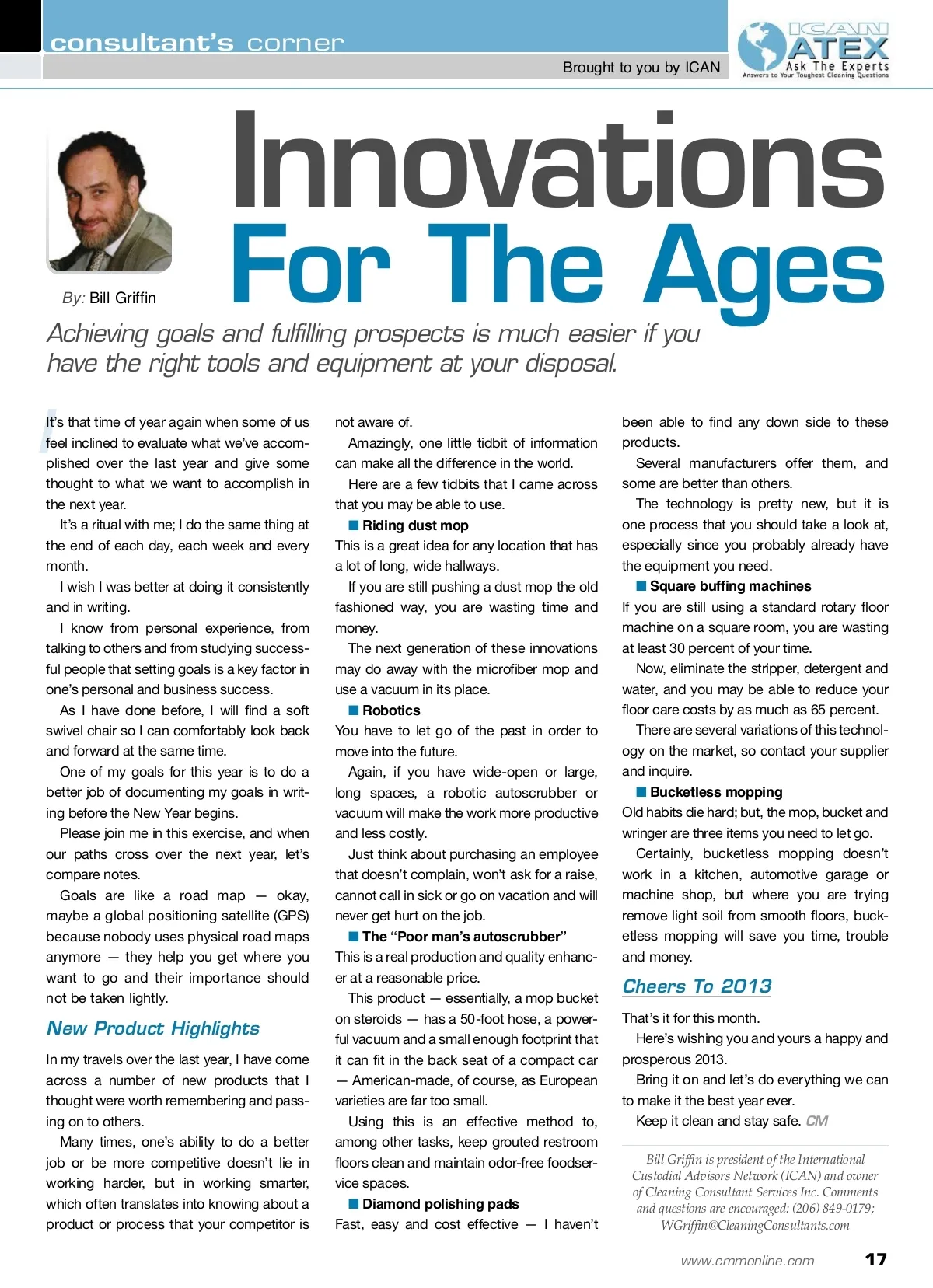
A True Gauge Of Efficacious Cleaning Adopting this approach could help facili-ties save money and labor, while enhancing the health and wellbeing of staffs and build-ing occupants alike. Since CPI can refer to both product and process, it should only be used as a guide and for particular kinds of soil. For example, a dust mop can remove gross debris and large clumps of dust very rapidly, as fast as the operator can walk in most cases, so it would have a high CPI for gross dust. It fails, however, in the removal of fine particles, especially those that settle into cracks and grout lines; hence, it would have a lower CPI than a backpack vacuum with a hard floor tool. It is beyond the scope of this article to suggest just what the ideal CPI number should be for each product and process, except to say that, the higher the CPI num-ber is — as a reflection of more of a specific soil removed over a given time period — the better. killing products are dishonestly sold is by making ridiculous claims such as, “This product kills 99.9 percent of germs,” while not providing the time required for this to occur. Since time is money, and labor is the real currency of cleaning, it may make sense to establish a ratio of germ kill to allotted time resulting in a number: The disinfection per-formance indicator (DPI). This DPI metric would help to separate products that are very effective from those that are not, and could help those prod-ucts with a higher DPI stand out from the masses. dents, custodians and other auxiliary staffs — reducing allergenic particles indoors, notably in classrooms, through effective cleaning fits well with the important SROT concept as it relates to a process — in this case, vacuuming. The sampling method we are using was developed by leading experts in allergen assaying and consists of a collection nozzle that fits over a standard vacuum hose to enable the allergens in a sample of carpet to be sucked up, capturing the dust in a small container that is sealed and sent to a laboratory for measurement. The before-cleaning allergen levels are recorded; then, after a PC4HS vacuuming program is started, measurements are taken again and sent to the same laboratory. The goal is to show an effective reduction in allergen loads on floors ultimately leading to an improvement of health and learning conditions in the school. This would be a superb dataset to use and translate into a cleaning perfor-mance indicator (CPI) that measures the true amount of unwanted matter removed from surfaces — should this concept take hold. Reducing Allergens Through Better Cleaning Process Cleaning for Healthy Schools (PC4HS) is currently involved in measuring allergen loads in carpets and other floor-ing surfaces at various schools across the country. The intent of the efforts is to show the effect that regular vacuuming of floors has on reducing allergens in schools. With chronic asthma as the number one cause of absenteeism in schools — by stu-The Disinfection Performance Indicator In addition, one of the ways in which germ-Tiptoeing To Triumph Given its potential magnitude, there is some hesitance in attempting to instill the soil removal over time (SROT) concept as a cleaning performance indicator (CPI) briefly outlined in this article without first developing some consensus amongst professionals from across the industry. The aim of realistically defining productivity — read: SROT — through the CPI lens is not to cannibalize the efforts of other hardworking industry champions; in fact, the exact opposite is accurate. Introducing such a model that would potentially derail the efforts of others working on important standards or concepts would be largely coun-terproductive to all parties involved. Organizations such as ISSA, the Cleaning Industry Research Institute (CIRI), IEHA and others have dedicated tremendous resources for the betterment of the commercial cleaning and maintenance industry, and their efforts to standardize cleaning processes using a systems approach should not go unrecognized. Since the concept of realistically defining productivity outlined in this article could be complementary to the exertions of various companies and organizations if introduced in a collaborative manner, it would be for the betterment of the entire industry to work collectively and share our individual ideas. CM 16 CM/Cleaning & Maintenance Management ® • January 2013
CMM – Archives Jan 2013: 16