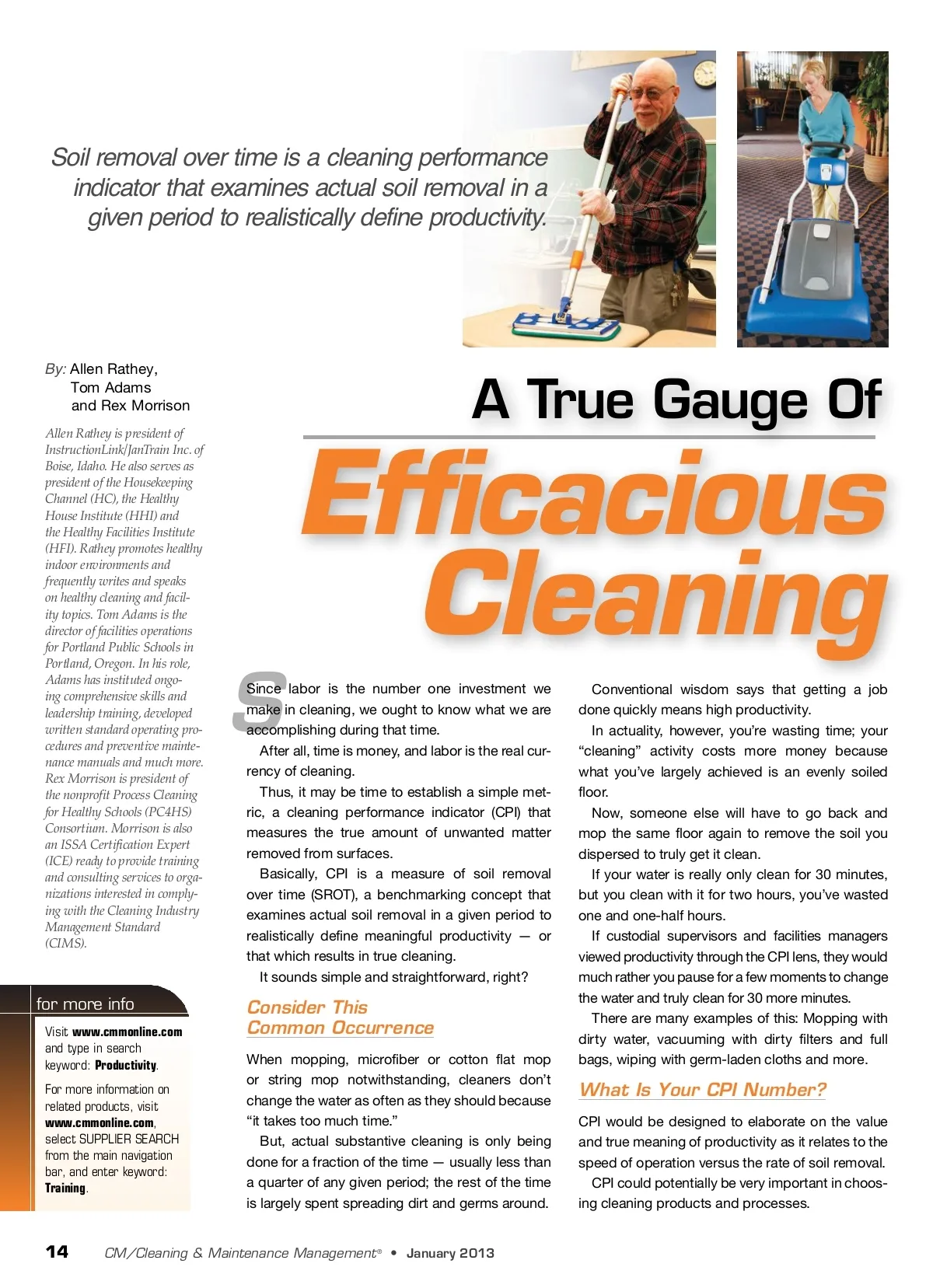
Soil removal over time is a cleaning performance indicator that examines actual soil removal in a given period to realistically define productivity. By: Allen Rathey, Tom Adams and Rex Morrison Allen Rathey is president of InstructionLink/JanTrain Inc. of Boise, Idaho. He also serves as president of the Housekeeping Channel (HC), the Healthy House Institute (HHI) and the Healthy Facilities Institute (HFI). Rathey promotes healthy indoor environments and frequently writes and speaks on healthy cleaning and facil-ity topics. Tom Adams is the director of facilities operations for Portland Public Schools in Portland, Oregon. In his role, Adams has instituted ongo-ing comprehensive skills and leadership training, developed written standard operating pro-cedures and preventive mainte-nance manuals and much more. Rex Morrison is president of the nonprofit Process Cleaning for Healthy Schools (PC4HS) Consortium. Morrison is also an ISSA Certification Expert (ICE) ready to provide training and consulting services to orga-nizations interested in comply-ing with the Cleaning Industry Management Standard (CIMS). A True Gauge Of Efficacious Cleaning S Since labor is the number one investment we make in cleaning, we ought to know what we are accomplishing during that time. After all, time is money, and labor is the real cur-rency of cleaning. Thus, it may be time to establish a simple met-ric, a cleaning performance indicator (CPI) that measures the true amount of unwanted matter removed from surfaces. Basically, CPI is a measure of soil removal over time (SROT), a benchmarking concept that examines actual soil removal in a given period to realistically define meaningful productivity — or that which results in true cleaning. It sounds simple and straightforward, right? Conventional wisdom says that getting a job done quickly means high productivity. In actuality, however, you’re wasting time; your “cleaning” activity costs more money because what you’ve largely achieved is an evenly soiled floor. Now, someone else will have to go back and mop the same floor again to remove the soil you dispersed to truly get it clean. If your water is really only clean for 30 minutes, but you clean with it for two hours, you’ve wasted one and one-half hours. If custodial supervisors and facilities managers viewed productivity through the CPI lens, they would much rather you pause for a few moments to change the water and truly clean for 30 more minutes. There are many examples of this: Mopping with dirty water, vacuuming with dirty filters and full bags, wiping with germ-laden cloths and more. for more info Visit www.cmmonline.com and type in search keyword: Productivity . For more information on related products, visit www.cmmonline.com , select SUPPLIER SEARCH from the main navigation bar, and enter keyword: Training . Consider This Common Occurrence When mopping, microfiber or cotton flat mop or string mop notwithstanding, cleaners don’t change the water as often as they should because “it takes too much time.” But, actual substantive cleaning is only being done for a fraction of the time — usually less than a quarter of any given period; the rest of the time is largely spent spreading dirt and germs around. What Is Your CPI Number? CPI would be designed to elaborate on the value and true meaning of productivity as it relates to the speed of operation versus the rate of soil removal. CPI could potentially be very important in choos-ing cleaning products and processes. 14 CM/Cleaning & Maintenance Management ® • January 2013
CMM – Archives Jan 2013: 14