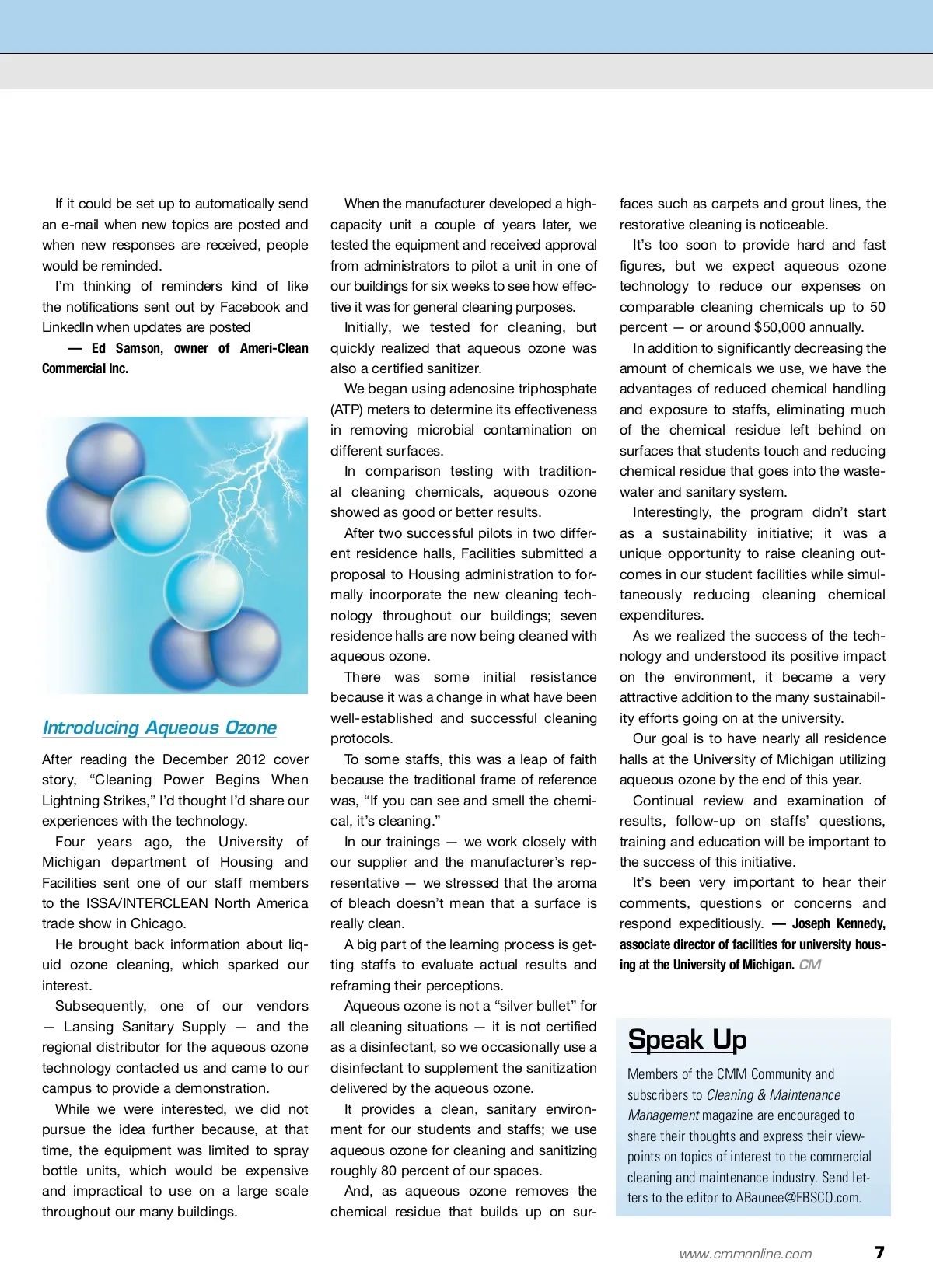
If it could be set up to automatically send an e-mail when new topics are posted and when new responses are received, people would be reminded. I’m thinking of reminders kind of like the notifications sent out by Facebook and LinkedIn when updates are posted — Ed Samson, owner of Ameri-Clean Commercial Inc. Introducing Aqueous Ozone After reading the December 2012 cover story, “Cleaning Power Begins When Lightning Strikes,” I’d thought I’d share our experiences with the technology. Four years ago, the University of Michigan department of Housing and Facilities sent one of our staff members to the ISSA/INTERCLEAN North America trade show in Chicago. He brought back information about liq-uid ozone cleaning, which sparked our interest. Subsequently, one of our vendors — Lansing Sanitary Supply — and the regional distributor for the aqueous ozone technology contacted us and came to our campus to provide a demonstration. While we were interested, we did not pursue the idea further because, at that time, the equipment was limited to spray bottle units, which would be expensive and impractical to use on a large scale throughout our many buildings. When the manufacturer developed a high-capacity unit a couple of years later, we tested the equipment and received approval from administrators to pilot a unit in one of our buildings for six weeks to see how effec-tive it was for general cleaning purposes. Initially, we tested for cleaning, but quickly realized that aqueous ozone was also a certified sanitizer. We began using adenosine triphosphate (ATP) meters to determine its effectiveness in removing microbial contamination on different surfaces. In comparison testing with tradition-al cleaning chemicals, aqueous ozone showed as good or better results. After two successful pilots in two differ-ent residence halls, Facilities submitted a proposal to Housing administration to for-mally incorporate the new cleaning tech-nology throughout our buildings; seven residence halls are now being cleaned with aqueous ozone. There was some initial resistance because it was a change in what have been well-established and successful cleaning protocols. To some staffs, this was a leap of faith because the traditional frame of reference was, “If you can see and smell the chemi-cal, it’s cleaning.” In our trainings — we work closely with our supplier and the manufacturer’s rep-resentative — we stressed that the aroma of bleach doesn’t mean that a surface is really clean. A big part of the learning process is get-ting staffs to evaluate actual results and reframing their perceptions. Aqueous ozone is not a “silver bullet” for all cleaning situations — it is not certified as a disinfectant, so we occasionally use a disinfectant to supplement the sanitization delivered by the aqueous ozone. It provides a clean, sanitary environ-ment for our students and staffs; we use aqueous ozone for cleaning and sanitizing roughly 80 percent of our spaces. And, as aqueous ozone removes the chemical residue that builds up on sur-faces such as carpets and grout lines, the restorative cleaning is noticeable. It’s too soon to provide hard and fast figures, but we expect aqueous ozone technology to reduce our expenses on comparable cleaning chemicals up to 50 percent — or around $50,000 annually. In addition to significantly decreasing the amount of chemicals we use, we have the advantages of reduced chemical handling and exposure to staffs, eliminating much of the chemical residue left behind on surfaces that students touch and reducing chemical residue that goes into the waste-water and sanitary system. Interestingly, the program didn’t start as a sustainability initiative; it was a unique opportunity to raise cleaning out-comes in our student facilities while simul-taneously reducing cleaning chemical expenditures. As we realized the success of the tech-nology and understood its positive impact on the environment, it became a very attractive addition to the many sustainabil-ity efforts going on at the university. Our goal is to have nearly all residence halls at the University of Michigan utilizing aqueous ozone by the end of this year. Continual review and examination of results, follow-up on staffs’ questions, training and education will be important to the success of this initiative. It’s been very important to hear their comments, questions or concerns and respond expeditiously. — Joseph Kennedy, associate director of facilities for university hous-ing at the University of Michigan. CM Speak Up Members of the CMM Community and subscribers to Cleaning & Maintenance Management magazine are encouraged to share their thoughts and express their view-points on topics of interest to the commercial cleaning and maintenance industry. Send let-ters to the editor to [email protected] . www.cmmonline.com 7
CMM – Archives Jan 2013: 7