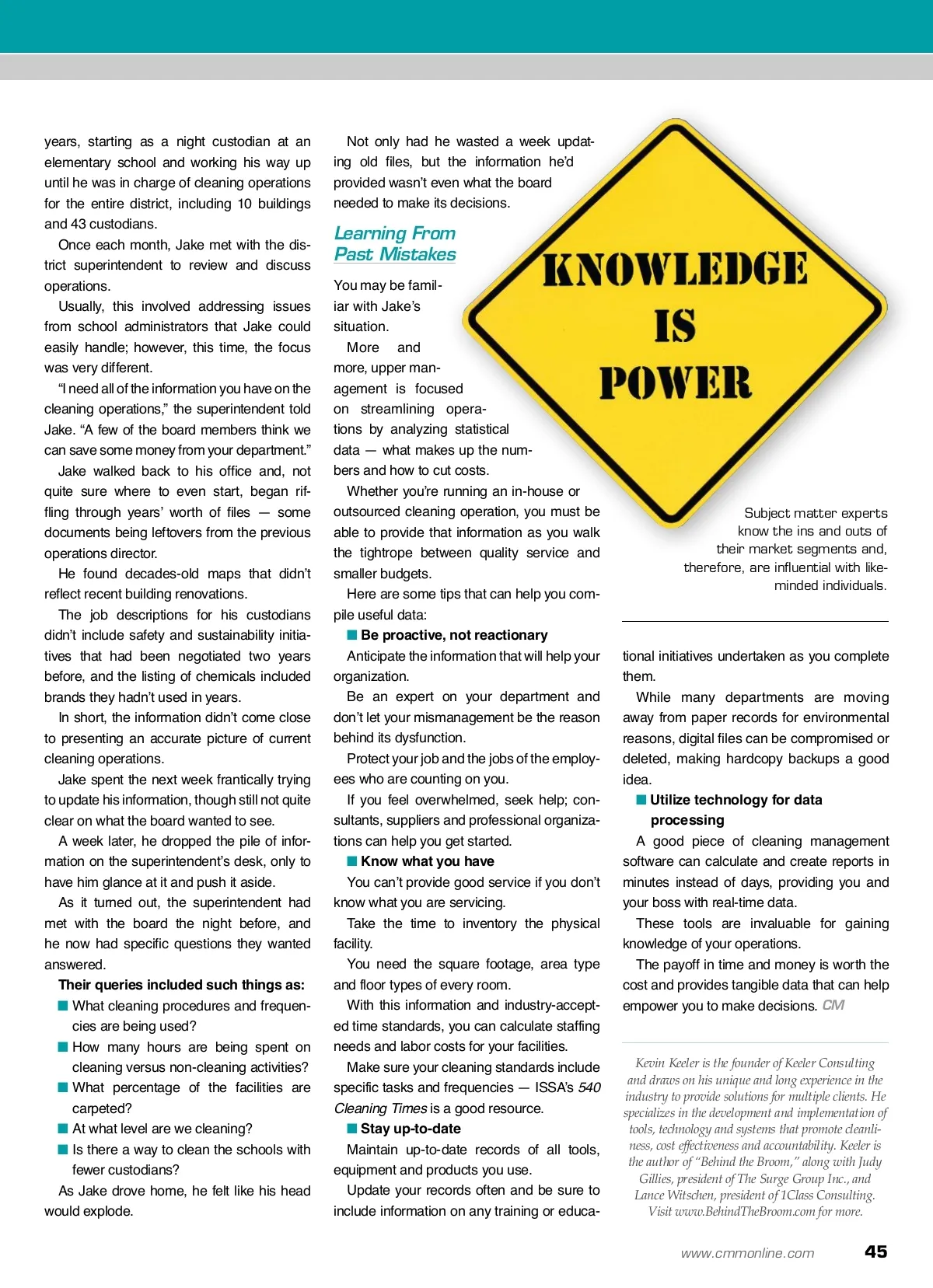
years, starting as a night custodian at an elementary school and working his way up until he was in charge of cleaning operations for the entire district, including 10 buildings and 43 custodians. Once each month, Jake met with the dis-trict superintendent to review and discuss operations. Usually, this involved addressing issues from school administrators that Jake could easily handle; however, this time, the focus was very different. “I need all of the information you have on the cleaning operations,” the superintendent told Jake. “A few of the board members think we can save some money from your department.” Jake walked back to his office and, not quite sure where to even start, began rif-fling through years’ worth of files — some documents being leftovers from the previous operations director. He found decades-old maps that didn’t reflect recent building renovations. The job descriptions for his custodians didn’t include safety and sustainability initia -tives that had been negotiated two years before, and the listing of chemicals included brands they hadn’t used in years. In short, the information didn’t come close to presenting an accurate picture of current cleaning operations. Jake spent the next week frantically trying to update his information, though still not quite clear on what the board wanted to see. A week later, he dropped the pile of infor-mation on the superintendent’s desk, only to have him glance at it and push it aside. As it turned out, the superintendent had met with the board the night before, and he now had specific questions they wanted answered. Their queries included such things as: ■ What cleaning procedures and frequen-cies are being used? ■ How many hours are being spent on cleaning versus non-cleaning activities? ■ What percentage of the facilities are carpeted? ■ At what level are we cleaning? ■ Is there a way to clean the schools with fewer custodians? As Jake drove home, he felt like his head would explode. Not only had he wasted a week updat-ing old files, but the information he’d provided wasn’t even what the board needed to make its decisions. Learning From Past Mistakes You may be famil-iar with Jake’s situation. More and more, upper man-agement is focused on streamlining opera-tions by analyzing statistical data — what makes up the num -bers and how to cut costs. Whether you’re running an in-house or outsourced cleaning operation, you must be able to provide that information as you walk the tightrope between quality service and smaller budgets. Here are some tips that can help you com-pile useful data: ■ Be proactive, not reactionary Anticipate the information that will help your organization. Be an expert on your department and don’t let your mismanagement be the reason behind its dysfunction. Protect your job and the jobs of the employ-ees who are counting on you. If you feel overwhelmed, seek help; con-sultants, suppliers and professional organiza-tions can help you get started. ■ Know what you have You can’t provide good service if you don’t know what you are servicing. Take the time to inventory the physical facility. You need the square footage, area type and floor types of every room. With this information and industry-accept-ed time standards, you can calculate staffing needs and labor costs for your facilities. Make sure your cleaning standards include specific tasks and frequencies — ISSA’s 540 Cleaning Times is a good resource. ■ Stay up-to-date Maintain up-to-date records of all tools, equipment and products you use. Update your records often and be sure to include information on any training or educa-Subject matter experts know the ins and outs of their market segments and, therefore, are influential with like-minded individuals. tional initiatives undertaken as you complete them. While many departments are moving away from paper records for environmental reasons, digital files can be compromised or deleted, making hardcopy backups a good idea. ■ Utilize technology for data processing A good piece of cleaning management software can calculate and create reports in minutes instead of days, providing you and your boss with real-time data. These tools are invaluable for gaining knowledge of your operations. The payoff in time and money is worth the cost and provides tangible data that can help empower you to make decisions. CM Kevin Keeler is the founder of Keeler Consulting and draws on his unique and long experience in the industry to provide solutions for multiple clients. He specializes in the development and implementation of tools, technology and systems that promote cleanli-ness, cost effectiveness and accountability. Keeler is the author of “Behind the Broom,” along with Judy Gillies, president of The Surge Group Inc., and Lance Witschen, president of 1Class Consulting. Visit www.BehindTheBroom.com for more. www.cmmonline.com 45
CMM – Archives Mar 2013: 45