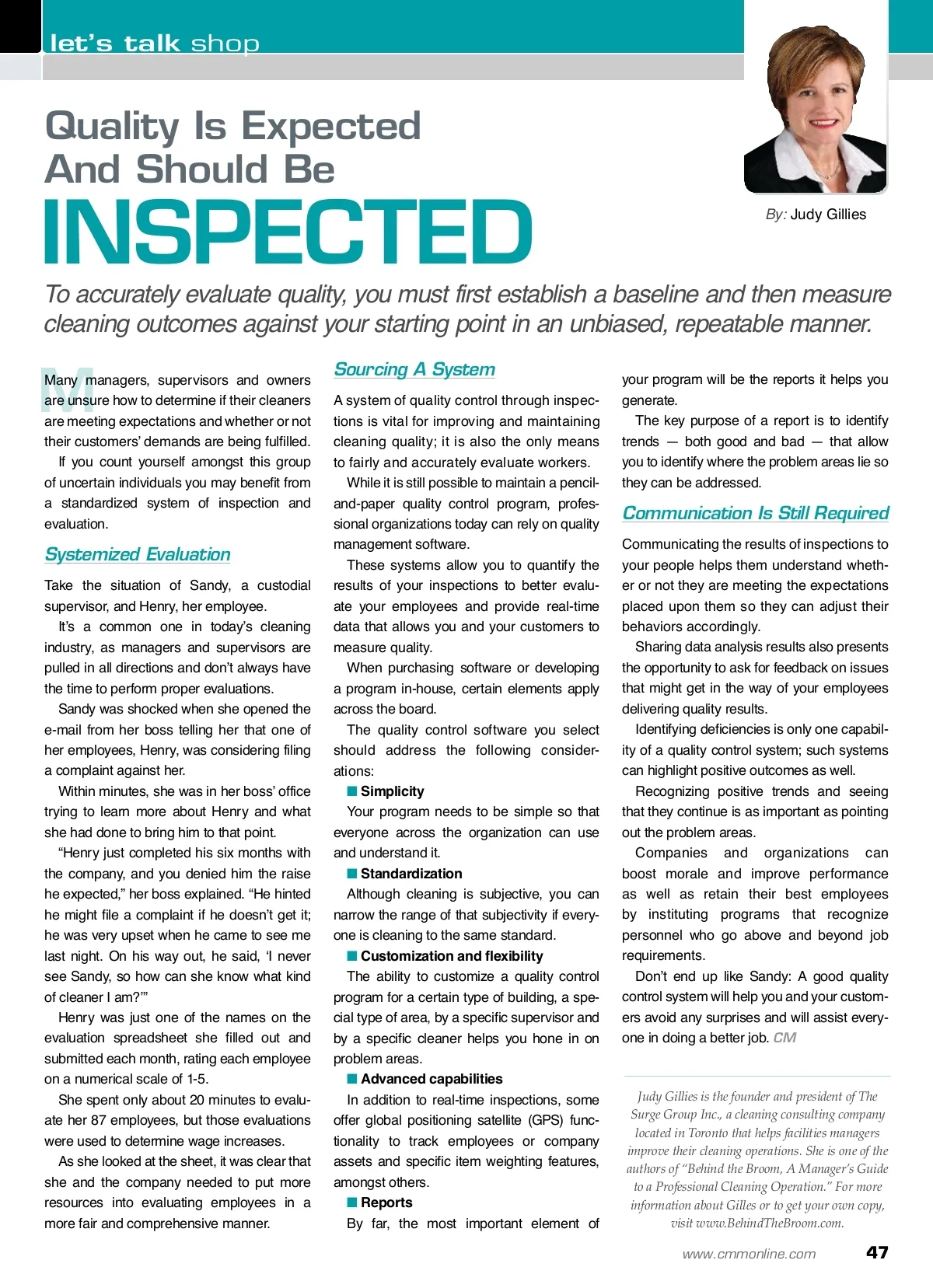
let’s talk shop Quality Is Expected And Should Be INSPECTED M Many managers, supervisors and owners are unsure how to determine if their cleaners are meeting expectations and whether or not their customers’ demands are being fulfilled. If you count yourself amongst this group of uncertain individuals you may benefit from a standardized system of inspection and evaluation. By: Judy Gillies To accurately evaluate quality, you must first establish a baseline and then measure cleaning outcomes against your starting point in an unbiased, repeatable manner. Sourcing A System A system of quality control through inspec-tions is vital for improving and maintaining cleaning quality; it is also the only means to fairly and accurately evaluate workers. While it is still possible to maintain a pencil-and-paper quality control program, profes-sional organizations today can rely on quality management software. These systems allow you to quantify the results of your inspections to better evalu -ate your employees and provide real-time data that allows you and your customers to measure quality. When purchasing software or developing a program in-house, certain elements apply across the board. The quality control software you select should address the following consider-ations: ■ Simplicity Your program needs to be simple so that everyone across the organization can use and understand it. ■ Standardization Although cleaning is subjective, you can narrow the range of that subjectivity if every -one is cleaning to the same standard. ■ Customization and flexibility The ability to customize a quality control program for a certain type of building, a spe -cial type of area, by a specific supervisor and by a specific cleaner helps you hone in on problem areas. ■ Advanced capabilities In addition to real-time inspections, some offer global positioning satellite (GPS) func -tionality to track employees or company assets and specific item weighting features, amongst others. ■ Reports By far, the most important element of your program will be the reports it helps you generate. The key purpose of a report is to identify trends — both good and bad — that allow you to identify where the problem areas lie so they can be addressed. Communication Is Still Required Communicating the results of inspections to your people helps them understand wheth-er or not they are meeting the expectations placed upon them so they can adjust their behaviors accordingly. Sharing data analysis results also presents the opportunity to ask for feedback on issues that might get in the way of your employees delivering quality results. Identifying deficiencies is only one capabil -ity of a quality control system; such systems can highlight positive outcomes as well. Recognizing positive trends and seeing that they continue is as important as pointing out the problem areas. Companies and organizations can boost morale and improve performance as well as retain their best employees by instituting programs that recognize personnel who go above and beyond job requirements. Don’t end up like Sandy: A good quality control system will help you and your custom-ers avoid any surprises and will assist every-one in doing a better job. CM Systemized Evaluation Take the situation of Sandy, a custodial supervisor, and Henry, her employee. It’s a common one in today’s cleaning industry, as managers and supervisors are pulled in all directions and don’t always have the time to perform proper evaluations. Sandy was shocked when she opened the e-mail from her boss telling her that one of her employees, Henry, was considering filing a complaint against her. Within minutes, she was in her boss’ office trying to learn more about Henry and what she had done to bring him to that point. “Henry just completed his six months with the company, and you denied him the raise he expected,” her boss explained. “He hinted he might file a complaint if he doesn’t get it; he was very upset when he came to see me last night. On his way out, he said, ‘I never see Sandy, so how can she know what kind of cleaner I am?’” Henry was just one of the names on the evaluation spreadsheet she filled out and submitted each month, rating each employee on a numerical scale of 1-5. She spent only about 20 minutes to evalu -ate her 87 employees, but those evaluations were used to determine wage increases. As she looked at the sheet, it was clear that she and the company needed to put more resources into evaluating employees in a more fair and comprehensive manner. Judy Gillies is the founder and president of The Surge Group Inc., a cleaning consulting company located in Toronto that helps facilities managers improve their cleaning operations. She is one of the authors of “Behind the Broom, A Manager’s Guide to a Professional Cleaning Operation.” For more information about Gilles or to get your own copy, visit www.BehindTheBroom.com. www.cmmonline.com 47
CMM – Archives Apr 2013: 47