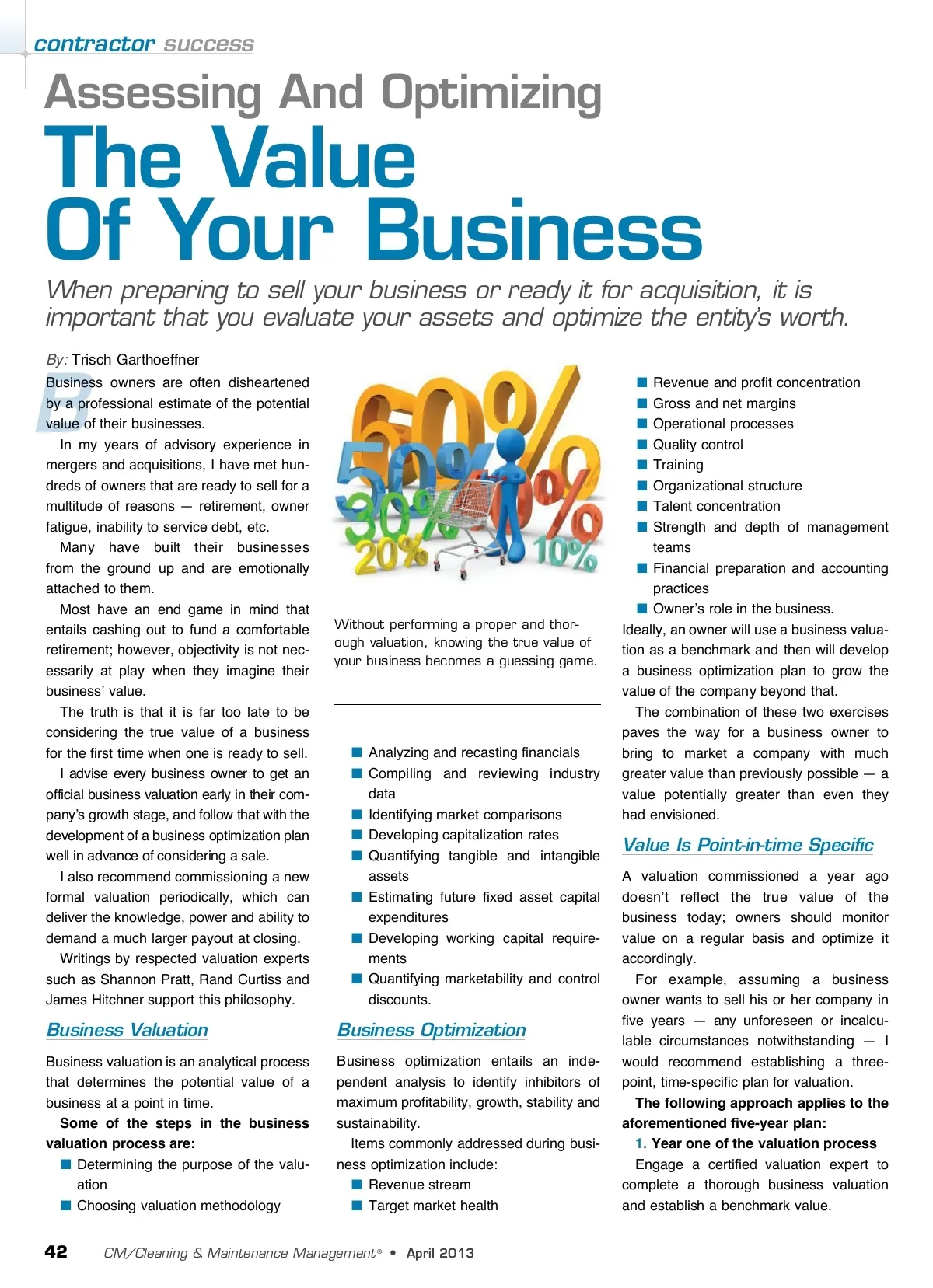
contractor success Assessing And Optimizing The Value Of Your Business When preparing to sell your business or ready it for acquisition, it is important that you evaluate your assets and optimize the entity’s worth. By: Trisch Garthoeffner B Business owners are often disheartened by a professional estimate of the potential value of their businesses. In my years of advisory experience in mergers and acquisitions, I have met hun-dreds of owners that are ready to sell for a multitude of reasons — retirement, owner fatigue, inability to service debt, etc. Many have built their businesses from the ground up and are emotionally attached to them. Most have an end game in mind that entails cashing out to fund a comfortable retirement; however, objectivity is not nec-essarily at play when they imagine their business’ value. The truth is that it is far too late to be considering the true value of a business for the first time when one is ready to sell. I advise every business owner to get an official business valuation early in their com-pany’s growth stage, and follow that with the development of a business optimization plan well in advance of considering a sale. I also recommend commissioning a new formal valuation periodically, which can deliver the knowledge, power and ability to demand a much larger payout at closing. Writings by respected valuation experts such as Shannon Pratt, Rand Curtiss and James Hitchner support this philosophy. Without performing a proper and thor-ough valuation, knowing the true value of your business becomes a guessing game. ■ Analyzing and recasting financials ■ Compiling and reviewing industry data ■ Identifying market comparisons ■ Developing capitalization rates ■ Quantifying tangible and intangible assets ■ Estimating future fixed asset capital expenditures ■ Developing working capital require-ments ■ Quantifying marketability and control discounts. Revenue and profit concentration Gross and net margins Operational processes Quality control Training Organizational structure Talent concentration Strength and depth of management teams ■ Financial preparation and accounting practices ■ Owner’s role in the business. Ideally, an owner will use a business valua-tion as a benchmark and then will develop a business optimization plan to grow the value of the company beyond that. The combination of these two exercises paves the way for a business owner to bring to market a company with much greater value than previously possible — a value potentially greater than even they had envisioned. ■ ■ ■ ■ ■ ■ ■ ■ Value Is Point-in-time Specific A valuation commissioned a year ago doesn’t reflect the true value of the business today; owners should monitor value on a regular basis and optimize it accordingly. For example, assuming a business owner wants to sell his or her company in five years — any unforeseen or incalcu-lable circumstances notwithstanding — I would recommend establishing a three-point, time-specific plan for valuation. The following approach applies to the aforementioned five-year plan: 1. Year one of the valuation process Engage a certified valuation expert to complete a thorough business valuation and establish a benchmark value. Business Valuation Business valuation is an analytical process that determines the potential value of a business at a point in time. Some of the steps in the business valuation process are: ■ Determining the purpose of the valu-ation ■ Choosing valuation methodology Business Optimization Business optimization entails an inde-pendent analysis to identify inhibitors of maximum profitability, growth, stability and sustainability. Items commonly addressed during busi-ness optimization include: ■ Revenue stream ■ Target market health 42 CM/Cleaning & Maintenance Management ® • April 2013
CMM – Archives Apr 2013: 42