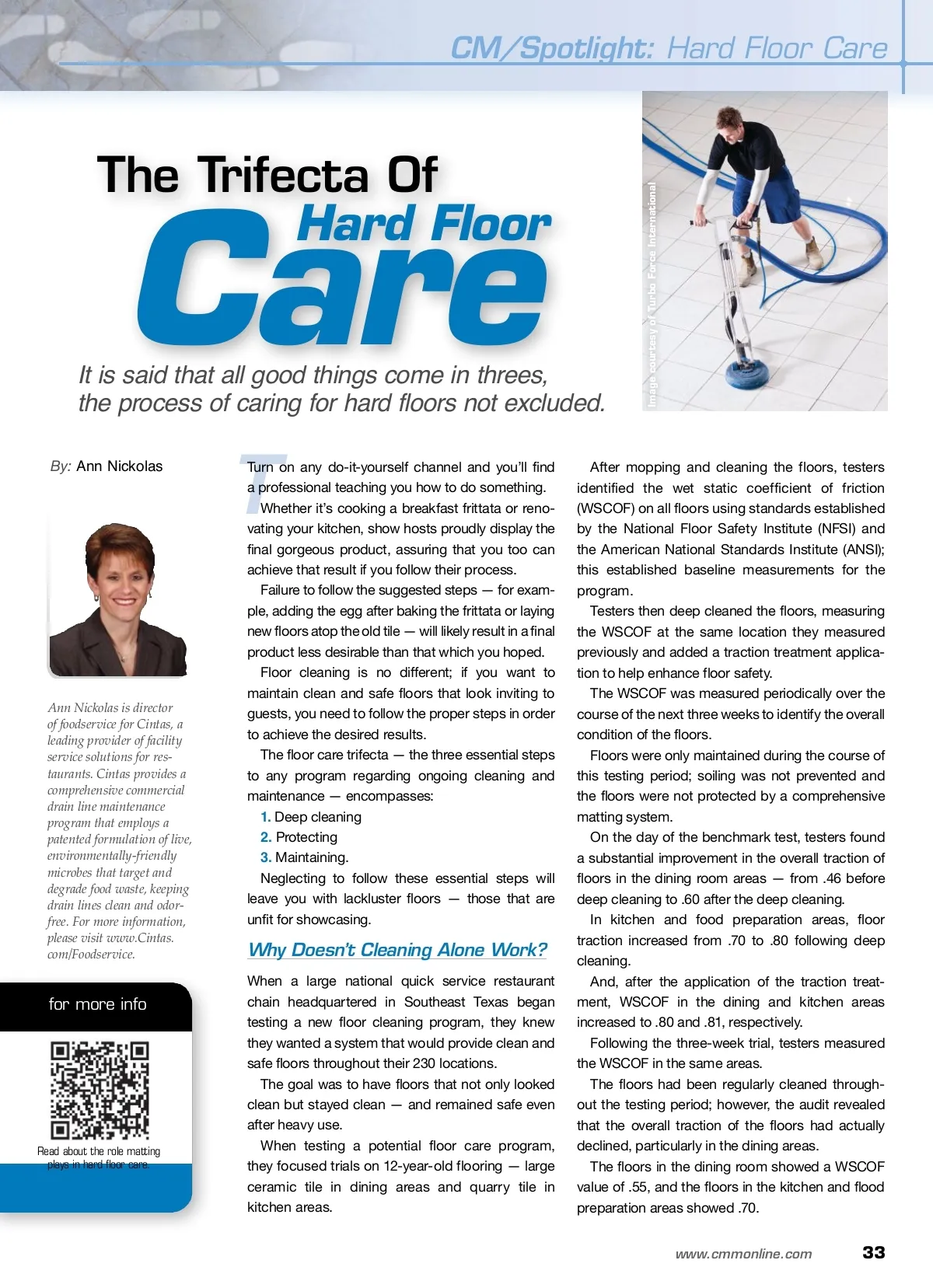
CM/Spotlight: Hard Floor Care Care T It is said that all good things come in threes, the process of caring for hard floors not excluded. By: Ann Nickolas Turn on any do-it-yourself channel and you’ll find a professional teaching you how to do something. Whether it’s cooking a breakfast frittata or reno-vating your kitchen, show hosts proudly display the final gorgeous product, assuring that you too can achieve that result if you follow their process. Failure to follow the suggested steps — for exam-ple, adding the egg after baking the frittata or laying new floors atop the old tile — will likely result in a final product less desirable than that which you hoped. Floor cleaning is no different; if you want to maintain clean and safe floors that look inviting to guests, you need to follow the proper steps in order to achieve the desired results. The floor care trifecta — the three essential steps to any program regarding ongoing cleaning and maintenance — encompasses: 1. Deep cleaning 2. Protecting 3. Maintaining. Neglecting to follow these essential steps will leave you with lackluster floors — those that are unfit for showcasing. Ann Nickolas is director of foodservice for Cintas, a leading provider of facility service solutions for res-taurants. Cintas provides a comprehensive commercial drain line maintenance program that employs a patented formulation of live, environmentally-friendly microbes that target and degrade food waste, keeping drain lines clean and odor-free. For more information, please visit www.Cintas. com/Foodservice. Why Doesn’t Cleaning Alone Work? When a large national quick service restaurant chain headquartered in Southeast Texas began testing a new floor cleaning program, they knew they wanted a system that would provide clean and safe floors throughout their 230 locations. The goal was to have floors that not only looked clean but stayed clean — and remained safe even after heavy use. When testing a potential floor care program, they focused trials on 12-year-old flooring — large ceramic tile in dining areas and quarry tile in kitchen areas. for more info Read about the role matting plays in hard floor care. After mopping and cleaning the floors, testers identified the wet static coefficient of friction (WSCOF) on all floors using standards established by the National Floor Safety Institute (NFSI) and the American National Standards Institute (ANSI); this established baseline measurements for the program. Testers then deep cleaned the floors, measuring the WSCOF at the same location they measured previously and added a traction treatment applica-tion to help enhance floor safety. The WSCOF was measured periodically over the course of the next three weeks to identify the overall condition of the floors. Floors were only maintained during the course of this testing period; soiling was not prevented and the floors were not protected by a comprehensive matting system. On the day of the benchmark test, testers found a substantial improvement in the overall traction of floors in the dining room areas — from .46 before deep cleaning to .60 after the deep cleaning. In kitchen and food preparation areas, floor traction increased from .70 to .80 following deep cleaning. And, after the application of the traction treat-ment, WSCOF in the dining and kitchen areas increased to .80 and .81, respectively. Following the three-week trial, testers measured the WSCOF in the same areas. The floors had been regularly cleaned through-out the testing period; however, the audit revealed that the overall traction of the floors had actually declined, particularly in the dining areas. The floors in the dining room showed a WSCOF value of .55, and the floors in the kitchen and flood preparation areas showed .70. www.cmmonline.com Image courtesy of Turbo Force International The Trifecta Of Hard Floor 33
CMM – Archives Apr 2013: 33