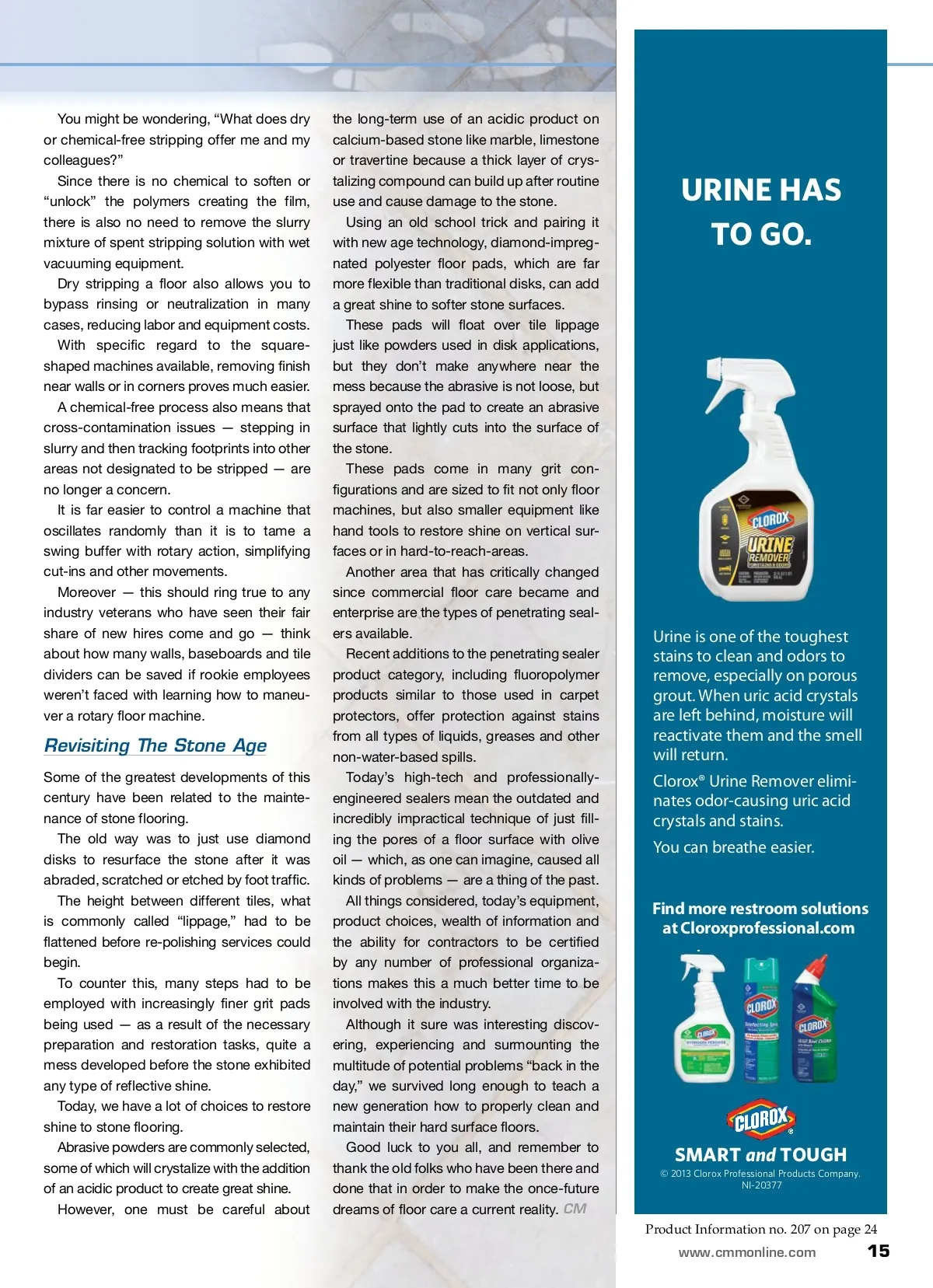
You might be wondering, “What does dry or chemical-free stripping offer me and my colleagues?” Since there is no chemical to soften or “unlock” the polymers creating the film, there is also no need to remove the slurry mixture of spent stripping solution with wet vacuuming equipment. Dry stripping a floor also allows you to bypass rinsing or neutralization in many cases, reducing labor and equipment costs. With specific regard to the square-shaped machines available, removing finish near walls or in corners proves much easier. A chemical-free process also means that cross-contamination issues — stepping in slurry and then tracking footprints into other areas not designated to be stripped — are no longer a concern. It is far easier to control a machine that oscillates randomly than it is to tame a swing buffer with rotary action, simplifying cut-ins and other movements. Moreover — this should ring true to any industry veterans who have seen their fair share of new hires come and go — think about how many walls, baseboards and tile dividers can be saved if rookie employees weren’t faced with learning how to maneu-ver a rotary floor machine. Revisiting The Stone Age Some of the greatest developments of this century have been related to the mainte-nance of stone flooring. The old way was to just use diamond disks to resurface the stone after it was abraded, scratched or etched by foot traffic. The height between different tiles, what is commonly called “lippage,” had to be flattened before re-polishing services could begin. To counter this, many steps had to be employed with increasingly finer grit pads being used — as a result of the necessary preparation and restoration tasks, quite a mess developed before the stone exhibited any type of reflective shine. Today, we have a lot of choices to restore shine to stone flooring. Abrasive powders are commonly selected, some of which will crystalize with the addition of an acidic product to create great shine. However, one must be careful about the long-term use of an acidic product on calcium-based stone like marble, limestone or travertine because a thick layer of crys-talizing compound can build up after routine use and cause damage to the stone. Using an old school trick and pairing it with new age technology, diamond-impreg-nated polyester floor pads, which are far more flexible than traditional disks, can add a great shine to softer stone surfaces. These pads will float over tile lippage just like powders used in disk applications, but they don’t make anywhere near the mess because the abrasive is not loose, but sprayed onto the pad to create an abrasive surface that lightly cuts into the surface of the stone. These pads come in many grit con-figurations and are sized to fit not only floor machines, but also smaller equipment like hand tools to restore shine on vertical sur-faces or in hard-to-reach-areas. Another area that has critically changed since commercial floor care became and enterprise are the types of penetrating seal-ers available. Recent additions to the penetrating sealer product category, including fluoropolymer products similar to those used in carpet protectors, offer protection against stains from all types of liquids, greases and other non-water-based spills. Today’s high-tech and professionally-engineered sealers mean the outdated and incredibly impractical technique of just fill-ing the pores of a floor surface with olive oil — which, as one can imagine, caused all kinds of problems — are a thing of the past. All things considered, today’s equipment, product choices, wealth of information and the ability for contractors to be certified by any number of professional organiza-tions makes this a much better time to be involved with the industry. Although it sure was interesting discov-ering, experiencing and surmounting the multitude of potential problems “back in the day,” we survived long enough to teach a new generation how to properly clean and maintain their hard surface floors. Good luck to you all, and remember to thank the old folks who have been there and done that in order to make the once-future dreams of floor care a current reality. CM URINE HAS TO GO. Urine is one of the toughest stains to clean and odors to remove, especially on porous grout. When uric acid crystals are left behind, moisture will reactivate them and the smell will return. Clorox® Urine Remover elimi-nates odor-causing uric acid crystals and stains. You can breathe easier. Find more restroom solutions at Cloroxprofessional.com SMART and TOUGH © 2013 Clorox Professional Products Company. NI-20377 Product Information no. 207 on page 24 www.cmmonline.com 15
CMM – Archives Apr 2013: 15