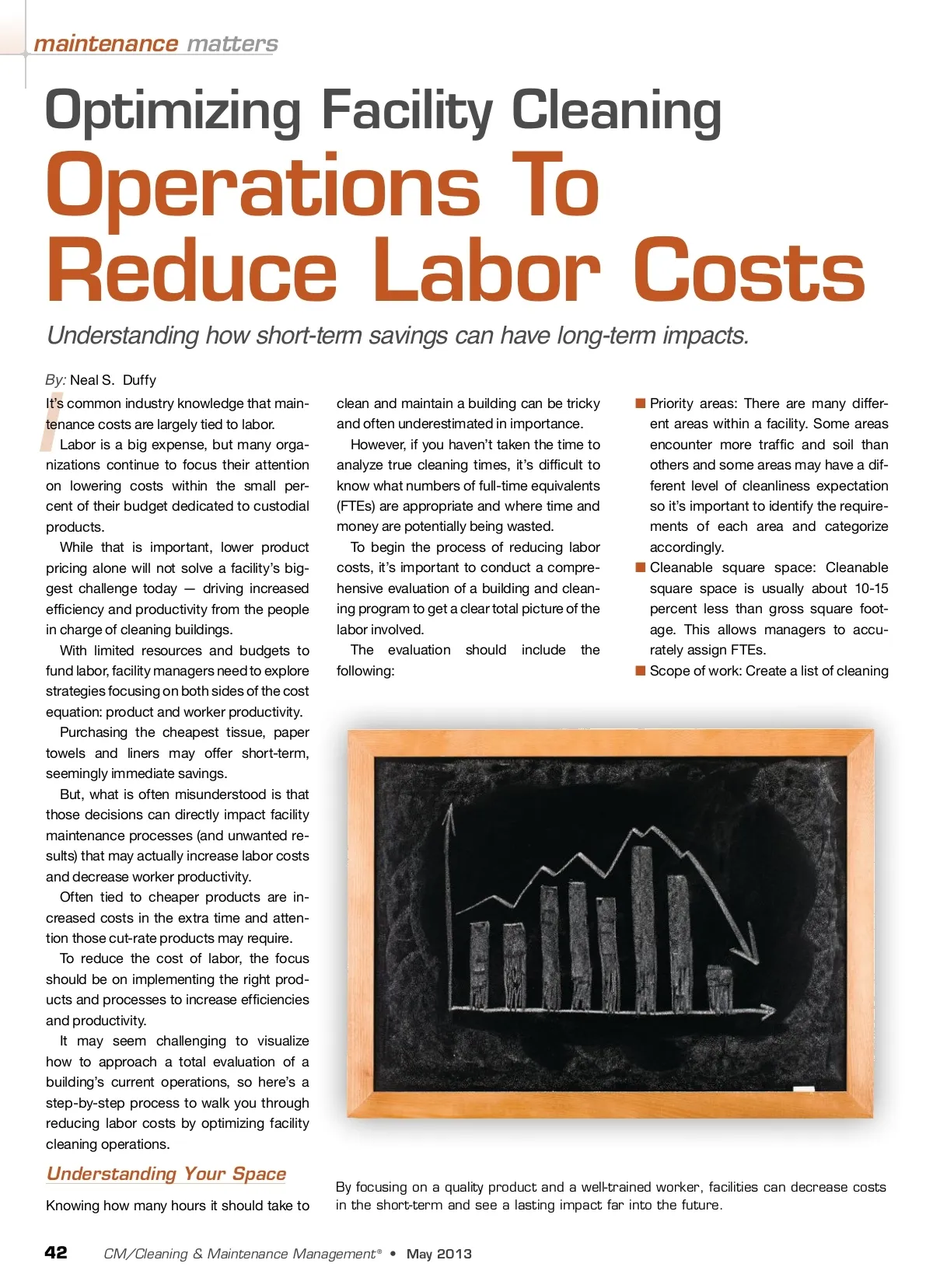
maintenance matters Optimizing Facility Cleaning Operations To Reduce Labor Costs Understanding how short-term savings can have long-term impacts. By: Neal S. Duffy I It’s common industry knowledge that main-tenance costs are largely tied to labor. Labor is a big expense, but many orga-nizations continue to focus their attention on lowering costs within the small per-cent of their budget dedicated to custodial products. While that is important, lower product pricing alone will not solve a facility’s big-gest challenge today — driving increased efficiency and productivity from the people in charge of cleaning buildings. With limited resources and budgets to fund labor, facility managers need to explore strategies focusing on both sides of the cost equation: product and worker productivity. Purchasing the cheapest tissue, paper towels and liners may offer short-term, seemingly immediate savings. But, what is often misunderstood is that those decisions can directly impact facility maintenance processes (and unwanted re-sults) that may actually increase labor costs and decrease worker productivity. Often tied to cheaper products are in-creased costs in the extra time and atten-tion those cut-rate products may require. To reduce the cost of labor, the focus should be on implementing the right prod-ucts and processes to increase efficiencies and productivity. It may seem challenging to visualize how to approach a total evaluation of a building’s current operations, so here’s a step-by-step process to walk you through reducing labor costs by optimizing facility cleaning operations. clean and maintain a building can be tricky and often underestimated in importance. However, if you haven’t taken the time to analyze true cleaning times, it’s difficult to know what numbers of full-time equivalents (FTEs) are appropriate and where time and money are potentially being wasted. To begin the process of reducing labor costs, it’s important to conduct a compre-hensive evaluation of a building and clean-ing program to get a clear total picture of the labor involved. The evaluation should include the following: ■ Priority areas: There are many differ-ent areas within a facility. Some areas encounter more traffic and soil than others and some areas may have a dif-ferent level of cleanliness expectation so it’s important to identify the require-ments of each area and categorize accordingly. ■ Cleanable square space: Cleanable square space is usually about 10-15 percent less than gross square foot-age. This allows managers to accu-rately assign FTEs. ■ Scope of work: Create a list of cleaning Understanding Your Space Knowing how many hours it should take to By focusing on a quality product and a well-trained worker, facilities can decrease costs in the short-term and see a lasting impact far into the future. 42 CM/Cleaning & Maintenance Management ® • May 2013
CMM – Archives May 2013: 42