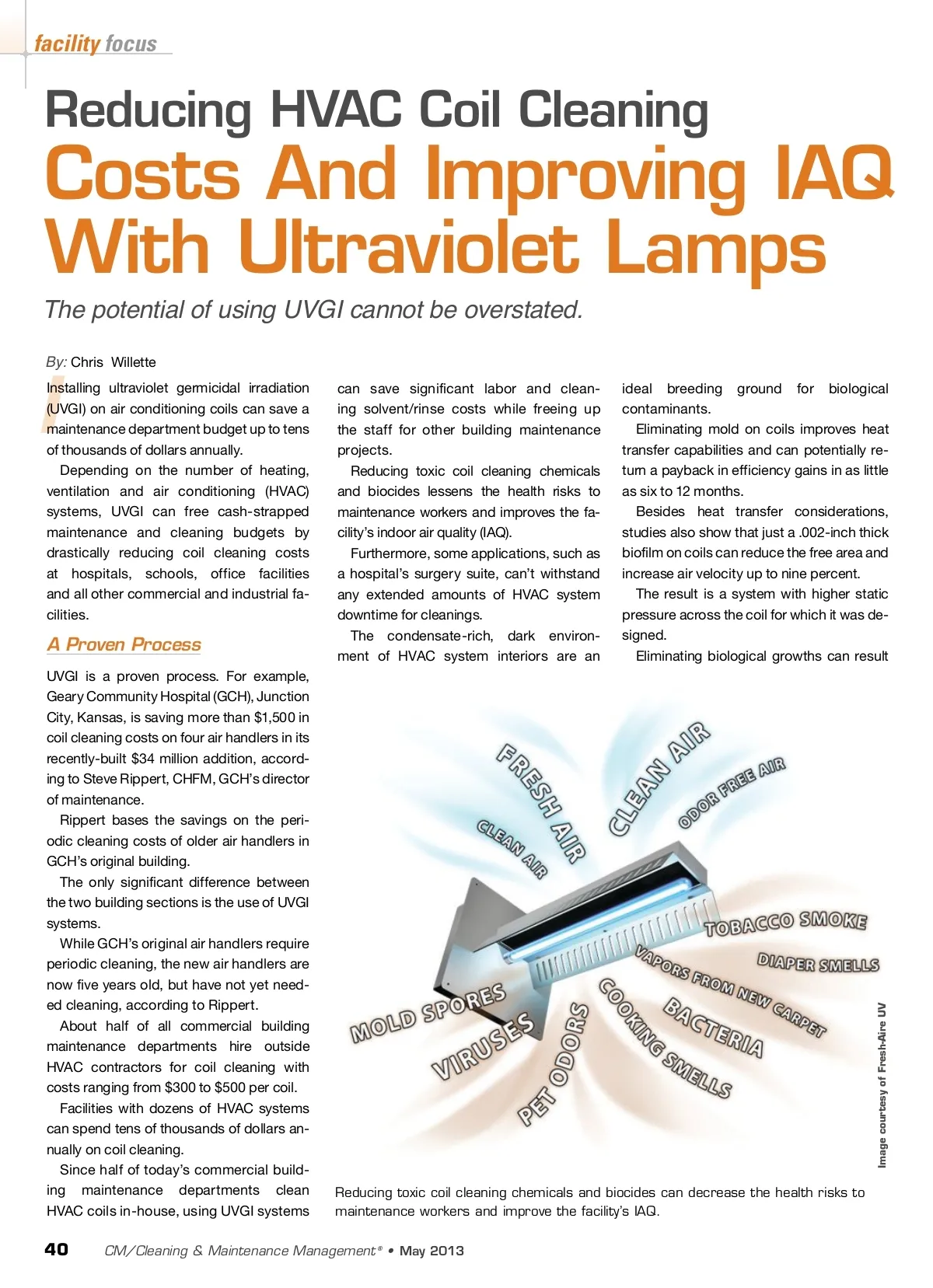
in a 30 percent cooling capacity increase compared to a dirty coil. Finally, clean coils extend the lifecycle of HVAC systems. Maintaining The Facility’s IAQ UVGI has been used for decades to sterilize and inactivate airborne biological contami-nants, such as fungi, mold, viruses, bacteria and other biological contaminants in HVAC systems. Until recently, however, minimal data was available to support its effectiveness claims. A 2012 study by one of the top five inter-national air cleaner equipment test labs, Air-mid Healthgroup (AHG), Dublin, Ireland, has proven UVGI’s effectiveness against mold, bacteria and viruses in a simulated HVAC unit environment. The study simulated airstream microbe inactivation in an ASTM/AHAM style envi-ronmental test chamber. AHG custom-built the chamber to simulate a typical building’s indoor environment with an HVAC air handler providing 73-degrees Fahrenheit (23-degress Celsius) tempera-tures, 55 percent relative humidities and air-flow velocities of 492-fpm (0.93m3/sec.). A single pass test was also performed on an ASHRAE Standard 52.2 test duct system. The test’s UVGI light single-pass inactiva-tion results were: ■ Bacteria (S. epidermidis): 98-85 per-cent ■ Virus (MS2 coliphage): 99.03 percent ■ Mold (A.niger): 78.80 percent. As impressive as these results are, they only represent a single-pass test. Multiple passes, as simulated in a typical HVAC system producing several room air changes hourly, would have produced even greater microbial inactivation, according to Dean T. Tompkins, Ph.D, P.E., a Milwaukee, Wisconsin-based independent IAQ consul-tant who reviewed the AHG test results. Installing And Maintaining UVGI Systems Most commercial facility maintenance de-partments are capable of in-house UVGI retrofits of existing air handlers. Commercial UVGI systems typically cost approximately $1,000 to $4,000 in equip-ment costs per air handling or rooftop unit, depending on the coil size and number of lamps needed for proper coverage. Installation labor typically requires two to six hours per unit. UVGI system configuration, including siz-ing and proper placement of the UV lamps, are an installation’s most critical factors. Some manufacturers provide online siz-ing programs. A user simply fills out an on-line form that prompts parameters, such as enclosure dimensions, air velocity and air handler/coil model. Output data includes selected lamp model and parameters, number of lamps, lamp locations, UV power, electrical power requirements, each lamp’s peak irradiance, in-duct irradiance (µW/cm 2 ) and microbe in-activation calculations. Some web services provide calculations of both airborne and cooling coil surface microbe disinfection efficiencies from UV light exposure, a free review by factory en-gineers and detailed color chart and graph image printouts for building owner presen-tations. Some manufacturers will also send a fac-tory technician to train a maintenance de-partment and supervise UVGI installations, especially if the retrofit project involves mul-tiple units. The type of UVGI system chosen for an HVAC unit will affect how much of an ad-ditional maintenance workload it puts on a facility’s staff. Like most products, UVGI comes in good, better and best classifications. Generally, high quality UVGI systems are maintenance-free, with the exception of routine lamp replacement. The quality of the equipment will affect longevity and the amount of routine mainte-nance required. UV lamps are available in one-year or two-year models. While two-year models are more expen-sive, the extended lifecycle will cut replace-ment labor by half or more compared to one-year lamps. Replacement generally amounts to a 10 minute or less process and simply involves unplugging the old lamp, removing it from the lamp clips and installing the new lamp(s). Replacement lamps generally come in 15-, 32-, 46-and 60-inch long models, rang-ing in cost from $60 to $150. The most reliable lamps have sturdy filaments with a cathode guard and a hard quartz glass lens and a secondary hard quartz shield for added stability. Not A One Size Fits All UV lamps are not all the same. They come in single-end and bi-pin va-rieties and the latter typically has electrical connector pins on both ends of the lamp and sometimes tend to be more failure-prone due the fragility of the exposed elec-trical connection points. Single-ended lamps, especially those using a remote ballast, are the quickest to replace. They snap quickly out of their sus-pension rack holder and the rubber electri-cal connection easily pulls off the lamp’s single pin end. Instead of a lamp fixture mounted bal-last, which can be as problematic and as unreliable as conventional fluorescent lamp ballasts, more reliable UVGI systems use remote power supplies that provide power to the lamp(s) via a marine-grade, water-resistant cable connection. When mounted outside the air handler, remote power supplies will have longer life-cycles than power supplies and/or ballasts designed for mounting inside the humid, corrosive environment of the unit. Thus, some manufacturers offer lifetime warranties on remote power supplies, which demonstrates confidence in the equip-ment’s longevity. UVGI for HVAC systems offers many ad-vantages for any commercial facility. It reduces a maintenance department’s workload, increases the HVAC system’s effi-ciency and lifecyle, while enhancing IAQ for the benefit of building occupants. CM Chris Willette is president of Fresh-Aire UV, www.FreshAireUV.com, a division of Triatomic Environmental Inc., Jupiter, Florida Willette is an engineer and a designer/ developer of indoor air quality products, such as the Fresh-Aire UV APCO, an air purifica-tion system that won the prestigious AHR Innovation Award for the IAQ Category at the 2011 AHR Expo. APCO combines the principles of germicidal UV-C light irradiation, gas-phase air purification and photo catalytic oxidation into one unit. Fresh-Aire UV also offers its Blue-Calc online sizing service and software for engineers or contractors plan-ning UVGI equipment for new or retrofitted HVAC systems. www.cmmonline.com 41
CMM – Archives May 2013: 41