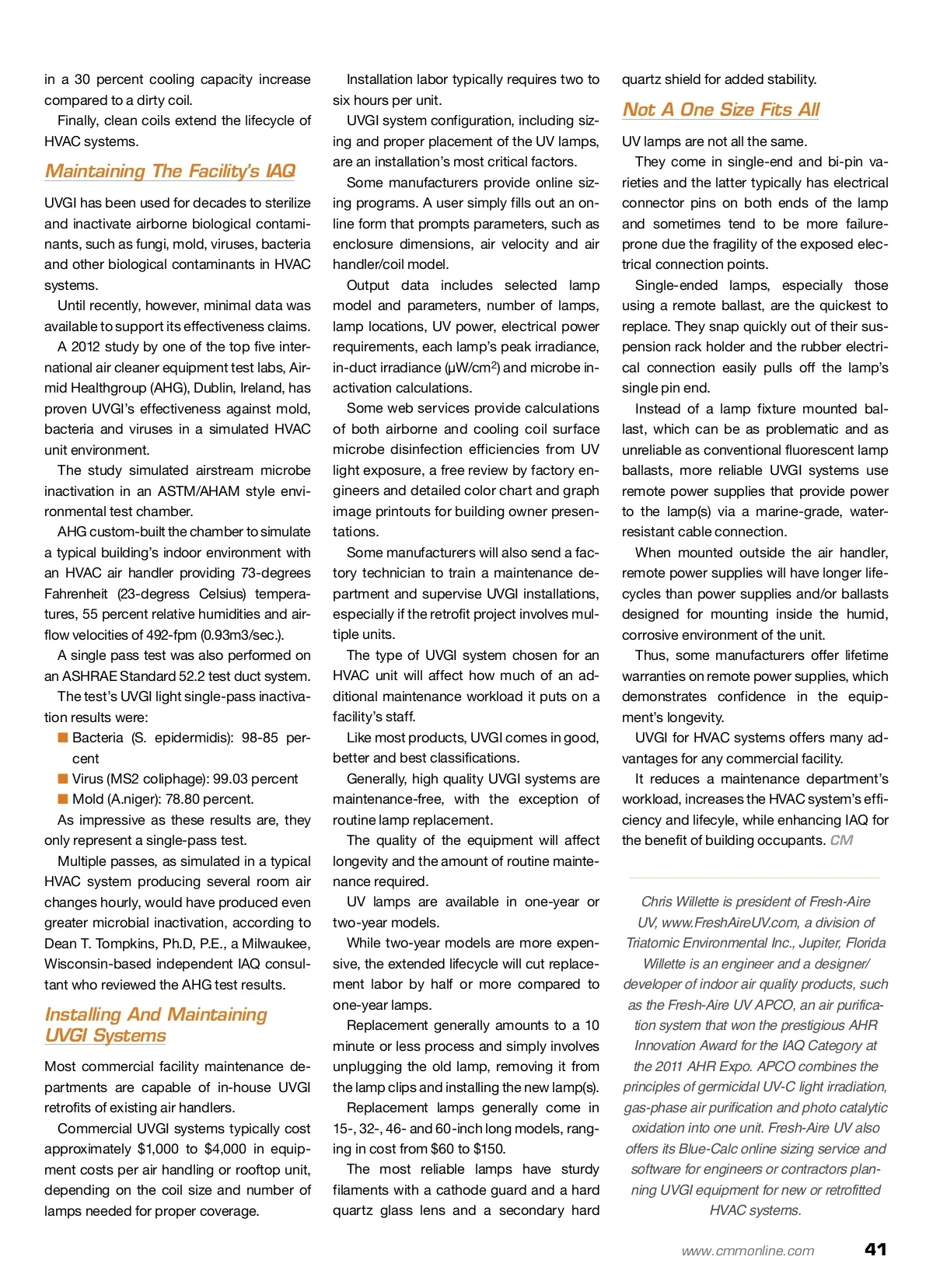
facility focus Reducing HVAC Coil Cleaning Costs And Improving IAQ With Ultraviolet Lamps The potential of using UVGI cannot be overstated. By: Chris Willette I Installing ultraviolet germicidal irradiation (UVGI) on air conditioning coils can save a maintenance department budget up to tens of thousands of dollars annually. Depending on the number of heating, ventilation and air conditioning (HVAC) systems, UVGI can free cash-strapped maintenance and cleaning budgets by drastically reducing coil cleaning costs at hospitals, schools, office facilities and all other commercial and industrial fa-cilities. A Proven Process UVGI is a proven process. For example, Geary Community Hospital (GCH), Junction City, Kansas, is saving more than $1,500 in coil cleaning costs on four air handlers in its recently-built $34 million addition, accord-ing to Steve Rippert, CHFM, GCH’s director of maintenance. Rippert bases the savings on the peri-odic cleaning costs of older air handlers in GCH’s original building. The only significant difference between the two building sections is the use of UVGI systems. While GCH’s original air handlers require periodic cleaning, the new air handlers are now five years old, but have not yet need-ed cleaning, according to Rippert. About half of all commercial building maintenance departments hire outside HVAC contractors for coil cleaning with costs ranging from $300 to $500 per coil. Facilities with dozens of HVAC systems can spend tens of thousands of dollars an-nually on coil cleaning. Since half of today’s commercial build-ing maintenance departments clean HVAC coils in-house, using UVGI systems can save significant labor and clean-ing solvent/rinse costs while freeing up the staff for other building maintenance projects. Reducing toxic coil cleaning chemicals and biocides lessens the health risks to maintenance workers and improves the fa-cility’s indoor air quality (IAQ). Furthermore, some applications, such as a hospital’s surgery suite, can’t withstand any extended amounts of HVAC system downtime for cleanings. The condensate-rich, dark environ-ment of HVAC system interiors are an ideal breeding ground for biological contaminants. Eliminating mold on coils improves heat transfer capabilities and can potentially re-turn a payback in efficiency gains in as little as six to 12 months. Besides heat transfer considerations, studies also show that just a .002-inch thick biofilm on coils can reduce the free area and increase air velocity up to nine percent. The result is a system with higher static pressure across the coil for which it was de-signed. Eliminating biological growths can result Reducing toxic coil cleaning chemicals and biocides can decrease the health risks to maintenance workers and improve the facility’s IAQ. 40 CM/Cleaning & Maintenance Management ® • May 2013 Image courtesy of Fresh-Aire UV
CMM – Archives May 2013: 40