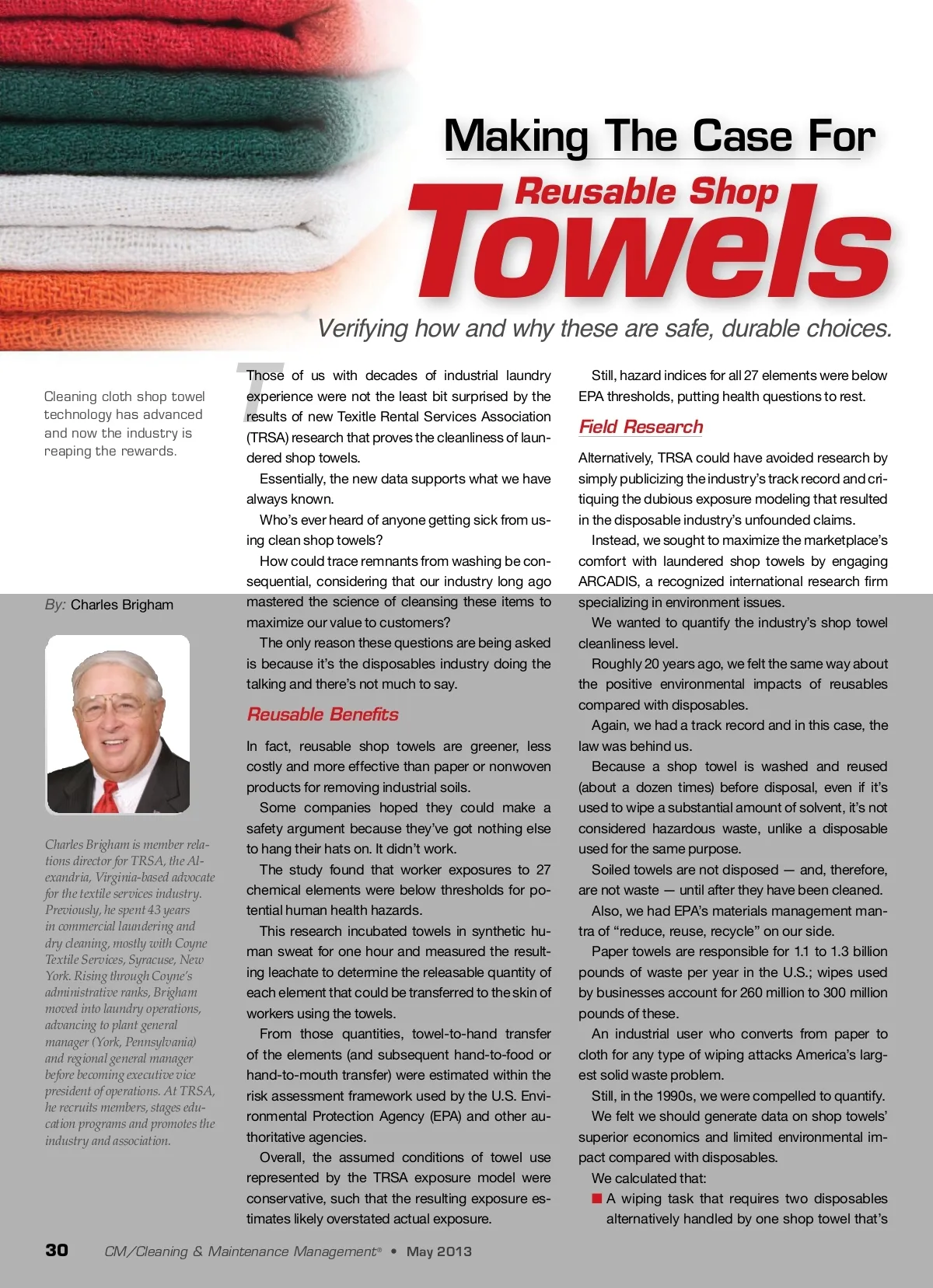
Making The Case For Verifying how and why these are safe, durable choices. Cleaning cloth shop towel technology has advanced and now the industry is reaping the rewards. Towels Field Research Reusable Shop T By: Charles Brigham Those of us with decades of industrial laundry experience were not the least bit surprised by the results of new Texitle Rental Services Association (TRSA) research that proves the cleanliness of laun-dered shop towels. Essentially, the new data supports what we have always known. Who’s ever heard of anyone getting sick from us-ing clean shop towels? How could trace remnants from washing be con-sequential, considering that our industry long ago mastered the science of cleansing these items to maximize our value to customers? The only reason these questions are being asked is because it’s the disposables industry doing the talking and there’s not much to say. Still, hazard indices for all 27 elements were below EPA thresholds, putting health questions to rest. Reusable Benefits In fact, reusable shop towels are greener, less costly and more effective than paper or nonwoven products for removing industrial soils. Some companies hoped they could make a safety argument because they’ve got nothing else to hang their hats on. It didn’t work. The study found that worker exposures to 27 chemical elements were below thresholds for po-tential human health hazards. This research incubated towels in synthetic hu-man sweat for one hour and measured the result-ing leachate to determine the releasable quantity of each element that could be transferred to the skin of workers using the towels. From those quantities, towel-to-hand transfer of the elements (and subsequent hand-to-food or hand-to-mouth transfer) were estimated within the risk assessment framework used by the U.S. Envi-ronmental Protection Agency (EPA) and other au-thoritative agencies. Overall, the assumed conditions of towel use represented by the TRSA exposure model were conservative, such that the resulting exposure es-timates likely overstated actual exposure. Charles Brigham is member rela-tions director for TRSA, the Al-exandria, Virginia-based advocate for the textile services industry. Previously, he spent 43 years in commercial laundering and dry cleaning, mostly with Coyne Textile Services, Syracuse, New York. Rising through Coyne’s administrative ranks, Brigham moved into laundry operations, advancing to plant general manager (York, Pennsylvania) and regional general manager before becoming executive vice president of operations. At TRSA, he recruits members, stages edu-cation programs and promotes the industry and association. Alternatively, TRSA could have avoided research by simply publicizing the industry’s track record and cri-tiquing the dubious exposure modeling that resulted in the disposable industry’s unfounded claims. Instead, we sought to maximize the marketplace’s comfort with laundered shop towels by engaging ARCADIS, a recognized international research firm specializing in environment issues. We wanted to quantify the industry’s shop towel cleanliness level. Roughly 20 years ago, we felt the same way about the positive environmental impacts of reusables compared with disposables. Again, we had a track record and in this case, the law was behind us. Because a shop towel is washed and reused (about a dozen times) before disposal, even if it’s used to wipe a substantial amount of solvent, it’s not considered hazardous waste, unlike a disposable used for the same purpose. Soiled towels are not disposed — and, therefore, are not waste — until after they have been cleaned. Also, we had EPA’s materials management man-tra of “reduce, reuse, recycle” on our side. Paper towels are responsible for 1.1 to 1.3 billion pounds of waste per year in the U.S.; wipes used by businesses account for 260 million to 300 million pounds of these. An industrial user who converts from paper to cloth for any type of wiping attacks America’s larg-est solid waste problem. Still, in the 1990s, we were compelled to quantify. We felt we should generate data on shop towels’ superior economics and limited environmental im-pact compared with disposables. We calculated that: ■ A wiping task that requires two disposables alternatively handled by one shop towel that’s 30 CM/Cleaning & Maintenance Management ® • May 2013
CMM – Archives May 2013: 30