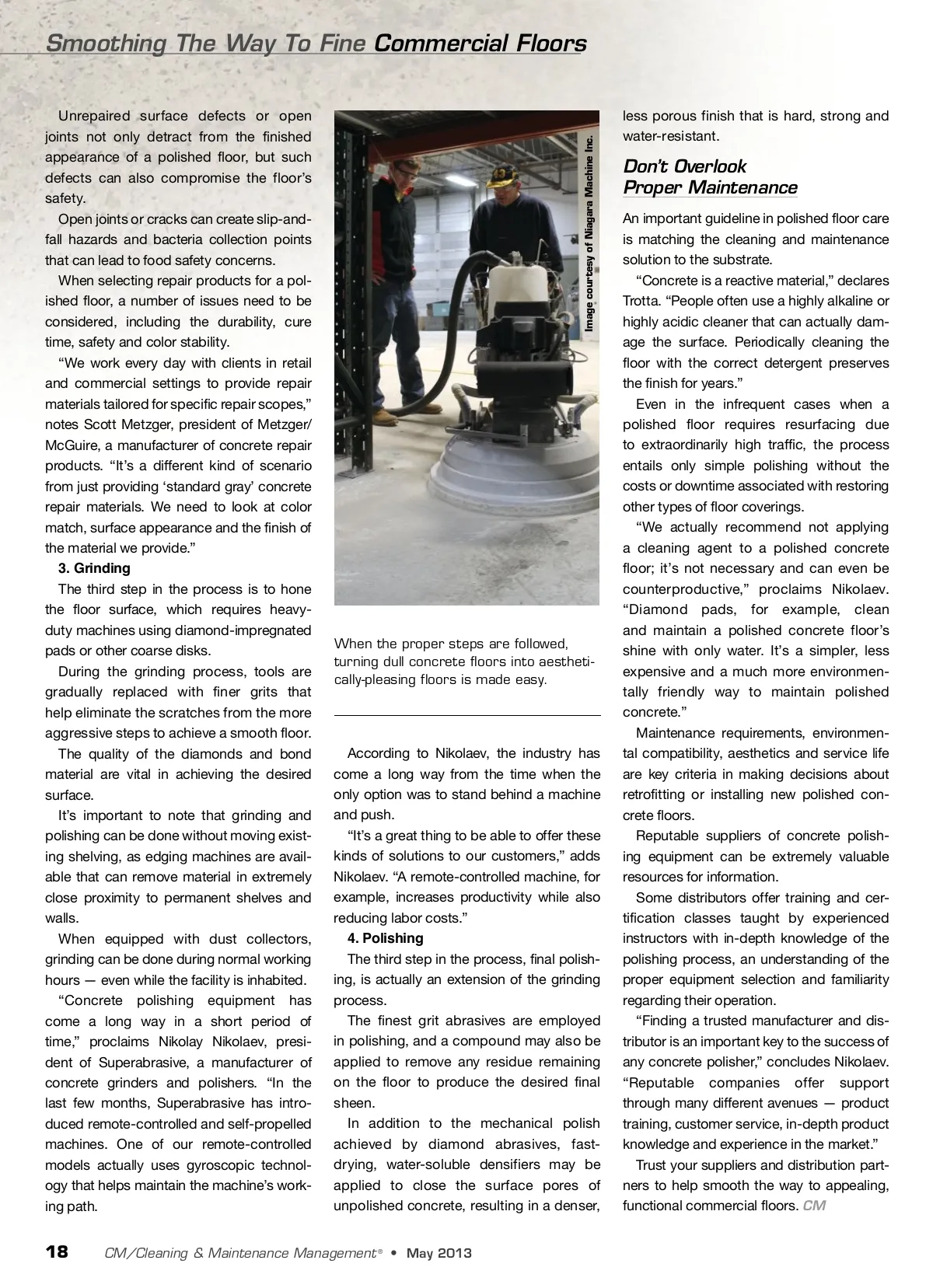
Smoothing The Way To Fine Commercial Floors Unrepaired surface defects or open joints not only detract from the finished appearance of a polished floor, but such defects can also compromise the floor’s safety. Open joints or cracks can create slip-and-fall hazards and bacteria collection points that can lead to food safety concerns. When selecting repair products for a pol-ished floor, a number of issues need to be considered, including the durability, cure time, safety and color stability. “We work every day with clients in retail and commercial settings to provide repair materials tailored for specific repair scopes,” notes Scott Metzger, president of Metzger/ McGuire, a manufacturer of concrete repair products. “It’s a different kind of scenario from just providing ‘standard gray’ concrete repair materials. We need to look at color match, surface appearance and the finish of the material we provide.” 3. Grinding The third step in the process is to hone the floor surface, which requires heavy-duty machines using diamond-impregnated pads or other coarse disks. During the grinding process, tools are gradually replaced with finer grits that help eliminate the scratches from the more aggressive steps to achieve a smooth floor. The quality of the diamonds and bond material are vital in achieving the desired surface. It’s important to note that grinding and polishing can be done without moving exist-ing shelving, as edging machines are avail-able that can remove material in extremely close proximity to permanent shelves and walls. When equipped with dust collectors, grinding can be done during normal working hours — even while the facility is inhabited. “Concrete polishing equipment has come a long way in a short period of time,” proclaims Nikolay Nikolaev, presi-dent of Superabrasive, a manufacturer of concrete grinders and polishers. “In the last few months, Superabrasive has intro-duced remote-controlled and self-propelled machines. One of our remote-controlled models actually uses gyroscopic technol-ogy that helps maintain the machine’s work-ing path. less porous finish that is hard, strong and water-resistant. Image courtesy of Niagara Machine Inc. Don’t Overlook Proper Maintenance An important guideline in polished floor care is matching the cleaning and maintenance solution to the substrate. “Concrete is a reactive material,” declares Trotta. “People often use a highly alkaline or highly acidic cleaner that can actually dam-age the surface. Periodically cleaning the floor with the correct detergent preserves the finish for years.” Even in the infrequent cases when a polished floor requires resurfacing due to extraordinarily high traffic, the process entails only simple polishing without the costs or downtime associated with restoring other types of floor coverings. “We actually recommend not applying a cleaning agent to a polished concrete floor; it’s not necessary and can even be counterproductive,” proclaims Nikolaev. “Diamond pads, for example, clean and maintain a polished concrete floor’s shine with only water. It’s a simpler, less expensive and a much more environmen-tally friendly way to maintain polished concrete.” Maintenance requirements, environmen-tal compatibility, aesthetics and service life are key criteria in making decisions about retrofitting or installing new polished con-crete floors. Reputable suppliers of concrete polish-ing equipment can be extremely valuable resources for information. Some distributors offer training and cer-tification classes taught by experienced instructors with in-depth knowledge of the polishing process, an understanding of the proper equipment selection and familiarity regarding their operation. “Finding a trusted manufacturer and dis-tributor is an important key to the success of any concrete polisher,” concludes Nikolaev. “Reputable companies offer support through many different avenues — product training, customer service, in-depth product knowledge and experience in the market.” Trust your suppliers and distribution part-ners to help smooth the way to appealing, functional commercial floors. CM When the proper steps are followed, turning dull concrete floors into aestheti-cally-pleasing floors is made easy. According to Nikolaev, the industry has come a long way from the time when the only option was to stand behind a machine and push. “It’s a great thing to be able to offer these kinds of solutions to our customers,” adds Nikolaev. “A remote-controlled machine, for example, increases productivity while also reducing labor costs.” 4. Polishing The third step in the process, final polish-ing, is actually an extension of the grinding process. The finest grit abrasives are employed in polishing, and a compound may also be applied to remove any residue remaining on the floor to produce the desired final sheen. In addition to the mechanical polish achieved by diamond abrasives, fast-drying, water-soluble densifiers may be applied to close the surface pores of unpolished concrete, resulting in a denser, 18 CM/Cleaning & Maintenance Management ® • May 2013
CMM – Archives May 2013: 18