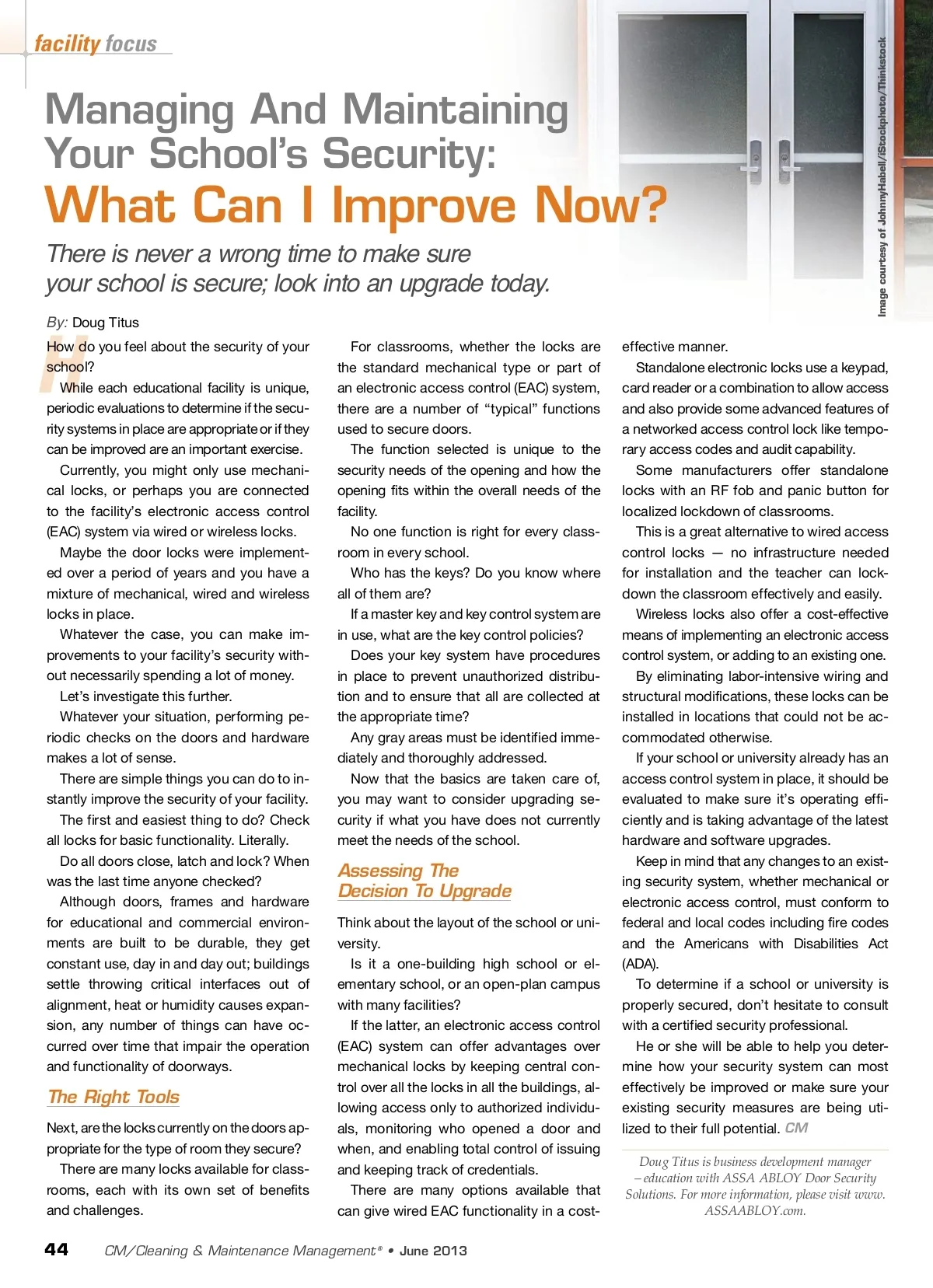
Managing And Maintaining Your School’s Security: What Can I Improve Now? There is never a wrong time to make sure your school is secure; look into an upgrade today. By: Doug Titus H How do you feel about the security of your school? While each educational facility is unique, periodic evaluations to determine if the secu-rity systems in place are appropriate or if they can be improved are an important exercise. Currently, you might only use mechani-cal locks, or perhaps you are connected to the facility’s electronic access control (EAC) system via wired or wireless locks. Maybe the door locks were implement-ed over a period of years and you have a mixture of mechanical, wired and wireless locks in place. Whatever the case, you can make im-provements to your facility’s security with-out necessarily spending a lot of money. Let’s investigate this further. Whatever your situation, performing pe-riodic checks on the doors and hardware makes a lot of sense. There are simple things you can do to in-stantly improve the security of your facility. The first and easiest thing to do? Check all locks for basic functionality. Literally. Do all doors close, latch and lock? When was the last time anyone checked? Although doors, frames and hardware for educational and commercial environ-ments are built to be durable, they get constant use, day in and day out; buildings settle throwing critical interfaces out of alignment, heat or humidity causes expan-sion, any number of things can have oc-curred over time that impair the operation and functionality of doorways. For classrooms, whether the locks are the standard mechanical type or part of an electronic access control (EAC) system, there are a number of “typical” functions used to secure doors. The function selected is unique to the security needs of the opening and how the opening fits within the overall needs of the facility. No one function is right for every class-room in every school. Who has the keys? Do you know where all of them are? If a master key and key control system are in use, what are the key control policies? Does your key system have procedures in place to prevent unauthorized distribu-tion and to ensure that all are collected at the appropriate time? Any gray areas must be identified imme-diately and thoroughly addressed. Now that the basics are taken care of, you may want to consider upgrading se-curity if what you have does not currently meet the needs of the school. Assessing The Decision To Upgrade Think about the layout of the school or uni-versity. Is it a one-building high school or el-ementary school, or an open-plan campus with many facilities? If the latter, an electronic access control (EAC) system can offer advantages over mechanical locks by keeping central con-trol over all the locks in all the buildings, al-lowing access only to authorized individu-als, monitoring who opened a door and when, and enabling total control of issuing and keeping track of credentials. There are many options available that can give wired EAC functionality in a cost-The Right Tools Next, are the locks currently on the doors ap-propriate for the type of room they secure? There are many locks available for class-rooms, each with its own set of benefits and challenges. effective manner. Standalone electronic locks use a keypad, card reader or a combination to allow access and also provide some advanced features of a networked access control lock like tempo-rary access codes and audit capability. Some manufacturers offer standalone locks with an RF fob and panic button for localized lockdown of classrooms. This is a great alternative to wired access control locks — no infrastructure needed for installation and the teacher can lock-down the classroom effectively and easily. Wireless locks also offer a cost-effective means of implementing an electronic access control system, or adding to an existing one. By eliminating labor-intensive wiring and structural modifications, these locks can be installed in locations that could not be ac-commodated otherwise. If your school or university already has an access control system in place, it should be evaluated to make sure it’s operating effi-ciently and is taking advantage of the latest hardware and software upgrades. Keep in mind that any changes to an exist-ing security system, whether mechanical or electronic access control, must conform to federal and local codes including fire codes and the Americans with Disabilities Act (ADA). To determine if a school or university is properly secured, don’t hesitate to consult with a certified security professional. He or she will be able to help you deter-mine how your security system can most effectively be improved or make sure your existing security measures are being uti-lized to their full potential. CM Doug Titus is business development manager – education with ASSA ABLOY Door Security Solutions. For more information, please visit www. ASSAABLOY.com. 44 CM/Cleaning & Maintenance Management ® • June 2013 Image courtesy of JohnnyHabell/iStockphoto/Thinkstock facility focus
CMM – Archives June 2013: 44