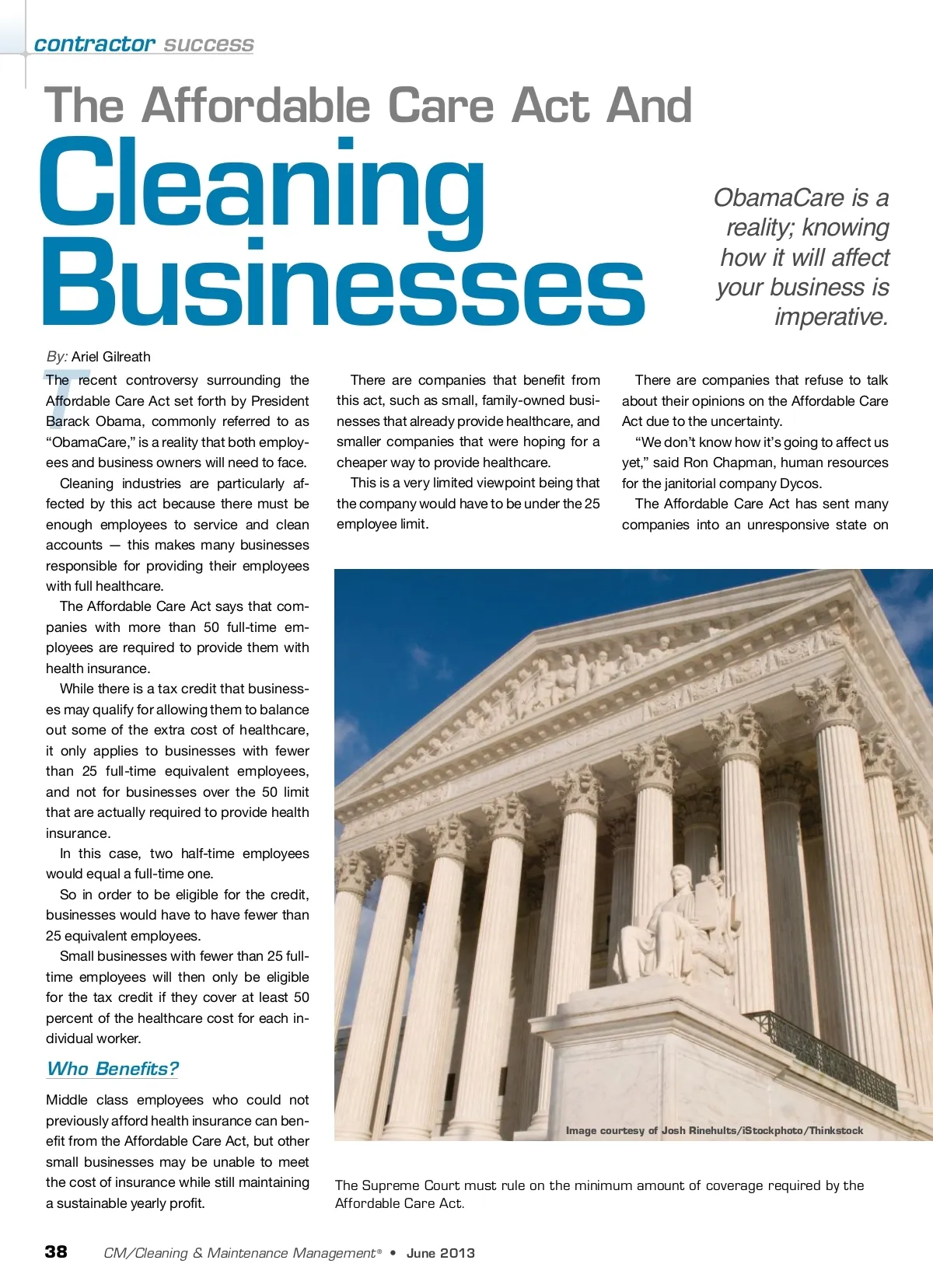
the matter, such as ABM Building Mainte-nance, Facility Services, Jani-King and In-terstate Solutions, who refuse to comment. Michael Hiles, vice president of sales and operations at Kelly’s Professional Cleaning Services Inc. (KPCS) said, “Most business-es are redirecting their hiring patterns from what constitutes full-time to part-time to try to stay in business.” The Penalty For Non-compliance The federal government cannot force all businesses to provide healthcare to their employees, but they can enact a tax on businesses that do not provide it. A similar example of this has to do with federal involvement in state laws. In 1985, the federal government created a law that said that any state with a legal drinking age under 21 would lose money from their highway funds given by the gov-ernment. Here is how the penalty would affect real businesses. KPCS Inc. is a janitorial business with 118 total employees; about 56 full-time and 62 part-time employees. The penalty cost of their business not providing health insurance to their employ-ees is anywhere from $2,000 to $3,000 per full-time employee per year. This penalty is only applied per full-time employee after the 30 mark. For every full-time employee after the first 30 employees, the company will be assessed a penalty for not following the Af-fordable Care Act. The added cost of healthcare or the add-ed cost of a penalty will cause small busi-nesses whose yearly profits fluctuate dra-matically to be wary of their end-of-the-year expense reports. This cost will have to be factored in, and businesses will more than likely need to acquire a stable number of accounts to make up for the cost, which is difficult since most accounts can decide to cancel at any time. Depending on the minimum amount of coverage the Supreme Court decides on, it may even save companies money to choose to pay the penalty over providing healthcare. “Our company would choose to pay the penalties as set forth under the law due to the cost savings as compared to a traditional health insurance plan. Even then, additional costs incurred with these penalties will have to be recovered from existing employees in the reduction of hours, wage rates and lay-offs creating uncertainty for all concerns,” explained Michael Hiles from KPCS Inc. The Affordable Care Act has been a con-troversy for the Republican and Democratic parties to argue about, along with employ-ees and employers who have their own per-spectives. However, some of the consequences make many business owners question whether or not the overall effect of the act will be positive. The Future Is Uncertain Metrolina Diversified Building Services not-ed that the Affordable Care Act would make their company consider changing their cur-rent hiring patterns. Some of the possibly dire consequences of this act come from the fact that many companies may try to get around it. In order to stay under the penalty limit, companies will have to either fire full-time employees or reduce their hours to make them part-time, causing many people to lose their jobs or lose a sustainable amount of pay. “Either way you look at it, our employees will have lost their ability to maintain the standard of living with which they are ac-customed, or the cost associated will jeop-ardize the level of profitability of the com-pany,” noted Hiles. Many details of the Affordable Care Act have yet to be hammered out, consider-ing the act will not go into effect until Janu-ary 2014. The general effect it will have on com-panies to provide healthcare is uncertain, considering the regulations concerning the minimum amount of coverage allowed has not been determined. A lot of companies have yet to make drastic decisions concerning the law in or-der to find out the court’s official ruling on the matter. The real concern lies on where the econo-my will stand when all is said and done. According to many companies, this law will redirect their business plans and cause them to be more hesitant with hir-ing and expanding, and could even lead to layoffs. Business owners and many entrepre-neurs argue that this consequence and hes-itation surrounding future investments and accounts, will greatly affect the economy. An economics professor at Winthrop Uni-versity, Robert Stonebraker said, “For the largest firms it isn’t going to matter because they are already providing health insurance, to them it is irrelevant. If I own a business with just over 50 employees, I must make a choice — offer health insurance or pay the penalty.” Businesses can consider lowering pay as an option to make up for the cost of health insurance for employees. “From an economics perspective, busi-nesses will need to decide either to of-fer health insurance or pay higher wages. Health insurance saves cost to employees, so even if their wage is lower due to the in-surance, they are still just as well off,” Stone-braker said. Businesses that do not provide higher wages or health insurance will have difficulty competing for employees with businesses that offer one of the options. The number of businesses in the range where there are more than 50 full-time em-ployees that are all paid minimum wage is small. “Less than five percent of employees are paid minimum wage, and most of them are part-time and not required to be provided health insurance,” Stonebraker said. The competitiveness of employees in an economy just out of recession may make it a necessary option for employers to decide between higher pay and healthcare. Even if employers choose to reduce their workers to part-time in order to get around the act, business owners must now face the imminent changes that will come with the Affordable Care Act at the start of 2014. CM Ariel Gilreath is a freelance writer and is cur-rently earning a B.A. in mass communication, journalism, at Winthrop University. She is from Greenville, South Carolina and was raised in a family that has owned a janitorial business for 25 years. To get in contact with Ariel, her email is [email protected]. www.cmmonline.com 39
CMM – Archives June 2013: 39