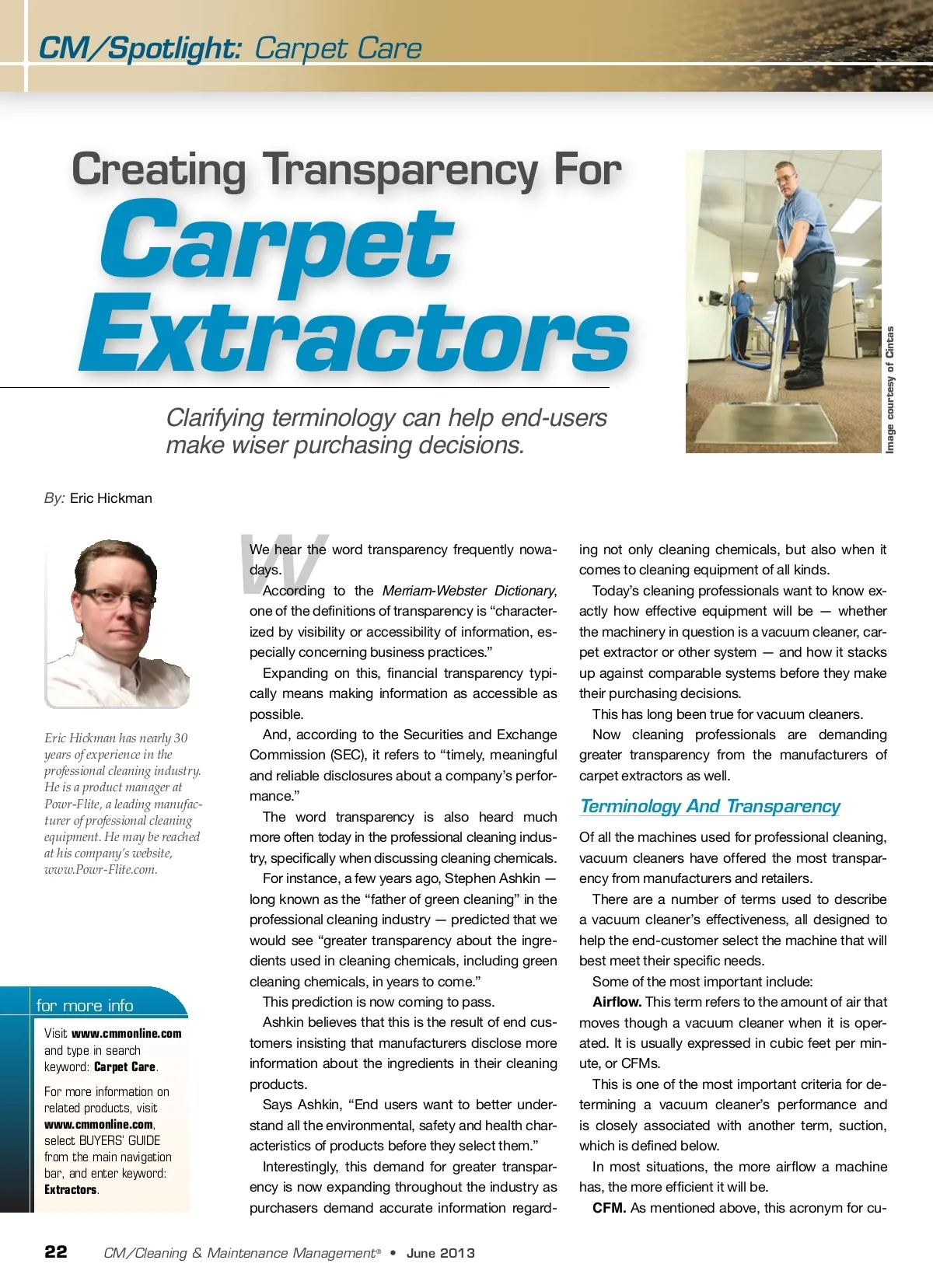
CM/Spotlight: Carpet Care Creating Transparency For Clarifying terminology can help end-users make wiser purchasing decisions. By: Eric Hickman W Eric Hickman has nearly 30 years of experience in the professional cleaning industry. He is a product manager at Powr-Flite, a leading manufac-turer of professional cleaning equipment. He may be reached at his company’s website, www.Powr-Flite.com. for more info Visit www.cmmonline.com and type in search keyword: Carpet Care . For more information on related products, visit www.cmmonline.com , select BUYERS’ GUIDE from the main navigation bar, and enter keyword: Extractors . We hear the word transparency frequently nowa-days. According to the Merriam-Webster Dictionary , one of the definitions of transparency is “character-ized by visibility or accessibility of information, es-pecially concerning business practices.” Expanding on this, financial transparency typi-cally means making information as accessible as possible. And, according to the Securities and Exchange Commission (SEC), it refers to “timely, meaningful and reliable disclosures about a company’s perfor-mance.” The word transparency is also heard much more often today in the professional cleaning indus-try, specifically when discussing cleaning chemicals. For instance, a few years ago, Stephen Ashkin — long known as the “father of green cleaning” in the professional cleaning industry — predicted that we would see “greater transparency about the ingre-dients used in cleaning chemicals, including green cleaning chemicals, in years to come.” This prediction is now coming to pass. Ashkin believes that this is the result of end cus-tomers insisting that manufacturers disclose more information about the ingredients in their cleaning products. Says Ashkin, “End users want to better under-stand all the environmental, safety and health char-acteristics of products before they select them.” Interestingly, this demand for greater transpar-ency is now expanding throughout the industry as purchasers demand accurate information regard-ing not only cleaning chemicals, but also when it comes to cleaning equipment of all kinds. Today’s cleaning professionals want to know ex-actly how effective equipment will be — whether the machinery in question is a vacuum cleaner, car-pet extractor or other system — and how it stacks up against comparable systems before they make their purchasing decisions. This has long been true for vacuum cleaners. Now cleaning professionals are demanding greater transparency from the manufacturers of carpet extractors as well. Terminology And Transparency Of all the machines used for professional cleaning, vacuum cleaners have offered the most transpar-ency from manufacturers and retailers. There are a number of terms used to describe a vacuum cleaner’s effectiveness, all designed to help the end-customer select the machine that will best meet their specific needs. Some of the most important include: Airflow. This term refers to the amount of air that moves though a vacuum cleaner when it is oper-ated. It is usually expressed in cubic feet per min-ute, or CFMs. This is one of the most important criteria for de-termining a vacuum cleaner’s performance and is closely associated with another term, suction, which is defined below. In most situations, the more airflow a machine has, the more efficient it will be. CFM. As mentioned above, this acronym for cu-22 CM/Cleaning & Maintenance Management ® • June 2013 Image courtesy of Cintas Carpet Extractors
CMM – Archives June 2013: 22