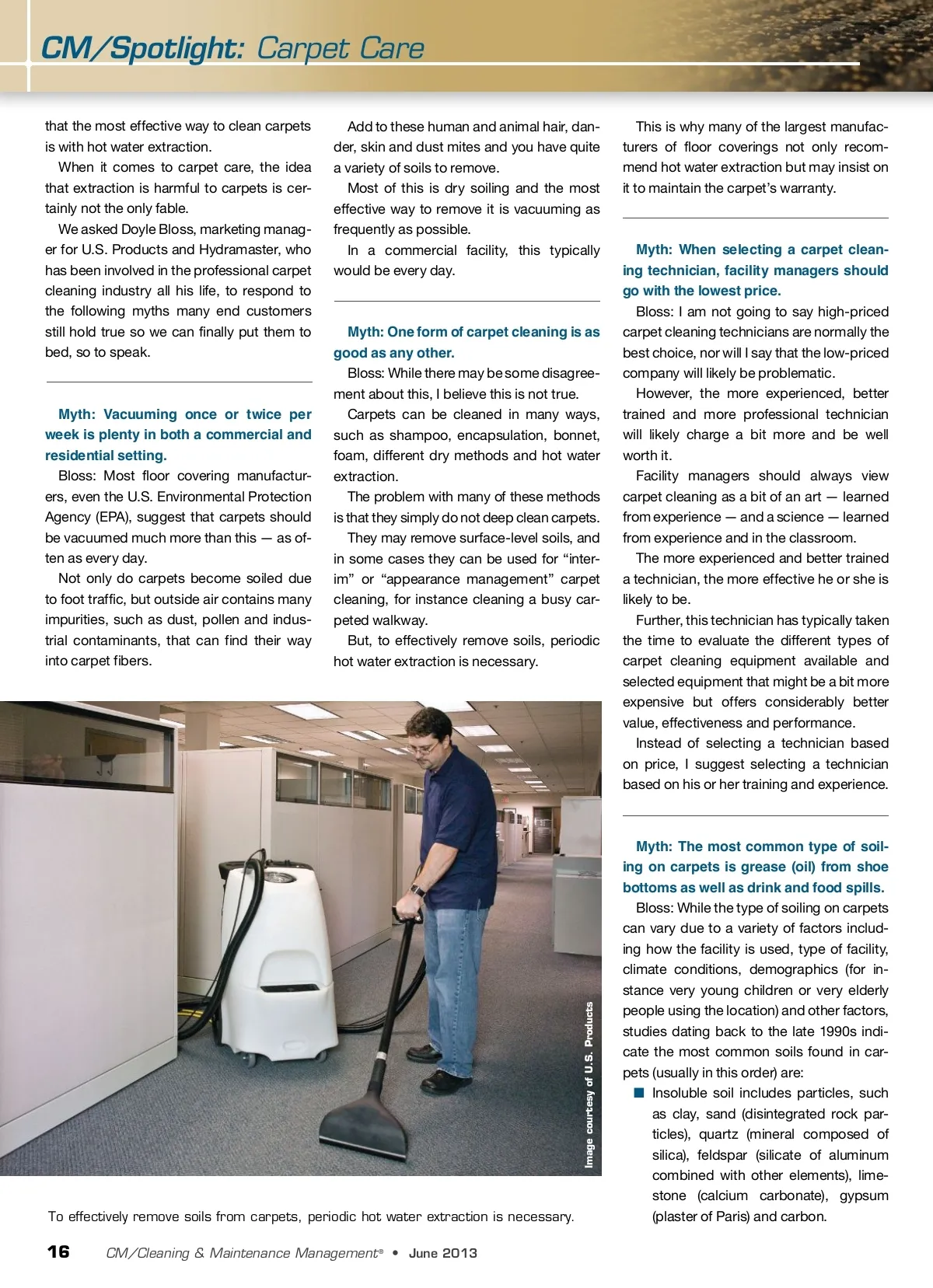
CM/Spotlight: Carpet Care that the most effective way to clean carpets is with hot water extraction. When it comes to carpet care, the idea that extraction is harmful to carpets is cer-tainly not the only fable. We asked Doyle Bloss, marketing manag-er for U.S. Products and Hydramaster, who has been involved in the professional carpet cleaning industry all his life, to respond to the following myths many end customers still hold true so we can finally put them to bed, so to speak. Add to these human and animal hair, dan-der, skin and dust mites and you have quite a variety of soils to remove. Most of this is dry soiling and the most effective way to remove it is vacuuming as frequently as possible. In a commercial facility, this typically would be every day. This is why many of the largest manufac-turers of floor coverings not only recom-mend hot water extraction but may insist on it to maintain the carpet’s warranty. Myth: Vacuuming once or twice per week is plenty in both a commercial and residential setting. Bloss: Most floor covering manufactur-ers, even the U.S. Environmental Protection Agency (EPA), suggest that carpets should be vacuumed much more than this — as of-ten as every day. Not only do carpets become soiled due to foot traffic, but outside air contains many impurities, such as dust, pollen and indus-trial contaminants, that can find their way into carpet fibers. Myth: One form of carpet cleaning is as good as any other. Bloss: While there may be some disagree-ment about this, I believe this is not true. Carpets can be cleaned in many ways, such as shampoo, encapsulation, bonnet, foam, different dry methods and hot water extraction. The problem with many of these methods is that they simply do not deep clean carpets. They may remove surface-level soils, and in some cases they can be used for “inter-im” or “appearance management” carpet cleaning, for instance cleaning a busy car-peted walkway. But, to effectively remove soils, periodic hot water extraction is necessary. Myth: When selecting a carpet clean-ing technician, facility managers should go with the lowest price. Bloss: I am not going to say high-priced carpet cleaning technicians are normally the best choice, nor will I say that the low-priced company will likely be problematic. However, the more experienced, better trained and more professional technician will likely charge a bit more and be well worth it. Facility managers should always view carpet cleaning as a bit of an art — learned from experience — and a science — learned from experience and in the classroom. The more experienced and better trained a technician, the more effective he or she is likely to be. Further, this technician has typically taken the time to evaluate the different types of carpet cleaning equipment available and selected equipment that might be a bit more expensive but offers considerably better value, effectiveness and performance. Instead of selecting a technician based on price, I suggest selecting a technician based on his or her training and experience. To effectively remove soils from carpets, periodic hot water extraction is necessary. Myth: The most common type of soil-ing on carpets is grease (oil) from shoe bottoms as well as drink and food spills. Bloss: While the type of soiling on carpets can vary due to a variety of factors includ-ing how the facility is used, type of facility, climate conditions, demographics (for in-stance very young children or very elderly people using the location) and other factors, studies dating back to the late 1990s indi-cate the most common soils found in car-pets (usually in this order) are: ■ Insoluble soil includes particles, such as clay, sand (disintegrated rock par-ticles), quartz (mineral composed of silica), feldspar (silicate of aluminum combined with other elements), lime-stone (calcium carbonate), gypsum (plaster of Paris) and carbon. 16 CM/Cleaning & Maintenance Management ® • June 2013 Image courtesy of U.S. Products
CMM – Archives June 2013: 16