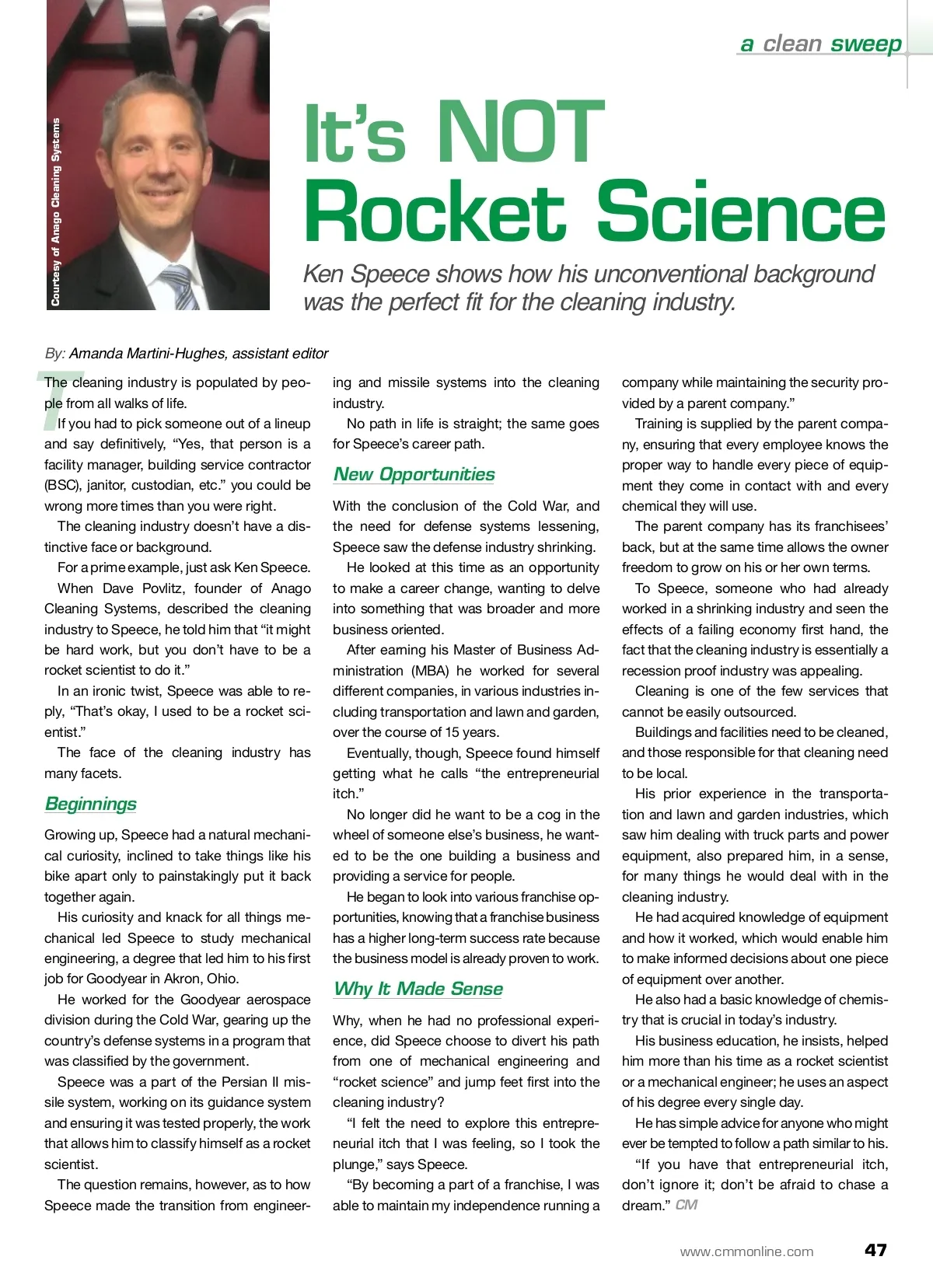
a clean sweep Courtesy of Anago Cleaning Systems It’s NOT Rocket Science Ken Speece shows how his unconventional background was the perfect fit for the cleaning industry. ing and missile systems into the cleaning industry. No path in life is straight; the same goes for Speece’s career path. company while maintaining the security pro-vided by a parent company.” Training is supplied by the parent compa-ny, ensuring that every employee knows the proper way to handle every piece of equip-ment they come in contact with and every chemical they will use. The parent company has its franchisees’ back, but at the same time allows the owner freedom to grow on his or her own terms. To Speece, someone who had already worked in a shrinking industry and seen the effects of a failing economy first hand, the fact that the cleaning industry is essentially a recession proof industry was appealing. Cleaning is one of the few services that cannot be easily outsourced. Buildings and facilities need to be cleaned, and those responsible for that cleaning need to be local. His prior experience in the transporta-tion and lawn and garden industries, which saw him dealing with truck parts and power equipment, also prepared him, in a sense, for many things he would deal with in the cleaning industry. He had acquired knowledge of equipment and how it worked, which would enable him to make informed decisions about one piece of equipment over another. He also had a basic knowledge of chemis-try that is crucial in today’s industry. His business education, he insists, helped him more than his time as a rocket scientist or a mechanical engineer; he uses an aspect of his degree every single day. He has simple advice for anyone who might ever be tempted to follow a path similar to his. “If you have that entrepreneurial itch, don’t ignore it; don’t be afraid to chase a dream.” CM www.cmmonline.com By: Amanda Martini-Hughes, assistant editor T The cleaning industry is populated by peo-ple from all walks of life. If you had to pick someone out of a lineup and say definitively, “Yes, that person is a facility manager, building service contractor (BSC), janitor, custodian, etc.” you could be wrong more times than you were right. The cleaning industry doesn’t have a dis-tinctive face or background. For a prime example, just ask Ken Speece. When Dave Povlitz, founder of Anago Cleaning Systems, described the cleaning industry to Speece, he told him that “it might be hard work, but you don’t have to be a rocket scientist to do it.” In an ironic twist, Speece was able to re-ply, “That’s okay, I used to be a rocket sci-entist.” The face of the cleaning industry has many facets. New Opportunities With the conclusion of the Cold War, and the need for defense systems lessening, Speece saw the defense industry shrinking. He looked at this time as an opportunity to make a career change, wanting to delve into something that was broader and more business oriented. After earning his Master of Business Ad-ministration (MBA) he worked for several different companies, in various industries in-cluding transportation and lawn and garden, over the course of 15 years. Eventually, though, Speece found himself getting what he calls “the entrepreneurial itch.” No longer did he want to be a cog in the wheel of someone else’s business, he want-ed to be the one building a business and providing a service for people. He began to look into various franchise op-portunities, knowing that a franchise business has a higher long-term success rate because the business model is already proven to work. Beginnings Growing up, Speece had a natural mechani-cal curiosity, inclined to take things like his bike apart only to painstakingly put it back together again. His curiosity and knack for all things me-chanical led Speece to study mechanical engineering, a degree that led him to his first job for Goodyear in Akron, Ohio. He worked for the Goodyear aerospace division during the Cold War, gearing up the country’s defense systems in a program that was classified by the government. Speece was a part of the Persian II mis-sile system, working on its guidance system and ensuring it was tested properly, the work that allows him to classify himself as a rocket scientist. The question remains, however, as to how Speece made the transition from engineer-Why It Made Sense Why, when he had no professional experi-ence, did Speece choose to divert his path from one of mechanical engineering and “rocket science” and jump feet first into the cleaning industry? “I felt the need to explore this entrepre-neurial itch that I was feeling, so I took the plunge,” says Speece. “By becoming a part of a franchise, I was able to maintain my independence running a 47
CMM – Archives July 2013: 47