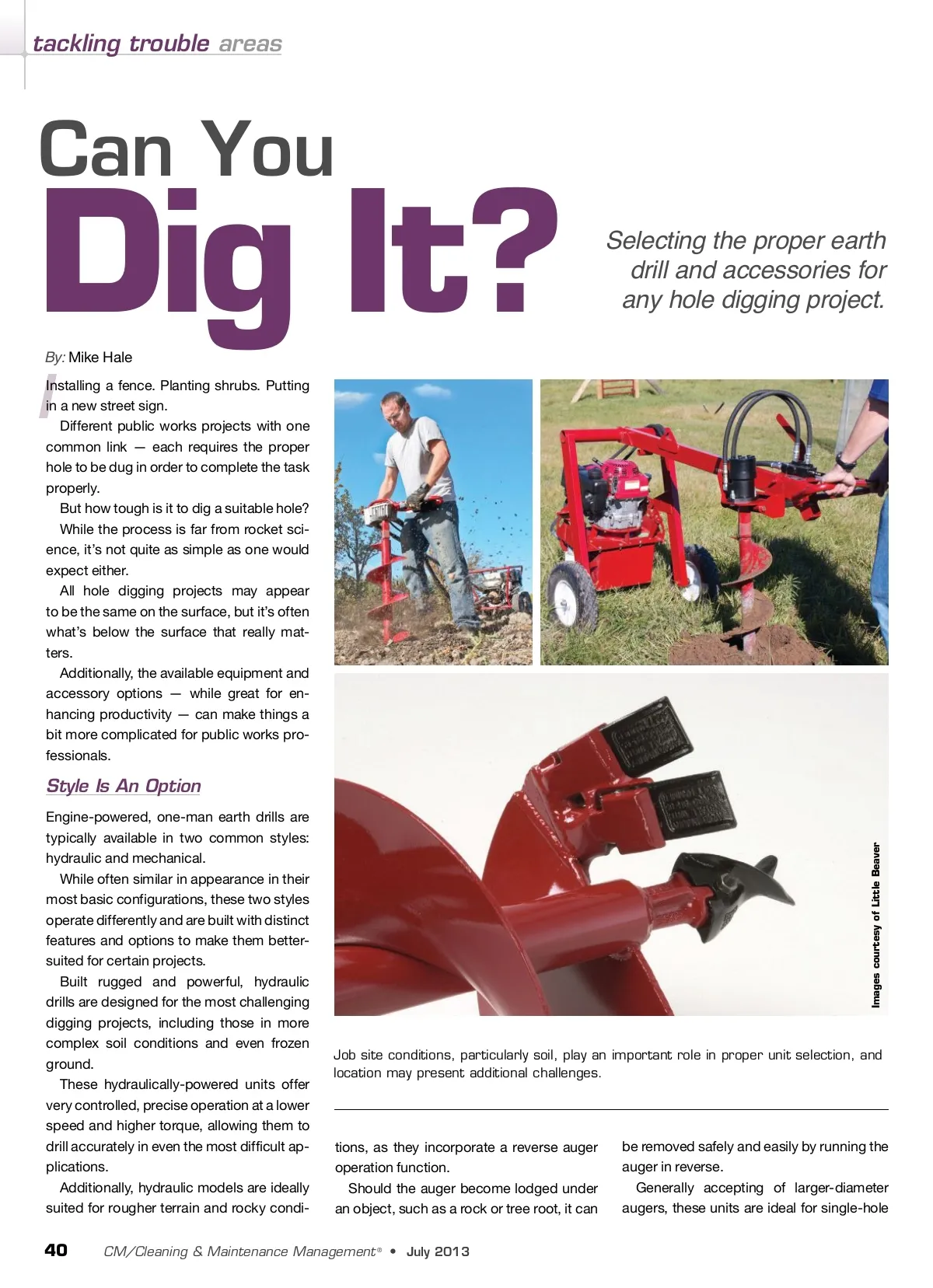
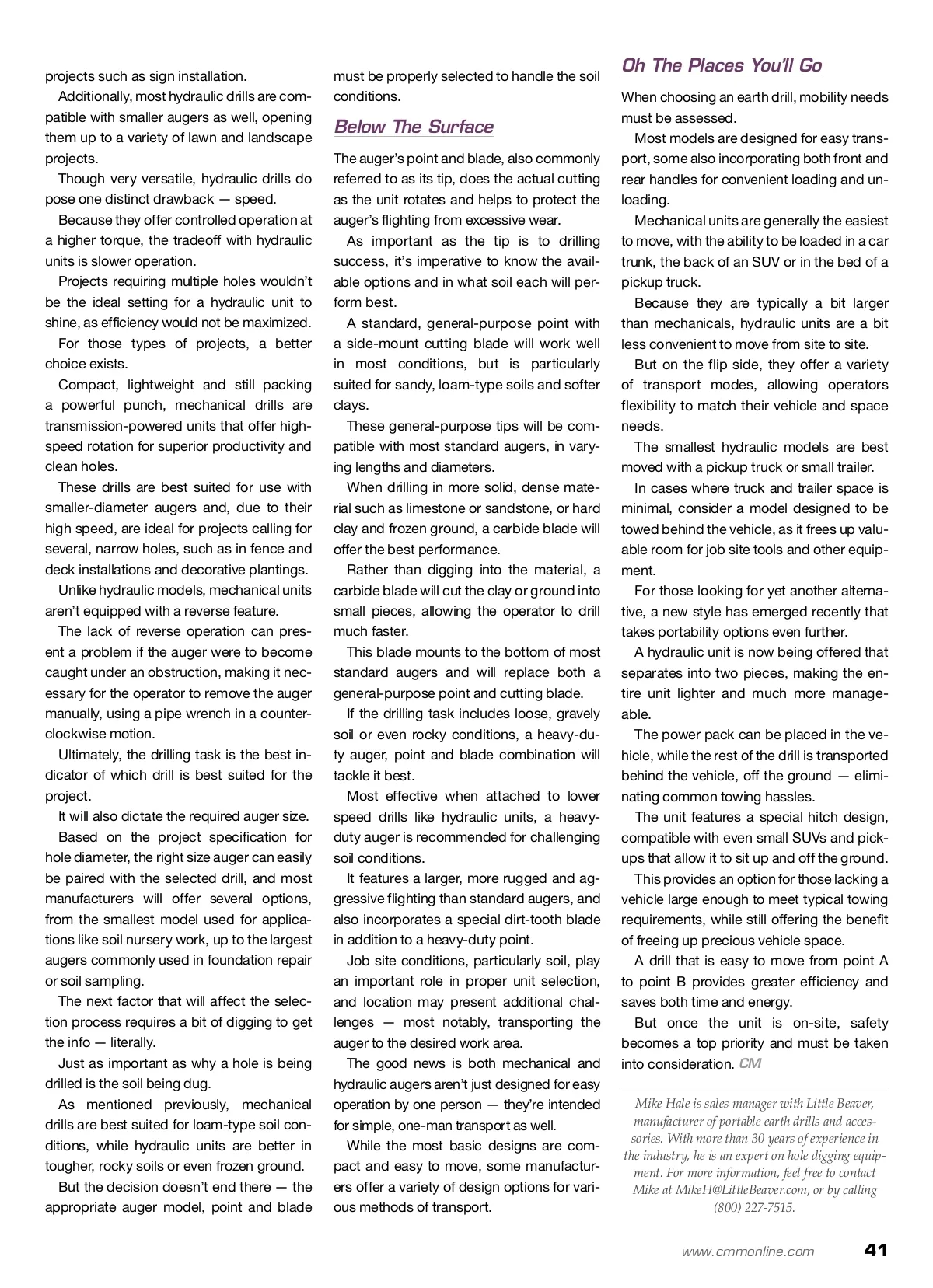
projects such as sign installation. Additionally, most hydraulic drills are com-patible with smaller augers as well, opening them up to a variety of lawn and landscape projects. Though very versatile, hydraulic drills do pose one distinct drawback — speed. Because they offer controlled operation at a higher torque, the tradeoff with hydraulic units is slower operation. Projects requiring multiple holes wouldn’t be the ideal setting for a hydraulic unit to shine, as efficiency would not be maximized. For those types of projects, a better choice exists. Compact, lightweight and still packing a powerful punch, mechanical drills are transmission-powered units that offer high-speed rotation for superior productivity and clean holes. These drills are best suited for use with smaller-diameter augers and, due to their high speed, are ideal for projects calling for several, narrow holes, such as in fence and deck installations and decorative plantings. Unlike hydraulic models, mechanical units aren’t equipped with a reverse feature. The lack of reverse operation can pres-ent a problem if the auger were to become caught under an obstruction, making it nec-essary for the operator to remove the auger manually, using a pipe wrench in a counter-clockwise motion. Ultimately, the drilling task is the best in-dicator of which drill is best suited for the project. It will also dictate the required auger size. Based on the project specification for hole diameter, the right size auger can easily be paired with the selected drill, and most manufacturers will offer several options, from the smallest model used for applica-tions like soil nursery work, up to the largest augers commonly used in foundation repair or soil sampling. The next factor that will affect the selec-tion process requires a bit of digging to get the info — literally. Just as important as why a hole is being drilled is the soil being dug. As mentioned previously, mechanical drills are best suited for loam-type soil con-ditions, while hydraulic units are better in tougher, rocky soils or even frozen ground. But the decision doesn’t end there — the appropriate auger model, point and blade must be properly selected to handle the soil conditions. Oh The Places You’ll Go When choosing an earth drill, mobility needs must be assessed. Most models are designed for easy trans-port, some also incorporating both front and rear handles for convenient loading and un-loading. Mechanical units are generally the easiest to move, with the ability to be loaded in a car trunk, the back of an SUV or in the bed of a pickup truck. Because they are typically a bit larger than mechanicals, hydraulic units are a bit less convenient to move from site to site. But on the flip side, they offer a variety of transport modes, allowing operators flexibility to match their vehicle and space needs. The smallest hydraulic models are best moved with a pickup truck or small trailer. In cases where truck and trailer space is minimal, consider a model designed to be towed behind the vehicle, as it frees up valu-able room for job site tools and other equip-ment. For those looking for yet another alterna-tive, a new style has emerged recently that takes portability options even further. A hydraulic unit is now being offered that separates into two pieces, making the en-tire unit lighter and much more manage-able. The power pack can be placed in the ve-hicle, while the rest of the drill is transported behind the vehicle, off the ground — elimi-nating common towing hassles. The unit features a special hitch design, compatible with even small SUVs and pick-ups that allow it to sit up and off the ground. This provides an option for those lacking a vehicle large enough to meet typical towing requirements, while still offering the benefit of freeing up precious vehicle space. A drill that is easy to move from point A to point B provides greater efficiency and saves both time and energy. But once the unit is on-site, safety becomes a top priority and must be taken into consideration. CM Mike Hale is sales manager with Little Beaver, manufacturer of portable earth drills and acces-sories. With more than 30 years of experience in the industry, he is an expert on hole digging equip-ment. For more information, feel free to contact Mike at [email protected], or by calling (800) 227-7515. www.cmmonline.com Below The Surface The auger’s point and blade, also commonly referred to as its tip, does the actual cutting as the unit rotates and helps to protect the auger’s flighting from excessive wear. As important as the tip is to drilling success, it’s imperative to know the avail-able options and in what soil each will per-form best. A standard, general-purpose point with a side-mount cutting blade will work well in most conditions, but is particularly suited for sandy, loam-type soils and softer clays. These general-purpose tips will be com-patible with most standard augers, in vary-ing lengths and diameters. When drilling in more solid, dense mate-rial such as limestone or sandstone, or hard clay and frozen ground, a carbide blade will offer the best performance. Rather than digging into the material, a carbide blade will cut the clay or ground into small pieces, allowing the operator to drill much faster. This blade mounts to the bottom of most standard augers and will replace both a general-purpose point and cutting blade. If the drilling task includes loose, gravely soil or even rocky conditions, a heavy-du-ty auger, point and blade combination will tackle it best. Most effective when attached to lower speed drills like hydraulic units, a heavy-duty auger is recommended for challenging soil conditions. It features a larger, more rugged and ag-gressive flighting than standard augers, and also incorporates a special dirt-tooth blade in addition to a heavy-duty point. Job site conditions, particularly soil, play an important role in proper unit selection, and location may present additional chal-lenges — most notably, transporting the auger to the desired work area. The good news is both mechanical and hydraulic augers aren’t just designed for easy operation by one person — they’re intended for simple, one-man transport as well. While the most basic designs are com-pact and easy to move, some manufactur-ers offer a variety of design options for vari-ous methods of transport. 41
CMM – Archives July 2013: 41