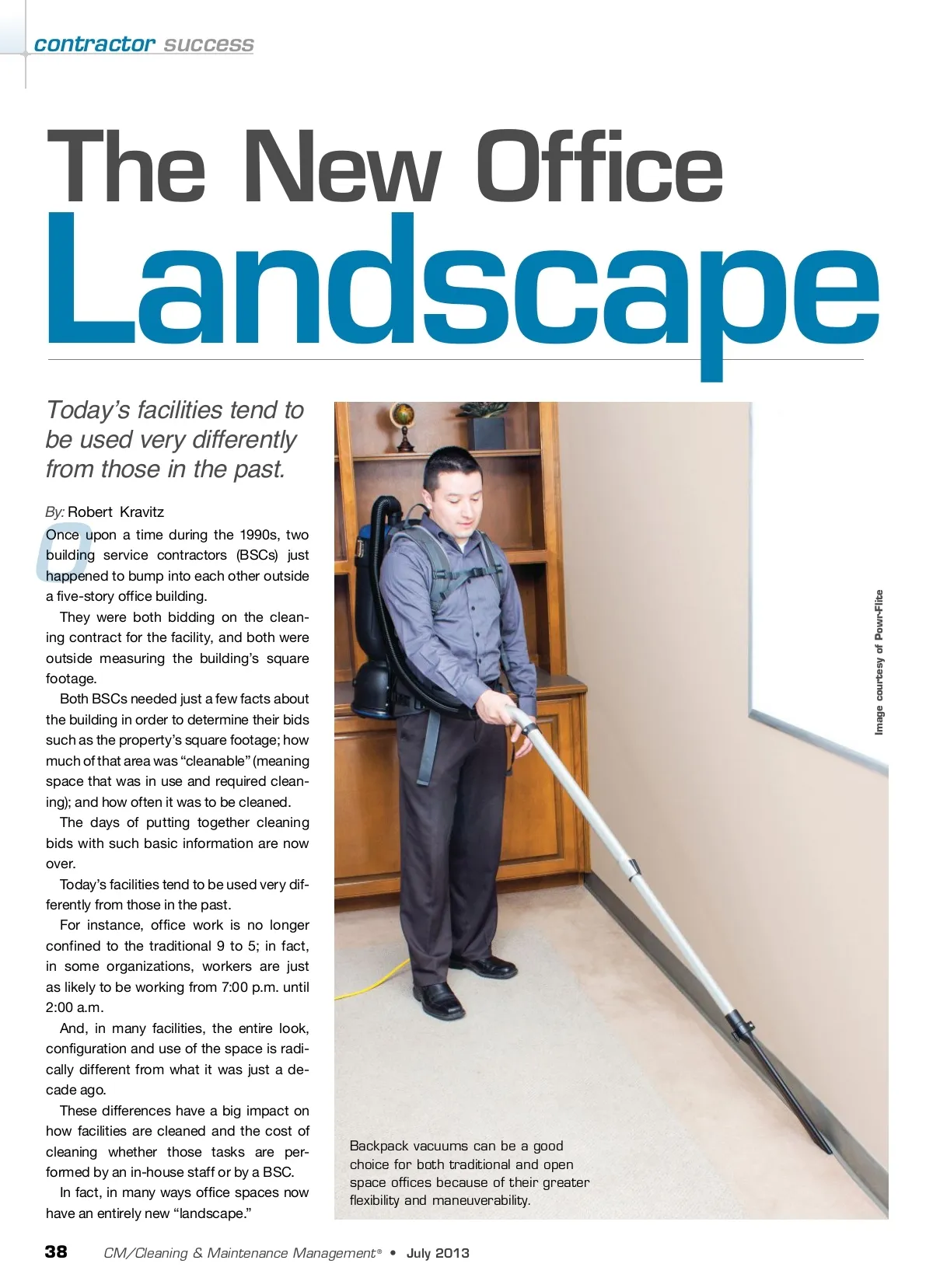
Traditional Office Space The period beginning shortly after World War II and extending into the 1990s was one of the most prosperous in U.S. history. This prosperity resulted in a building boom throughout the country spurred by the market to house both new and growing companies. This obviously also created many oppor-tunities for BSCs. These traditional office facilities were much alike and were usually composed of two essential parts: Rows and rows of work stations in the center of the work space sur-rounded by private executive offices with large windows around the exterior. Staff came in at around 8 or 9 a.m. and left around 5 p.m. A perfect example of this is the office de-sign used in the television series Mad Men , the period drama set during the early 1960s. Because most office facilities followed this same design configuration, most BSCs had a one-way-fits-all bidding procedure, estimating costs using little more than the square footage of the facility. Today, these assumptions no longer ap-ply to office space or the BSCs that maintain them. A new approach to office configuration, which may have gotten its start in Silicon Valley during the 1990s, is now being ad-opted by all kinds of companies, from soft-ware makers to law firms and advertising companies. Many businesses have found that work-ers are happier, more creative, more inno-vative and more productive when they work together in an environment in which sponta-neous collaboration is not only possible, but encouraged. This new style of office usage is called “open design” or “open concept” office space. Open design facilities often have very few walls, even in executive spaces; the work space is divided into grouped sections with or without partitions separating work sta-tions. Further, big conference rooms have gen-erally been reconfigured with tables lined with chairs and couches rather than one large table. The ways in which workers use these spaces have changed as well. For millions of office workers, the era of the typical 9 to 5 workday is over. Increasing numbers of workers are now working more flexible hours and/or telecom-muting, changes that have proven advanta-geous for many businesses and their staffs.* Cleaning Open Design Office Spaces “While cleaning contractors can still use the square footage, cleanable office space and other criteria mentioned earlier to base their charges, these figures are now a smaller piece of the pie,” says Eric Hickman, a cleaning consultant and a product manager for Powr-Flite. “There are now many other components involved in the bidding pro-cess.” For instance, Hickman says BSCs need to consider the following: ■ How many people actually use the facility on a regular basis? This is referred to as the facility’s density. ■ Is the office area composed of row after row of work stations, or are there clusters of work spaces with lots of open areas in between? This is referred to as the facility’s layout. ■ Exactly what cleaning is expected at the various kinds of work stations, and how often? ■ Are workers assigned specific desk spaces? Some offices now assign space on a first-come-first-served basis. This last issue is another change fostered by the switch to spontaneous, collaborative office landscapes. “Very often, if someone has their own assigned desk, they take ownership of it and take better care of it,” says Hickman. “If desks are randomly chosen, ownership, care and attention often go out the window. And this can increase the work load for the cleaning worker.” As to the actual cleaning, Hickman says open work spaces often require more time and attention to clean each work station (if this is included in the contract). With people sitting anywhere they want, infection control measures, especially on desk surfaces, must be increased, “prob-ably quite significantly,” adds Hickman. The use of traditional upright vacuum cleaners may also fall by the wayside in this new office landscape. “If there are lots of work stations or clus-ters of work stations, these all become im-pediments to traditional vacuuming with an upright, which can slow down the cleaning process significantly.” Hickman believes backpacks work well in more traditional, congested, as well as open space offices because of their greater flex-ibility and maneuverability. “Studies indicate that a backpack will like-ly help improve worker productivity in all of these settings,” Hickman explains. “Select-ing a lighter, quieter and more comfortable to wear backpack will surely be necessary. Systems that allow quick access to tools and accessories also can reduce vacuum-ing times” Manager Expectations About 20 years ago, the manager of a bank in Northern California told her new cleaning contractor that the first thing she did when entering her branch in the morning was to put on white gloves (literally) and check that the desks, teller area and restrooms, along with floors and carpets, were all spotless. One downside of the new open-design office landscape is that this kind of strictly scheduled attention to cleanliness may no longer apply. With workers coming and going at differ-ent times, areas that have just been cleaned can be quickly soiled again through use. Instead of expecting spotless cleaning, managers should focus on whether certain “standards of cleanliness” are being main-tained. This might include, for example, if desks are cleaned and/or disinfected daily; if all trash is removed; if all carpeted areas are vacuumed daily; whether floors and rest-rooms have been cleaned daily; etc. “The goal will be to make the facility as clean and healthy as possible while realizing it is being used far differently today than a decade or more ago,” says Hickman. *As of 2011, it is estimated that as many as 20 to 30 million American workers work from home at least one day per week. Source: Global Workplace Analytics. CM Robert Kravitz is a former building service contrac-tor and now a writer for the professional cleaning and building industries. He may be reached at [email protected] www.cmmonline.com 39
CMM – Archives July 2013: 39