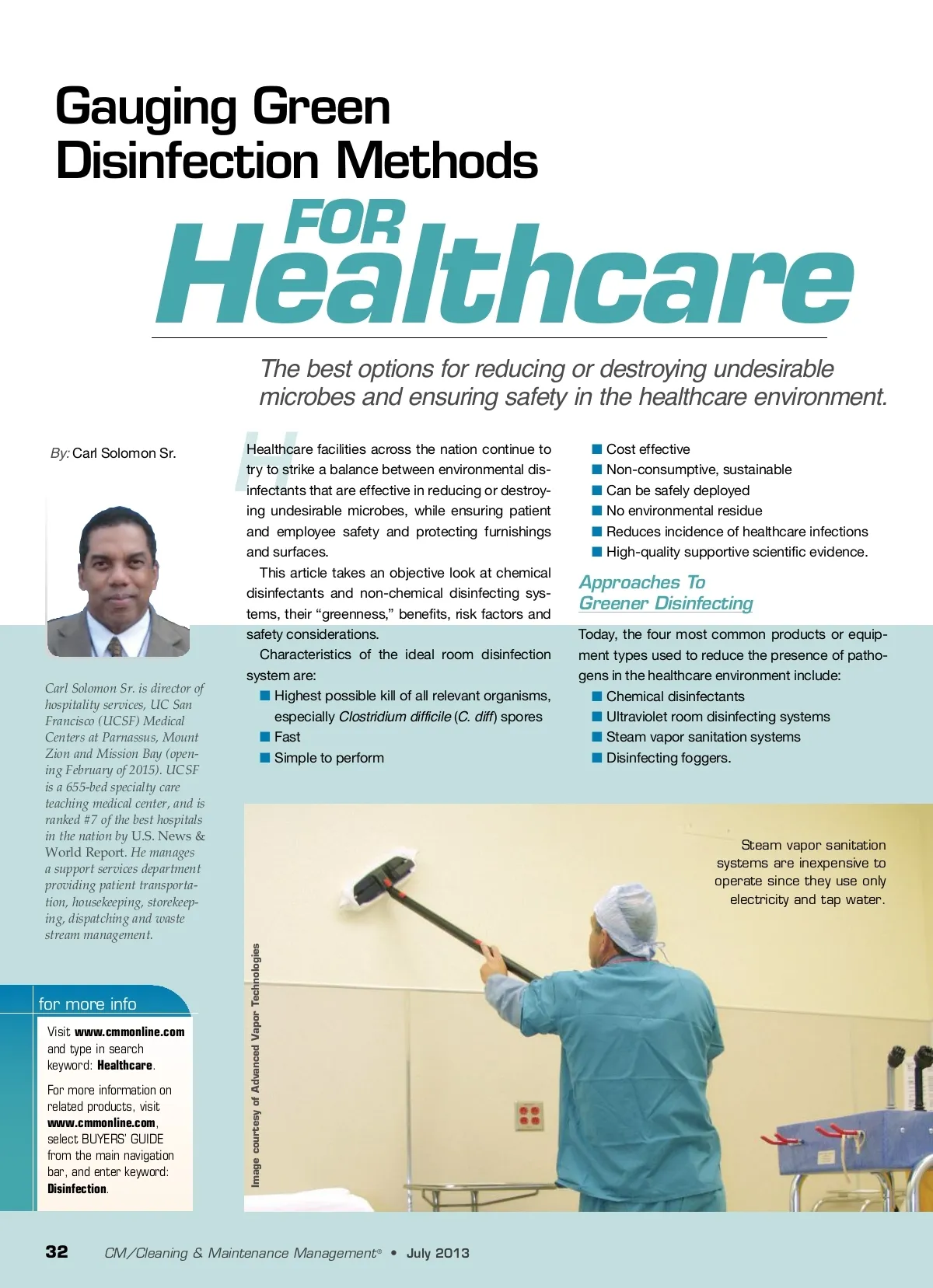
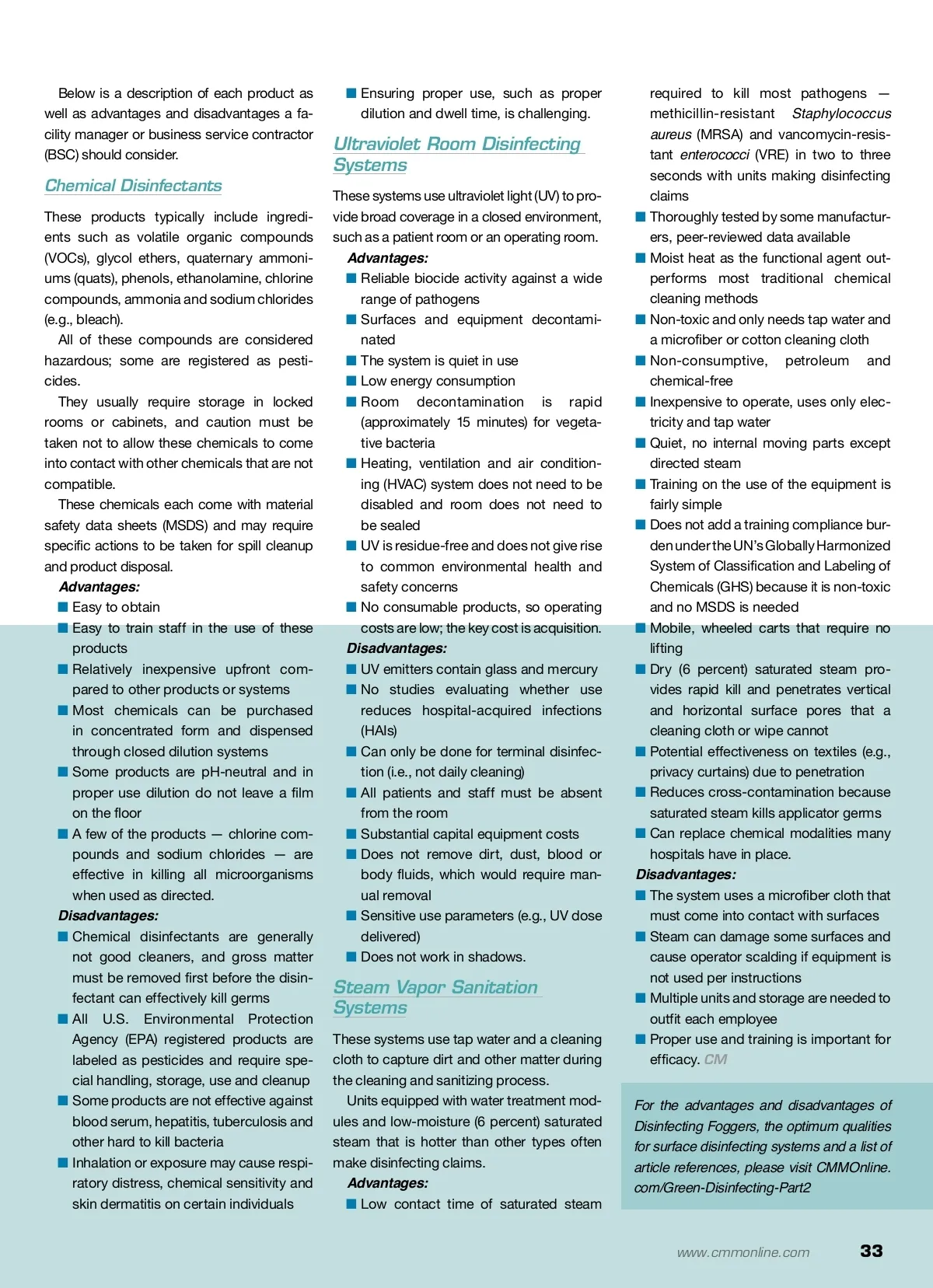
Below is a description of each product as well as advantages and disadvantages a fa-cility manager or business service contractor (BSC) should consider. ■ Ensuring proper use, such as proper dilution and dwell time, is challenging. Ultraviolet Room Disinfecting Systems These systems use ultraviolet light (UV) to pro-vide broad coverage in a closed environment, such as a patient room or an operating room. Advantages: ■ Reliable biocide activity against a wide range of pathogens ■ Surfaces and equipment decontami-nated ■ The system is quiet in use ■ Low energy consumption ■ Room decontamination is rapid (approximately 15 minutes) for vegeta-tive bacteria ■ Heating, ventilation and air condition-ing (HVAC) system does not need to be disabled and room does not need to be sealed ■ UV is residue-free and does not give rise to common environmental health and safety concerns ■ No consumable products, so operating costs are low; the key cost is acquisition. Disadvantages: ■ UV emitters contain glass and mercury ■ No studies evaluating whether use reduces hospital-acquired infections (HAIs) ■ Can only be done for terminal disinfec-tion (i.e., not daily cleaning) ■ All patients and staff must be absent from the room ■ Substantial capital equipment costs ■ Does not remove dirt, dust, blood or body fluids, which would require man-ual removal ■ Sensitive use parameters (e.g., UV dose delivered) ■ Does not work in shadows. Chemical Disinfectants These products typically include ingredi-ents such as volatile organic compounds (VOCs), glycol ethers, quaternary ammoni-ums (quats), phenols, ethanolamine, chlorine compounds, ammonia and sodium chlorides (e.g., bleach). All of these compounds are considered hazardous; some are registered as pesti-cides. They usually require storage in locked rooms or cabinets, and caution must be taken not to allow these chemicals to come into contact with other chemicals that are not compatible. These chemicals each come with material safety data sheets (MSDS) and may require specific actions to be taken for spill cleanup and product disposal. Advantages: ■ Easy to obtain ■ Easy to train staff in the use of these products ■ Relatively inexpensive upfront com-pared to other products or systems ■ Most chemicals can be purchased in concentrated form and dispensed through closed dilution systems ■ Some products are pH-neutral and in proper use dilution do not leave a film on the floor ■ A few of the products — chlorine com-pounds and sodium chlorides — are effective in killing all microorganisms when used as directed. Disadvantages: ■ Chemical disinfectants are generally not good cleaners, and gross matter must be removed first before the disin-fectant can effectively kill germs ■ All U.S. Environmental Protection Agency (EPA) registered products are labeled as pesticides and require spe-cial handling, storage, use and cleanup ■ Some products are not effective against blood serum, hepatitis, tuberculosis and other hard to kill bacteria ■ Inhalation or exposure may cause respi-ratory distress, chemical sensitivity and skin dermatitis on certain individuals Steam Vapor Sanitation Systems These systems use tap water and a cleaning cloth to capture dirt and other matter during the cleaning and sanitizing process. Units equipped with water treatment mod-ules and low-moisture (6 percent) saturated steam that is hotter than other types often make disinfecting claims. Advantages: ■ Low contact time of saturated steam required to kill most pathogens — methicillin-resistant Staphylococcus aureus (MRSA) and vancomycin-resis-tant enterococci (VRE) in two to three seconds with units making disinfecting claims ■ Thoroughly tested by some manufactur-ers, peer-reviewed data available ■ Moist heat as the functional agent out-performs most traditional chemical cleaning methods ■ Non-toxic and only needs tap water and a microfiber or cotton cleaning cloth ■ Non-consumptive, petroleum and chemical-free ■ Inexpensive to operate, uses only elec-tricity and tap water ■ Quiet, no internal moving parts except directed steam ■ Training on the use of the equipment is fairly simple ■ Does not add a training compliance bur-den under the UN’s Globally Harmonized System of Classification and Labeling of Chemicals (GHS) because it is non-toxic and no MSDS is needed ■ Mobile, wheeled carts that require no lifting ■ Dry (6 percent) saturated steam pro-vides rapid kill and penetrates vertical and horizontal surface pores that a cleaning cloth or wipe cannot ■ Potential effectiveness on textiles (e.g., privacy curtains) due to penetration ■ Reduces cross-contamination because saturated steam kills applicator germs ■ Can replace chemical modalities many hospitals have in place. Disadvantages: ■ The system uses a microfiber cloth that must come into contact with surfaces ■ Steam can damage some surfaces and cause operator scalding if equipment is not used per instructions ■ Multiple units and storage are needed to outfit each employee ■ Proper use and training is important for efficacy. CM For the advantages and disadvantages of Disinfecting Foggers, the optimum qualities for surface disinfecting systems and a list of article references, please visit CMMOnline. com/Green-Disinfecting-Part2 www.cmmonline.com 33
CMM – Archives July 2013: 33