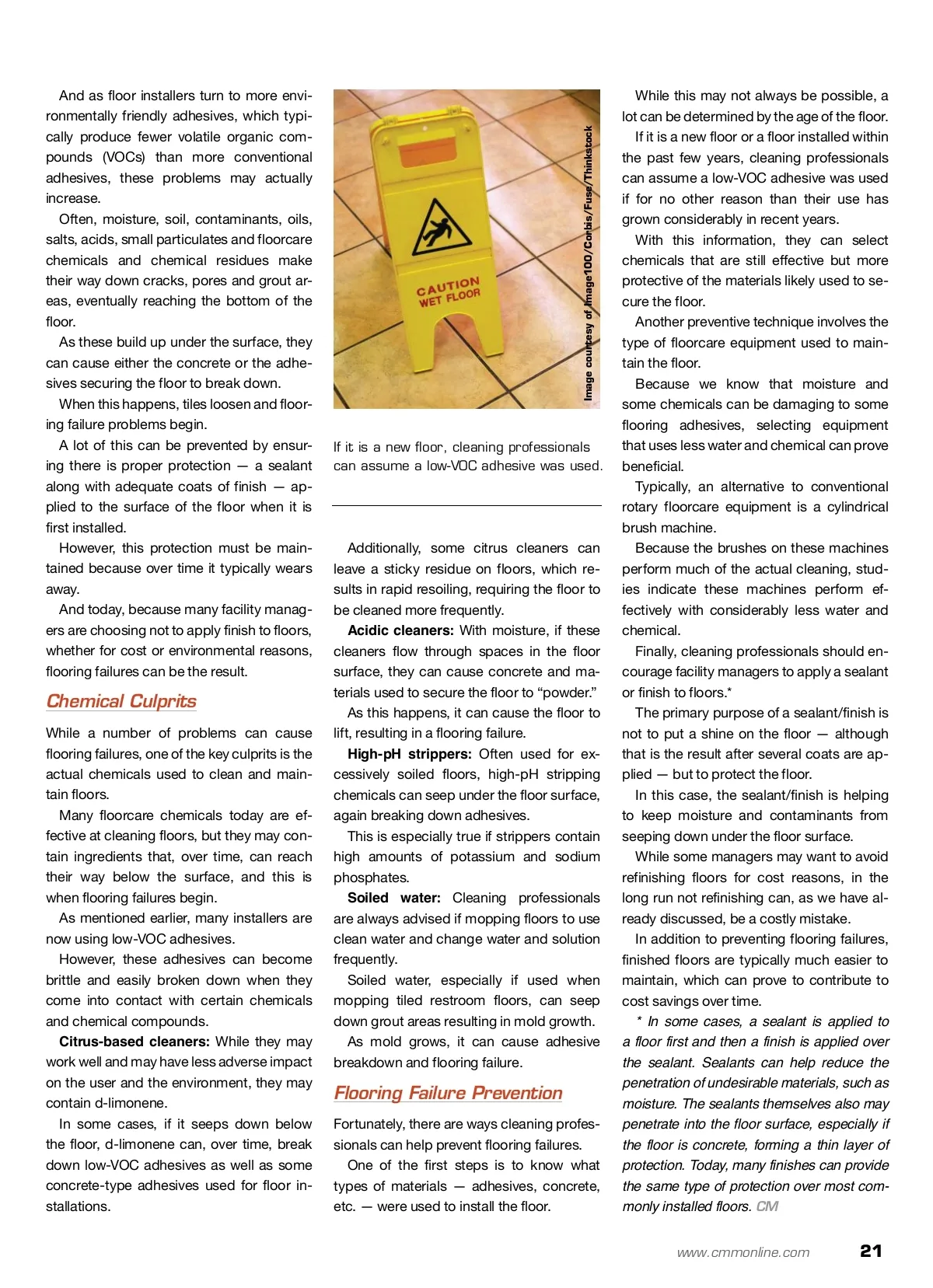
And as floor installers turn to more envi-ronmentally friendly adhesives, which typi-cally produce fewer volatile organic com-pounds (VOCs) than more conventional adhesives, these problems may actually increase. Often, moisture, soil, contaminants, oils, salts, acids, small particulates and floorcare chemicals and chemical residues make their way down cracks, pores and grout ar-eas, eventually reaching the bottom of the floor. As these build up under the surface, they can cause either the concrete or the adhe-sives securing the floor to break down. When this happens, tiles loosen and floor-ing failure problems begin. A lot of this can be prevented by ensur-ing there is proper protection — a sealant along with adequate coats of finish — ap-plied to the surface of the floor when it is first installed. However, this protection must be main-tained because over time it typically wears away. And today, because many facility manag-ers are choosing not to apply finish to floors, whether for cost or environmental reasons, flooring failures can be the result. If it is a new floor, cleaning professionals can assume a low-VOC adhesive was used. Chemical Culprits While a number of problems can cause flooring failures, one of the key culprits is the actual chemicals used to clean and main-tain floors. Many floorcare chemicals today are ef-fective at cleaning floors, but they may con-tain ingredients that, over time, can reach their way below the surface, and this is when flooring failures begin. As mentioned earlier, many installers are now using low-VOC adhesives. However, these adhesives can become brittle and easily broken down when they come into contact with certain chemicals and chemical compounds. Citrus-based cleaners: While they may work well and may have less adverse impact on the user and the environment, they may contain d-limonene. In some cases, if it seeps down below the floor, d-limonene can, over time, break down low-VOC adhesives as well as some concrete-type adhesives used for floor in-stallations. Additionally, some citrus cleaners can leave a sticky residue on floors, which re-sults in rapid resoiling, requiring the floor to be cleaned more frequently. Acidic cleaners: With moisture, if these cleaners flow through spaces in the floor surface, they can cause concrete and ma-terials used to secure the floor to “powder.” As this happens, it can cause the floor to lift, resulting in a flooring failure. High-pH strippers: Often used for ex-cessively soiled floors, high-pH stripping chemicals can seep under the floor surface, again breaking down adhesives. This is especially true if strippers contain high amounts of potassium and sodium phosphates. Soiled water: Cleaning professionals are always advised if mopping floors to use clean water and change water and solution frequently. Soiled water, especially if used when mopping tiled restroom floors, can seep down grout areas resulting in mold growth. As mold grows, it can cause adhesive breakdown and flooring failure. Flooring Failure Prevention Fortunately, there are ways cleaning profes-sionals can help prevent flooring failures. One of the first steps is to know what types of materials — adhesives, concrete, etc. — were used to install the floor. While this may not always be possible, a lot can be determined by the age of the floor. If it is a new floor or a floor installed within the past few years, cleaning professionals can assume a low-VOC adhesive was used if for no other reason than their use has grown considerably in recent years. With this information, they can select chemicals that are still effective but more protective of the materials likely used to se-cure the floor. Another preventive technique involves the type of floorcare equipment used to main-tain the floor. Because we know that moisture and some chemicals can be damaging to some flooring adhesives, selecting equipment that uses less water and chemical can prove beneficial. Typically, an alternative to conventional rotary floorcare equipment is a cylindrical brush machine. Because the brushes on these machines perform much of the actual cleaning, stud-ies indicate these machines perform ef-fectively with considerably less water and chemical. Finally, cleaning professionals should en-courage facility managers to apply a sealant or finish to floors.* The primary purpose of a sealant/finish is not to put a shine on the floor — although that is the result after several coats are ap-plied — but to protect the floor. In this case, the sealant/finish is helping to keep moisture and contaminants from seeping down under the floor surface. While some managers may want to avoid refinishing floors for cost reasons, in the long run not refinishing can, as we have al-ready discussed, be a costly mistake. In addition to preventing flooring failures, finished floors are typically much easier to maintain, which can prove to contribute to cost savings over time. * In some cases, a sealant is applied to a floor first and then a finish is applied over the sealant. Sealants can help reduce the penetration of undesirable materials, such as moisture. The sealants themselves also may penetrate into the floor surface, especially if the floor is concrete, forming a thin layer of protection. Today, many finishes can provide the same type of protection over most com-monly installed floors. CM www.cmmonline.com Image courtesy of Image100/Corbis/Fuse/Thinkstock 21
CMM – Archives July 2013: 21