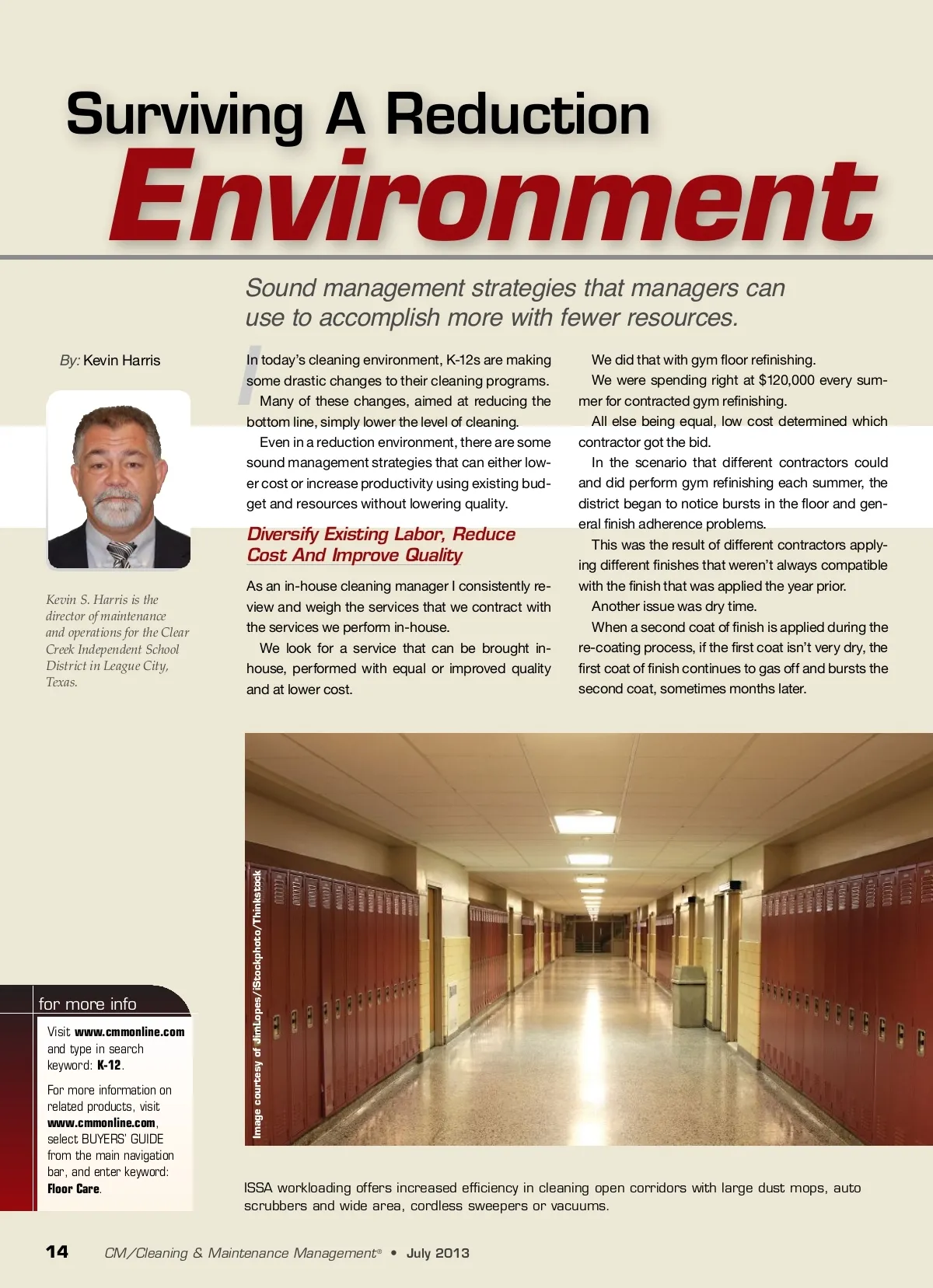
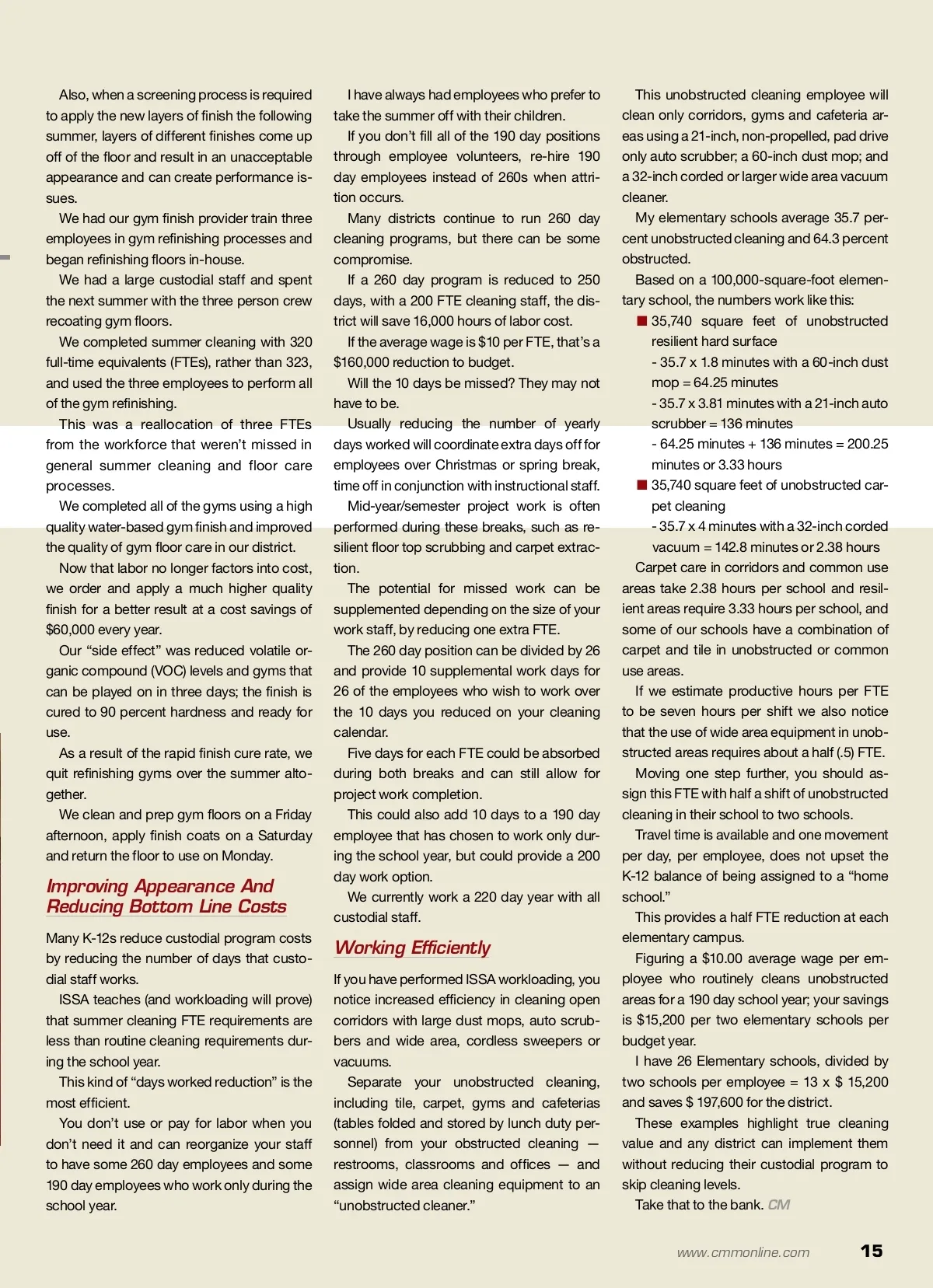
Also, when a screening process is required to apply the new layers of finish the following summer, layers of different finishes come up off of the floor and result in an unacceptable appearance and can create performance is-sues. We had our gym finish provider train three employees in gym refinishing processes and began refinishing floors in-house. We had a large custodial staff and spent the next summer with the three person crew recoating gym floors. We completed summer cleaning with 320 full-time equivalents (FTEs), rather than 323, and used the three employees to perform all of the gym refinishing. This was a reallocation of three FTEs from the workforce that weren’t missed in general summer cleaning and floor care processes. We completed all of the gyms using a high quality water-based gym finish and improved the quality of gym floor care in our district. Now that labor no longer factors into cost, we order and apply a much higher quality finish for a better result at a cost savings of $60,000 every year. Our “side effect” was reduced volatile or-ganic compound (VOC) levels and gyms that can be played on in three days; the finish is cured to 90 percent hardness and ready for use. As a result of the rapid finish cure rate, we quit refinishing gyms over the summer alto-gether. We clean and prep gym floors on a Friday afternoon, apply finish coats on a Saturday and return the floor to use on Monday. Improving Appearance And Reducing Bottom Line Costs Many K-12s reduce custodial program costs by reducing the number of days that custo-dial staff works. ISSA teaches (and workloading will prove) that summer cleaning FTE requirements are less than routine cleaning requirements dur-ing the school year. This kind of “days worked reduction” is the most efficient. You don’t use or pay for labor when you don’t need it and can reorganize your staff to have some 260 day employees and some 190 day employees who work only during the school year. I have always had employees who prefer to take the summer off with their children. If you don’t fill all of the 190 day positions through employee volunteers, re-hire 190 day employees instead of 260s when attri-tion occurs. Many districts continue to run 260 day cleaning programs, but there can be some compromise. If a 260 day program is reduced to 250 days, with a 200 FTE cleaning staff, the dis-trict will save 16,000 hours of labor cost. If the average wage is $10 per FTE, that’s a $160,000 reduction to budget. Will the 10 days be missed? They may not have to be. Usually reducing the number of yearly days worked will coordinate extra days off for employees over Christmas or spring break, time off in conjunction with instructional staff. Mid-year/semester project work is often performed during these breaks, such as re-silient floor top scrubbing and carpet extrac-tion. The potential for missed work can be supplemented depending on the size of your work staff, by reducing one extra FTE. The 260 day position can be divided by 26 and provide 10 supplemental work days for 26 of the employees who wish to work over the 10 days you reduced on your cleaning calendar. Five days for each FTE could be absorbed during both breaks and can still allow for project work completion. This could also add 10 days to a 190 day employee that has chosen to work only dur-ing the school year, but could provide a 200 day work option. We currently work a 220 day year with all custodial staff. Working Efficiently If you have performed ISSA workloading, you notice increased efficiency in cleaning open corridors with large dust mops, auto scrub-bers and wide area, cordless sweepers or vacuums. Separate your unobstructed cleaning, including tile, carpet, gyms and cafeterias (tables folded and stored by lunch duty per-sonnel) from your obstructed cleaning — restrooms, classrooms and offices — and assign wide area cleaning equipment to an “unobstructed cleaner.” This unobstructed cleaning employee will clean only corridors, gyms and cafeteria ar-eas using a 21-inch, non-propelled, pad drive only auto scrubber; a 60-inch dust mop; and a 32-inch corded or larger wide area vacuum cleaner. My elementary schools average 35.7 per-cent unobstructed cleaning and 64.3 percent obstructed. Based on a 100,000-square-foot elemen-tary school, the numbers work like this: ■ 35,740 square feet of unobstructed resilient hard surface -35.7 x 1.8 minutes with a 60-inch dust mop = 64.25 minutes -35.7 x 3.81 minutes with a 21-inch auto scrubber = 136 minutes -64.25 minutes + 136 minutes = 200.25 minutes or 3.33 hours ■ 35,740 square feet of unobstructed car-pet cleaning -35.7 x 4 minutes with a 32-inch corded vacuum = 142.8 minutes or 2.38 hours Carpet care in corridors and common use areas take 2.38 hours per school and resil-ient areas require 3.33 hours per school, and some of our schools have a combination of carpet and tile in unobstructed or common use areas. If we estimate productive hours per FTE to be seven hours per shift we also notice that the use of wide area equipment in unob-structed areas requires about a half (.5) FTE. Moving one step further, you should as-sign this FTE with half a shift of unobstructed cleaning in their school to two schools. Travel time is available and one movement per day, per employee, does not upset the K-12 balance of being assigned to a “home school.” This provides a half FTE reduction at each elementary campus. Figuring a $10.00 average wage per em-ployee who routinely cleans unobstructed areas for a 190 day school year; your savings is $15,200 per two elementary schools per budget year. I have 26 Elementary schools, divided by two schools per employee = 13 x $ 15,200 and saves $ 197,600 for the district. These examples highlight true cleaning value and any district can implement them without reducing their custodial program to skip cleaning levels. Take that to the bank. CM www.cmmonline.com 15
CMM – Archives July 2013: 15