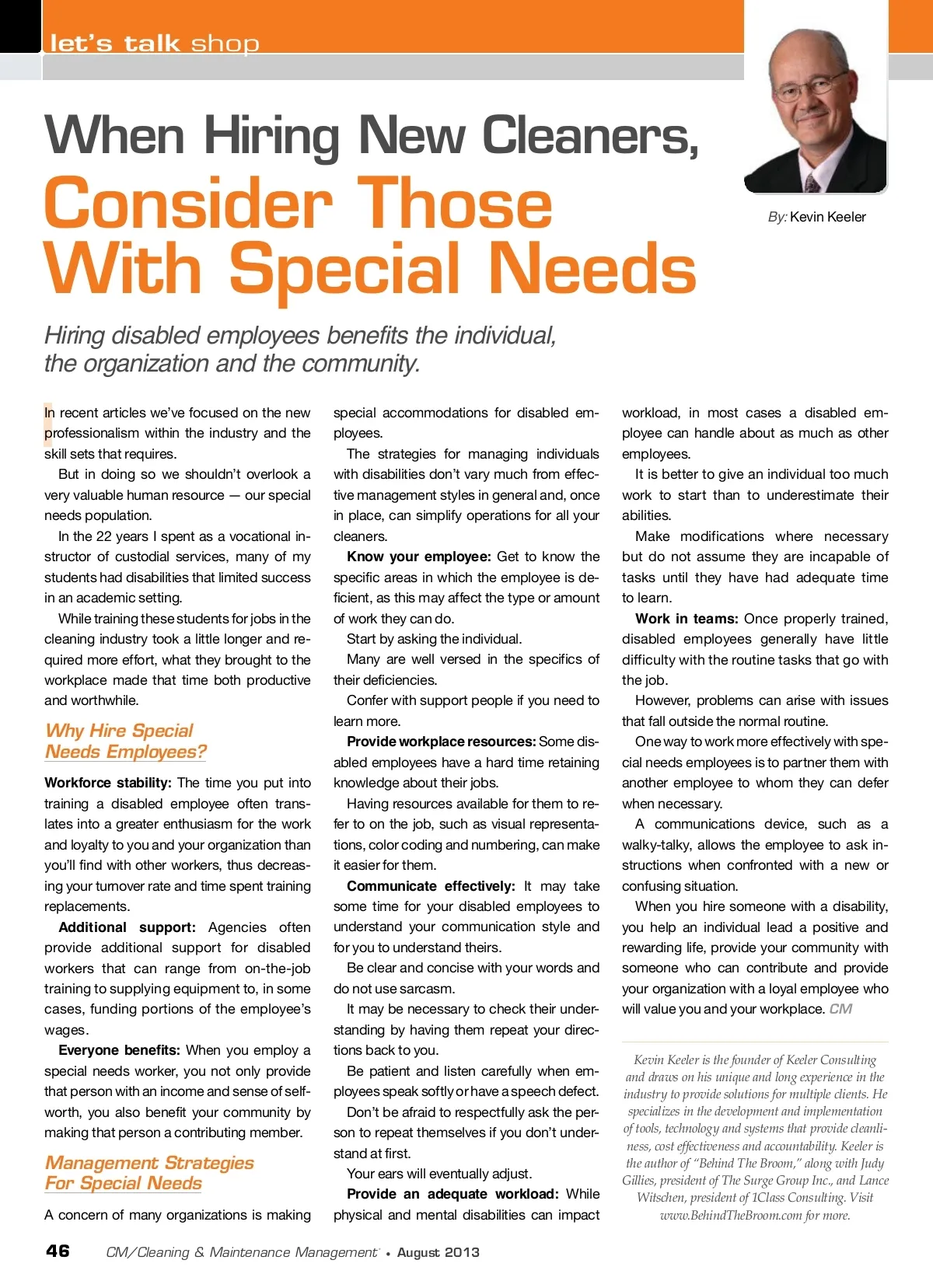
let’s talk shop When Hiring New Cleaners, Consider Those With Special Needs Hiring disabled employees benefits the individual, the organization and the community. By: Kevin Keeler I In recent articles we’ve focused on the new professionalism within the industry and the skill sets that requires. But in doing so we shouldn’t overlook a very valuable human resource — our special needs population. In the 22 years I spent as a vocational in-structor of custodial services, many of my students had disabilities that limited success in an academic setting. While training these students for jobs in the cleaning industry took a little longer and re-quired more effort, what they brought to the workplace made that time both productive and worthwhile. Why Hire Special Needs Employees? Workforce stability: The time you put into training a disabled employee often trans-lates into a greater enthusiasm for the work and loyalty to you and your organization than you’ll find with other workers, thus decreas-ing your turnover rate and time spent training replacements. Additional support: Agencies often provide additional support for disabled workers that can range from on-the-job training to supplying equipment to, in some cases, funding portions of the employee’s wages. Everyone benefits: When you employ a special needs worker, you not only provide that person with an income and sense of self-worth, you also benefit your community by making that person a contributing member. Management Strategies For Special Needs A concern of many organizations is making special accommodations for disabled em-ployees. The strategies for managing individuals with disabilities don’t vary much from effec-tive management styles in general and, once in place, can simplify operations for all your cleaners. Know your employee: Get to know the specific areas in which the employee is de-ficient, as this may affect the type or amount of work they can do. Start by asking the individual. Many are well versed in the specifics of their deficiencies. Confer with support people if you need to learn more. Provide workplace resources: Some dis-abled employees have a hard time retaining knowledge about their jobs. Having resources available for them to re-fer to on the job, such as visual representa-tions, color coding and numbering, can make it easier for them. Communicate effectively: It may take some time for your disabled employees to understand your communication style and for you to understand theirs. Be clear and concise with your words and do not use sarcasm. It may be necessary to check their under-standing by having them repeat your direc-tions back to you. Be patient and listen carefully when em-ployees speak softly or have a speech defect. Don’t be afraid to respectfully ask the per-son to repeat themselves if you don’t under-stand at first. Your ears will eventually adjust. Provide an adequate workload: While physical and mental disabilities can impact workload, in most cases a disabled em-ployee can handle about as much as other employees. It is better to give an individual too much work to start than to underestimate their abilities. Make modifications where necessary but do not assume they are incapable of tasks until they have had adequate time to learn. Work in teams: Once properly trained, disabled employees generally have little difficulty with the routine tasks that go with the job. However, problems can arise with issues that fall outside the normal routine. One way to work more effectively with spe-cial needs employees is to partner them with another employee to whom they can defer when necessary. A communications device, such as a walky-talky, allows the employee to ask in-structions when confronted with a new or confusing situation. When you hire someone with a disability, you help an individual lead a positive and rewarding life, provide your community with someone who can contribute and provide your organization with a loyal employee who will value you and your workplace. CM Kevin Keeler is the founder of Keeler Consulting and draws on his unique and long experience in the industry to provide solutions for multiple clients. He specializes in the development and implementation of tools, technology and systems that provide cleanli-ness, cost effectiveness and accountability. Keeler is the author of “Behind The Broom,” along with Judy Gillies, president of The Surge Group Inc., and Lance Witschen, president of 1Class Consulting. Visit www.BehindTheBroom.com for more. 46 CM/Cleaning & Maintenance Management ® • August 2013
CMM – Archives August 2013: 46