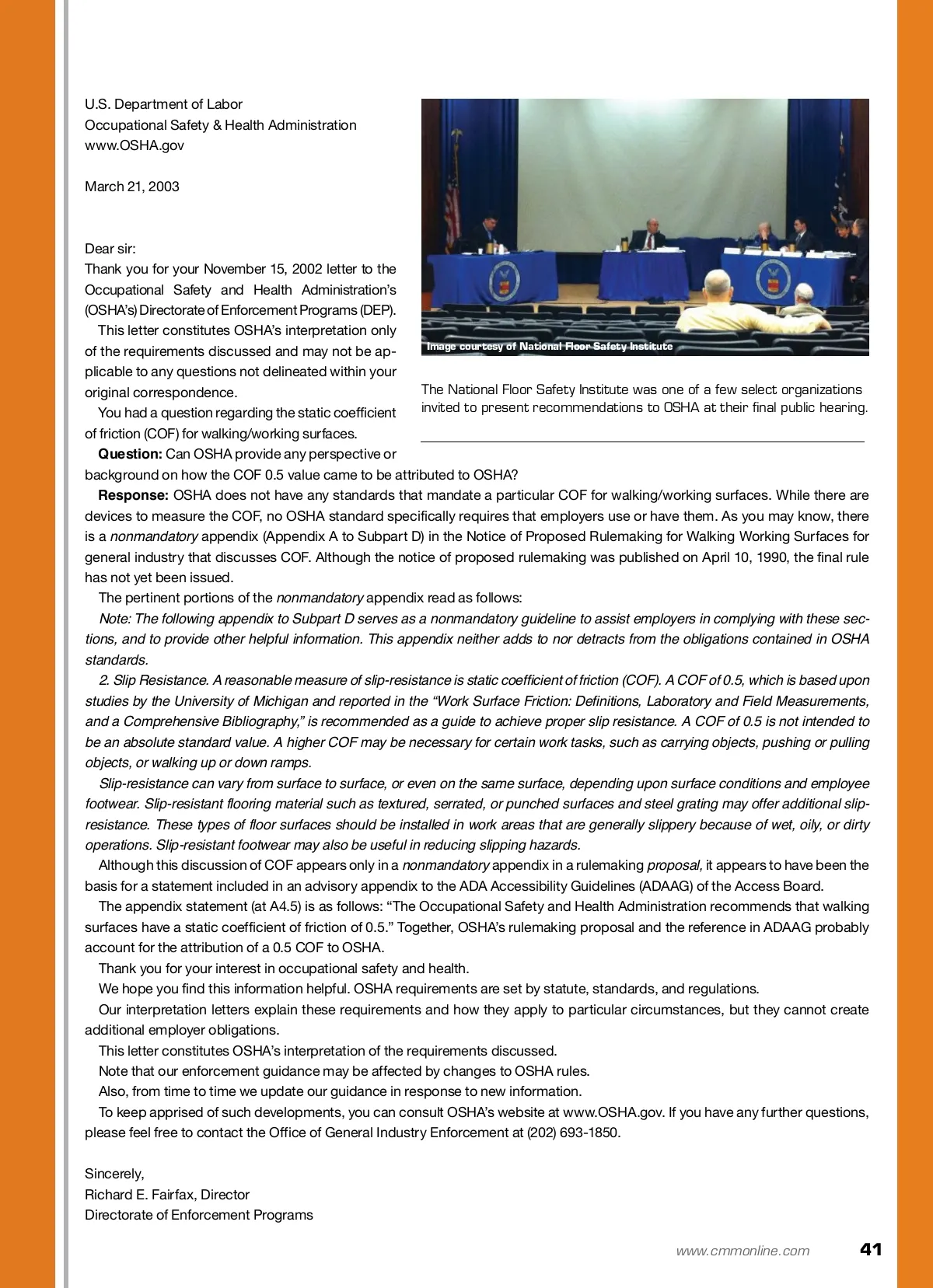
New OSHA Rules For Floor Safety Updated guidelines say floors should be inspected by “qualified persons.” By: Russell Kendzior I In August 2013, the U.S. Department of La-bor’s Occupational Safety and Health Ad-ministration (OSHA) is scheduled to release new rules for Walking and Working Surfaces (29 CFR Part 1910), that raise the bar for floorcare, safety and inspection. Subpart D of 29 CFR part 1910, Walking and Working Surfaces … “sets forth general industry requirements for employers to pro-tect employees from slips, trips and falls…” In developing revised rules, OSHA held hearings and conducted extensive scientific and technical research to inform a defini-tive approach to help protect workers from slips, trips and falls. OSHA consulted sources such as the Na-tional Bureau of Standards (now the National Institute of Standards and Technology) and the American National Standards Institute (ANSI), which the agency used to develop the proposed revisions to subparts D and I. Past studies referenced by OSHA in its new walkway rules include those produced by ANSI (e.g., ANSI A1264.2-2001 -Stan-dard for …Walking/Working Surfaces), the University of Michigan (e.g., A Bibliography of Coefficient of Friction Literature Relating to Slip Type Accidents ; Department of Indus-trial and Operations Engineering, College of Engineering, University of Michigan) and many others. These studies established a foundation for OSHA’s earlier traction recommenda-tions to help ensure a safe walkway, how-ever, no coefficient of friction (COF) value was ever required or enforced by OSHA; a nonmandatory coefficient of friction is listed in the appendix of OSHA rules. (See also the March 2003 OSHA rules “in-terpretation letter” from Richard E. Fairfax, director, OSHA Directorate of Enforcement Programs, explaining the nonmandatory nature of the COF recommendation in the walkway-rules appendix.) Although the earlier rules were authori-tative in the 1980s at the time of develop-ment, OSHA felt that — due to significant increases in the reported number of work-place falls — it was time to revise their re-quirements. Qualified Person Required For Inspections Under the proposed new rules, OSHA will now require that: “Only qualified persons shall be permitted to inspect, maintain or repair walking and working surfaces…” OSHA defines a qualified person as one “capable of identifying existing or potential hazards in specific surroundings or working conditions which may be hazardous or dan-gerous to employees; and has been trained for the specific task assigned.” NFSI thus supports OSHA’s revisions to subpart D Walking and Working Surface re-quirements. Anticipating associated training needs, NFSI has increased the availability and scope of its authoritative Walkway Auditor Certification Training through new training facilities in Southlake, Texas. NFSI is in the final stage of becoming an official ANSI Accredited Training Organiza-tion, and in late Fall 2013 will be address-ing the need for training qualified persons through its soon to be released Walkway Safety Management training program which is based on the proposed ANSI/NFSI B101.8 “Floor Safety Management Program for Slip, Trip and Fall Prevention.” What Choice Do I Have In Field Measurement Devices? NFSI recently published an up-to-date list of NFSI-approved tribometers to enable ef-fective field measurement of walkway trac-tion, based on the wet Coefficient of Friction (COF) of floors, as part of a comprehensive floor safety program. NFSI applauds OSHA for stepping up with new rules that require qualified persons to inspect floors with the goal of raising floor-care to floor safety. For more information on becoming a qual-ified person to inspect floors, contact NFSI to learn more about training programs. CM Russell J. Kendzior — an internationally recognized leading expert in slip-and-fall accident prevention — is the president and chief executive officer (CEO) of Traction Experts Inc. and founder of the National Floor Safety Institute (NFSI). Sought nationwide as a safety consultant, public speaker and expert witness, Kendzior is the author of the best-selling book on accident prevention entitled, Slip and Fall Prevention Made Easy (Government Institutes, Inc., 1999) as well as the book entitled, Falls Aren’t Funny . What’s Inspection Got To Do With It? OSHA’s proposed new rule will require that: a. An effective housekeeping program (in-cluding floorcare) is needed. b. That a “qualified person” is required to perform walkway inspections. It is clear that — by OSHA mandate — ev-ery employer will be required to designate a qualified person to inspect their walkways to ensure they are in compliance with the newly referenced ANSI standards. Walkways with a wet SCOF of 0.60 or greater or wet DCOF of 0.42 or greater are defined as “High-Traction” under the ANSI/ NFSI B101.1 and ANSI/NFSI B101.3 stan-dards respectively. Where Can You Get Trained To Be A Qualified Person? The National Floor Safety Institute (NFSI) was one of a few select organizations in-vited to present recommendations to OSHA at their final public hearing. 40 CM/Cleaning & Maintenance Management ® • August 2013 Image courtesy of National Floor Safety Institute facility focus
CMM – Archives August 2013: 40