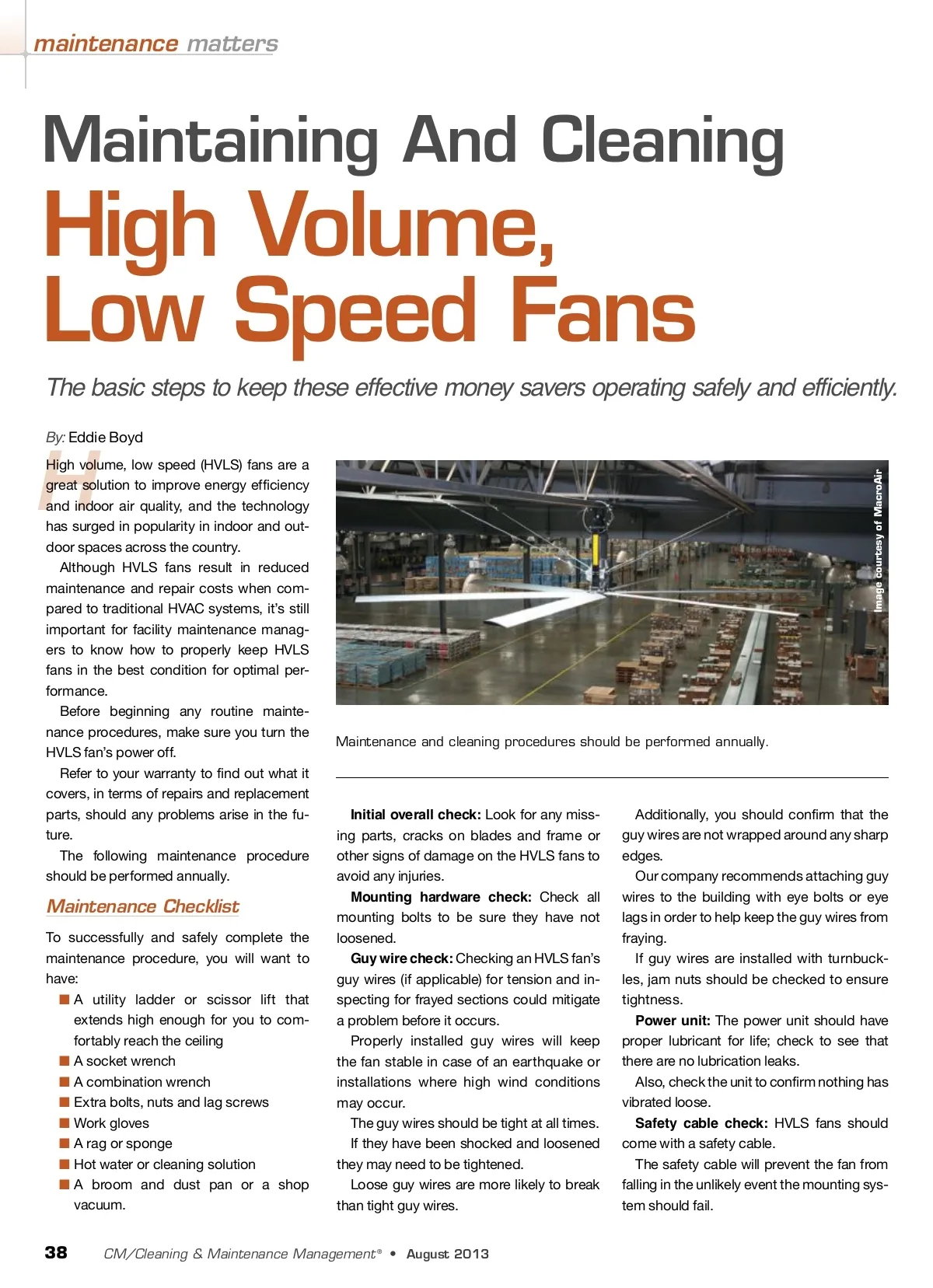
Depending on the fan model and installa-tion method, the safety cable either wraps around the building structure and the fan frame or comes out of the top of the fan and wraps around the building structure. The safety cable is an important part of the safety system and acts as a last resort should an earthquake, collision or similar catastrophic event occur. As such, it’s vital for you to ensure that it is intact and properly secured. Then, simply wipe down the outside of the enclosure with a cloth or duster. Should any problems arise, refer to your warranty to find out what it covers, in terms of repairs and replacement parts. Finding The Right HVLS For Your Facility If you don’t have an HVLS fan in your facil-ity and your facility manager is considering adding one, here are additional things to consider when comparing HVLS fans and manufacturers to ensure you’re getting the best performance for your application and need: ■ Performance needs: Take a good look at your facility space and existing HVAC systems to see which HVLS fan best meets your need. Can you take advan-tage of natural ventilation or do you need to supplement a forced-air system? ■ Installation: Building parameters, sup-port beams or structures, clearance requirements and built-in control fea-tures will all affect installation and, ulti-mately, the fan’s performance. To main-Cleaning The HVLS Fan Blade: Depending on the type of commer-cial application your HVLS fan is in, there can be quite a bit of dust or other particulates, in-cluding grease, clinging to the fan’s blades. While this may not affect fan performance, we recommend you keep the blades clean by wiping the fan blades with a rag or sponge using hot water or regular cleaning solutions. Please do not use chlorine or any chemi-cals containing chlorine. Control panel: In a dusty and dirty envi-ronment, a can of compressed air works well to clean the inside of the panel. tain continuous air exchange, MacroAir recommends installing one HVLS fan per 20,000 square feet of space. ■ Customer service and warranties: Bottom line, the HVLS fan manufac-turer you select should be just as avail-able as the representative group selling you the fan and should help you have a good understanding of the warranty coverage. Supplementing traditional HVAC systems with HVLS fans continues to be an efficient solution to help reduce energy costs, in-crease energy efficiency and keep indoor temperatures balanced and regulated within any commercial application. CM Eddie Boyd is president of MacroAir, which manu-factures energy-efficient, long-lasting HVLS fans that can be found in warehouses, manufacturing plants, airplane hangars, agricultural arenas and retail establishments across the U.S. and around the world. The company is the exclusive HVLS fan supplier for independent auto dealerships of BMW, Chrysler, Ford, General Motors, Lexus, Mercedes-Benz, Nissan and Toyota. To learn more about the HVLS industry and MacroAir’s line of HVLS fans, visit www.MacroAirFans.com. FREE INFO: Reader Service 211 or CMMOnline.com/freeinfo www.cmmonline.com 39
CMM – Archives August 2013: 39