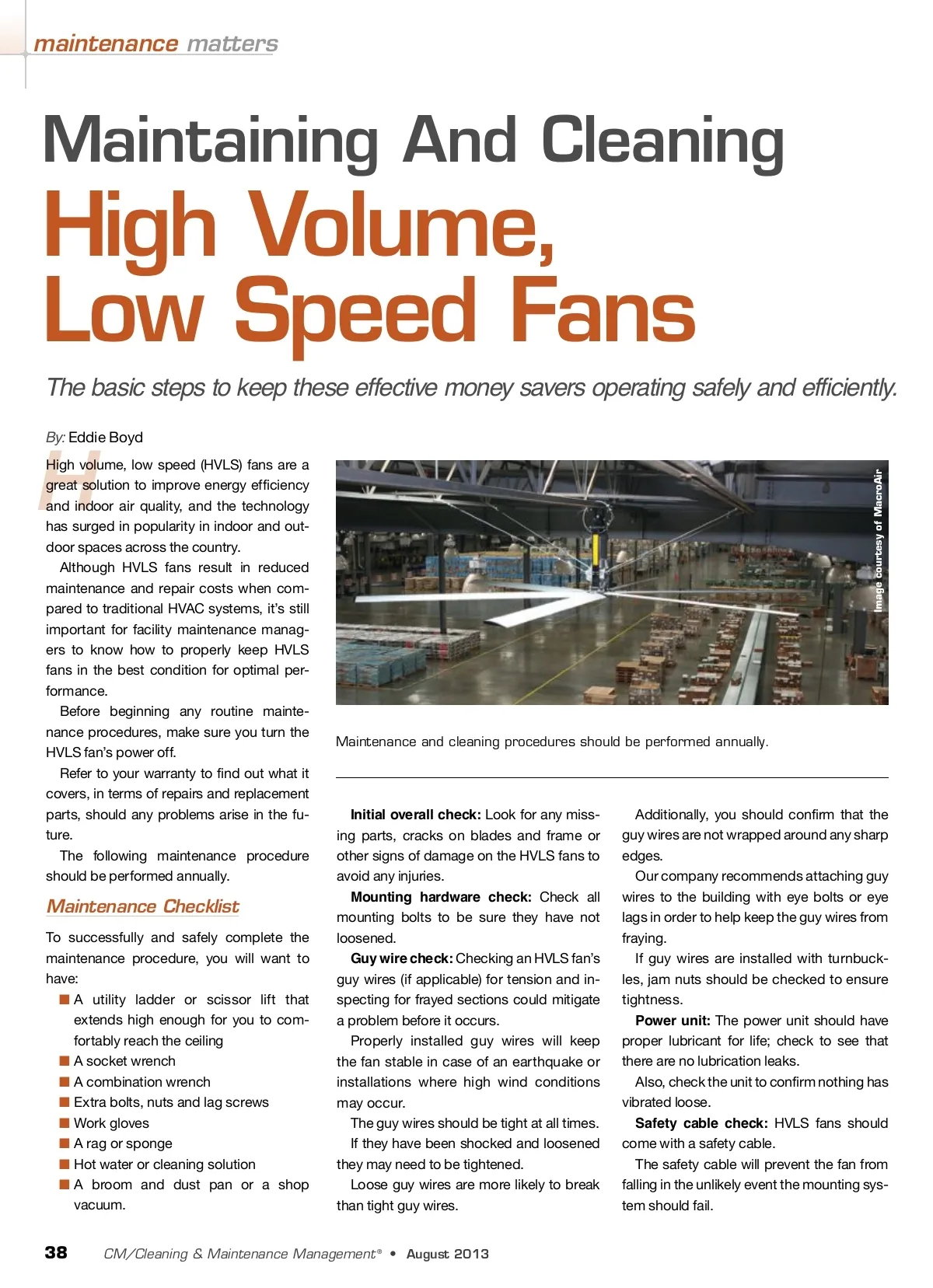
maintenance matters Maintaining And Cleaning High Volume, Low Speed Fans The basic steps to keep these effective money savers operating safely and efficiently. By: Eddie Boyd Image courtesy of MacroAir H High volume, low speed (HVLS) fans are a great solution to improve energy efficiency and indoor air quality, and the technology has surged in popularity in indoor and out-door spaces across the country. Although HVLS fans result in reduced maintenance and repair costs when com-pared to traditional HVAC systems, it’s still important for facility maintenance manag-ers to know how to properly keep HVLS fans in the best condition for optimal per-formance. Before beginning any routine mainte-nance procedures, make sure you turn the HVLS fan’s power off. Refer to your warranty to find out what it covers, in terms of repairs and replacement parts, should any problems arise in the fu-ture. The following maintenance procedure should be performed annually. Maintenance and cleaning procedures should be performed annually. Maintenance Checklist To successfully and safely complete the maintenance procedure, you will want to have: ■ A utility ladder or scissor lift that extends high enough for you to com-fortably reach the ceiling ■ A socket wrench ■ A combination wrench ■ Extra bolts, nuts and lag screws ■ Work gloves ■ A rag or sponge ■ Hot water or cleaning solution ■ A broom and dust pan or a shop vacuum. Initial overall check: Look for any miss-ing parts, cracks on blades and frame or other signs of damage on the HVLS fans to avoid any injuries. Mounting hardware check: Check all mounting bolts to be sure they have not loosened. Guy wire check: Checking an HVLS fan’s guy wires (if applicable) for tension and in-specting for frayed sections could mitigate a problem before it occurs. Properly installed guy wires will keep the fan stable in case of an earthquake or installations where high wind conditions may occur. The guy wires should be tight at all times. If they have been shocked and loosened they may need to be tightened. Loose guy wires are more likely to break than tight guy wires. Additionally, you should confirm that the guy wires are not wrapped around any sharp edges. Our company recommends attaching guy wires to the building with eye bolts or eye lags in order to help keep the guy wires from fraying. If guy wires are installed with turnbuck-les, jam nuts should be checked to ensure tightness. Power unit: The power unit should have proper lubricant for life; check to see that there are no lubrication leaks. Also, check the unit to confirm nothing has vibrated loose. Safety cable check: HVLS fans should come with a safety cable. The safety cable will prevent the fan from falling in the unlikely event the mounting sys-tem should fail. 38 CM/Cleaning & Maintenance Management ® • August 2013
CMM – Archives August 2013: 38