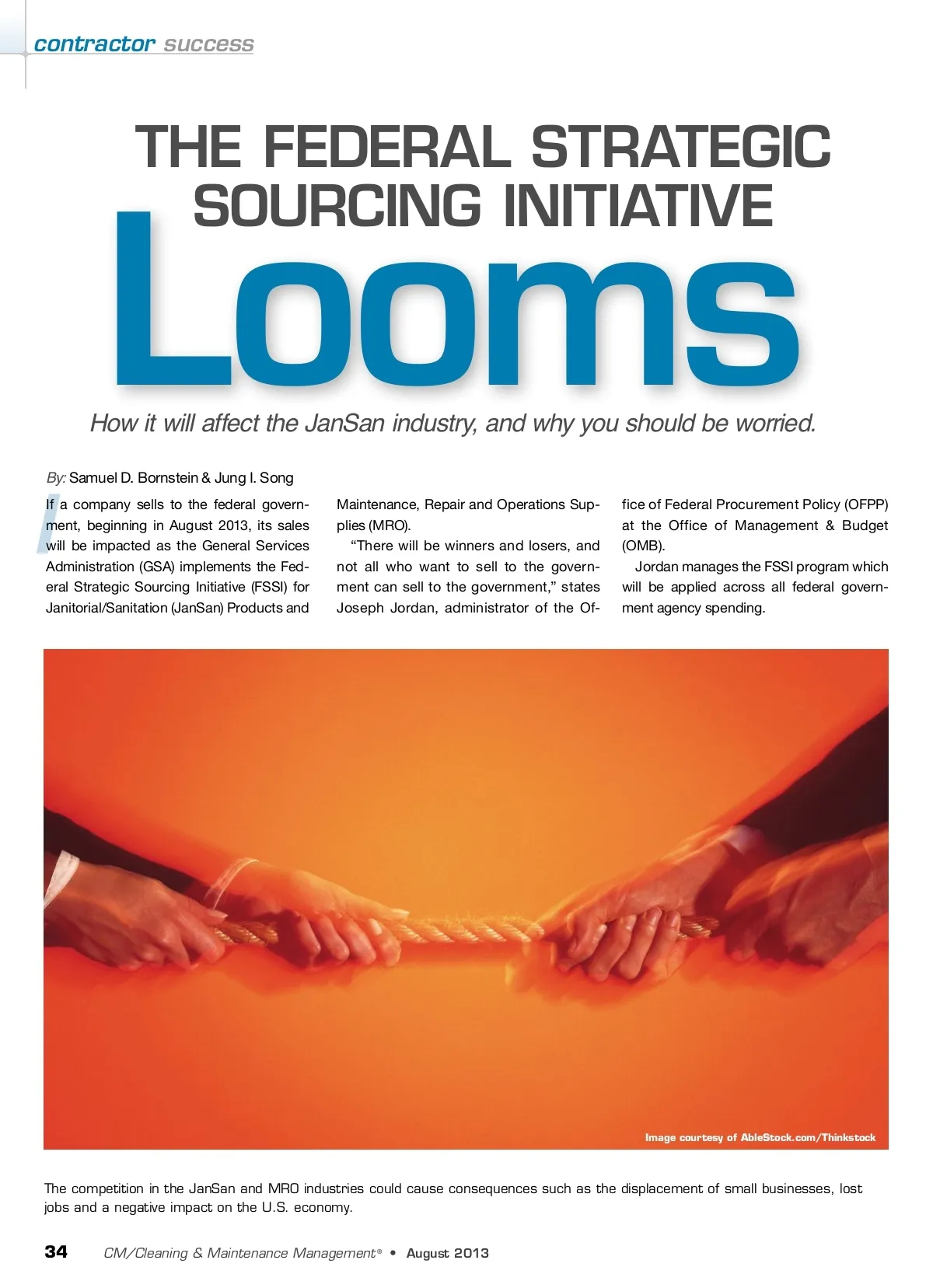
The OFPP and OMB are moving on a fast-track to implement the FSSI, and currently this JanSan and MRO FSSI is going mostly unnoticed in the industry. Our firm, Bornstein & Song, has been researching the FSSI since its inception in 2010 when it was implemented for GSA Schedule 75 Office Supplies. Based upon this research, we see the FSSI as a controversial and risky federal government procurement program which has had a damaging and negative impact on businesses. Background Having experience with small business is-sues as they relate to the business communi-ty and to the economy at large, we have testi-fied and authored small business legislation in various states and testified on the impact of strategic sourcing before a California State Assembly Committee which was evaluating the California Strategic Sourcing Program. We presented research which quantified the economic, social and other costs to the government which previously were not considered when California implemented strategic sourcing for state government contracts. As a result, the California Strategic Sourc-ing Initiative Program (CSSI) was put on hold. Having seen the damage the FSSI pro-gram has already caused for the office sup-plies businesses in the federal contracting community, and realizing that the JanSan and MRO FSSI is going mostly unnoticed in the industry, we wanted to alert the industry to the dangers of the FSSI program. Just ask the GSA Schedule 75 Office Supplies (OS2) contractors who suffered ir-reversible damage when the FSSI for GSA OS2 was implemented in June 2010. The history of FSSI for the office supplies federal business community is not pretty. The fear is that the JanSan and MRO in-dustry will suffer the same consequences with the displacement of small businesses, lost jobs and a negative impact on the U.S. economy at a time when the health of small businesses and job creation is most essen-tial to economic recovery. JanSan Blanket Purchase Agreements (BPAs) and 15 FSSI MRO BPAs from among the total JanSan and MRO industry which accounts for over $652 million in spending through the GSA. While the GSA accounts for only 7 percent of the $530 billion of government spending, the ramifications of these FSSI BPAs extend far beyond GSA. The OMB is receiving commitment let-ters from the federal agencies to purchase JanSan and MRO products from these 30 FSSI BPAs. In addition to the FSSI for JanSan and MRO, which applies to products and equip-ment, the GSA intends to implement an FSSI for Building Maintenance and Opera-tions (BMO) in 2014, which will impact build-ing service contractors and in-house facility managers. These FSSIs will cover all bases in the industry, and all contractors and vendors must be alert to this issue. What Is The FSSI? How will the FSSI Request for Quotation (RFQ) impact JanSan and MRO business-es? The FSSI is a procurement vehicle which awards contracts, called FSSI BPAs, to sell selected products or services across the federal government. These FSSI BPAs are awarded after a RFQ is issued for reply in a limited time-frame in which prospective vendors can submit their lowest price quotes and meet certain qualification requirements. Vendors who miss the RFQ deadline could be shut out of the market for years. For example, in 2010 the FSSI BPAs for GSA Schedule 75 Office Supplies (OS2) were awarded to only 15 out of 569 total contractors, and the GSA Schedule 75 was closed to new offers for two years. There are no indications that it will reopen soon. The July 2013 deadline for the JanSan & MRO FSSI RFQ has passed and few were aware of the RFQ, and even fewer were qualified to submit quotes within the time-frame set in the RFQ. awarded FSSI BPAs will be made manda-tory for all federal government purchases. That means, unless a vendor is awarded an FSSI BPA, the vendor may notice that his/her federal sales will be lost to the few selected vendors who were awarded the FSSI BPAs. The best example of how a previous FSSI has impacted an industry is evidenced by the history of the FSSI for GSA Schedule 75 Office Supplies. Bornstein & Song Research has highlight-ed that most federal agencies have issued commitment letters to purchase office sup-plies from the 15 awarded FSSI BPAs. It is expected that these same federal agencies will also issue commitment letters to purchase JanSan and MRO products from the 15 FSSI JanSan BPAs and 15 FSSI MRO BPAs. Bornstein & Song is conducting a national survey to assess the GSA FSSI BPA Sched-ule 75 Office Supplies three years after the change. We will provide input from the GSA Schedule 75 Office Supplies contractors who were impacted by this pilot FSSI. Their responses should provide valu-able feedback on how the FSSI program has affected their businesses, their lives and their trusted and devoted employees who lost their jobs, specifically blamed on this FSSI. The survey results will give an indication of what the JanSan and MRO industry can expect as the FSSI is implemented in Au-gust 2013. Using this survey, we will present data and evidence that the implementation of the JanSan and MRO FSSI should be post-poned and reevaluated in its present form, in light of the impact which the GSA FSSI has had on the Schedule 75 Office Supplies contractors since its inception in 2010. CM Samuel D. Bornstein is a 35-year professor of Accounting & Taxation at Kean University School of Business, Union, New Jersey. Jung I. Song, CPA is managing partner of Bornstein & Song CPAs & Consultants in Oakhurst, New Jersey. Since 2000, Bornstein & Song Research has been driven by the faith-based belief that they have been given an opportunity to be a “vehicle for good” to address issues which impact small businesses and the economy. Visit www.BornsteinSongFSSI.com for more information. www.cmmonline.com A Few Winners, But More Losers The GSA intends to award only 15 FSSI FSSI Will Be Mandatory In the December 5, 2012 OMB Memo, the federal government made it clear that the 35
CMM – Archives August 2013: 35