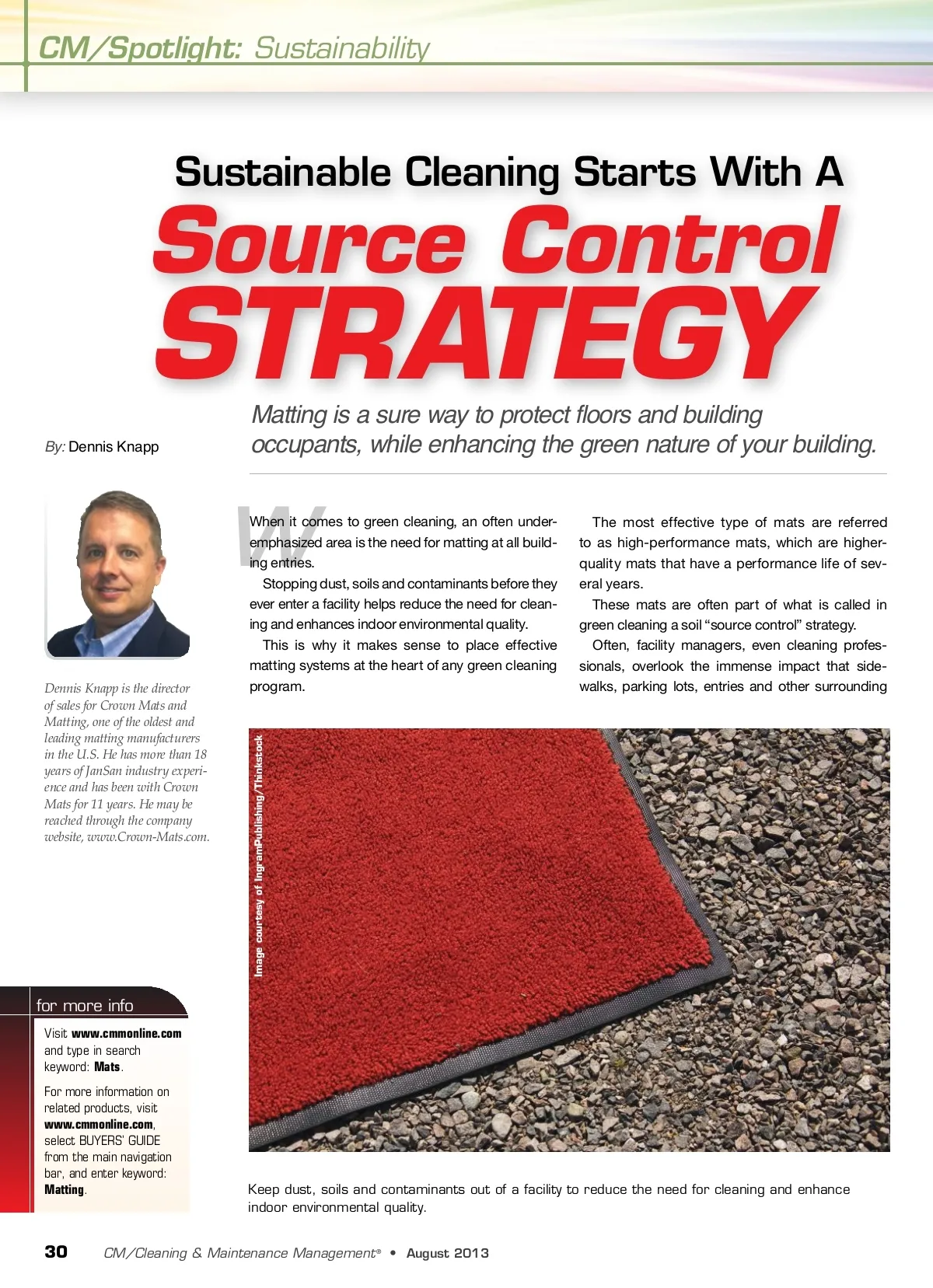
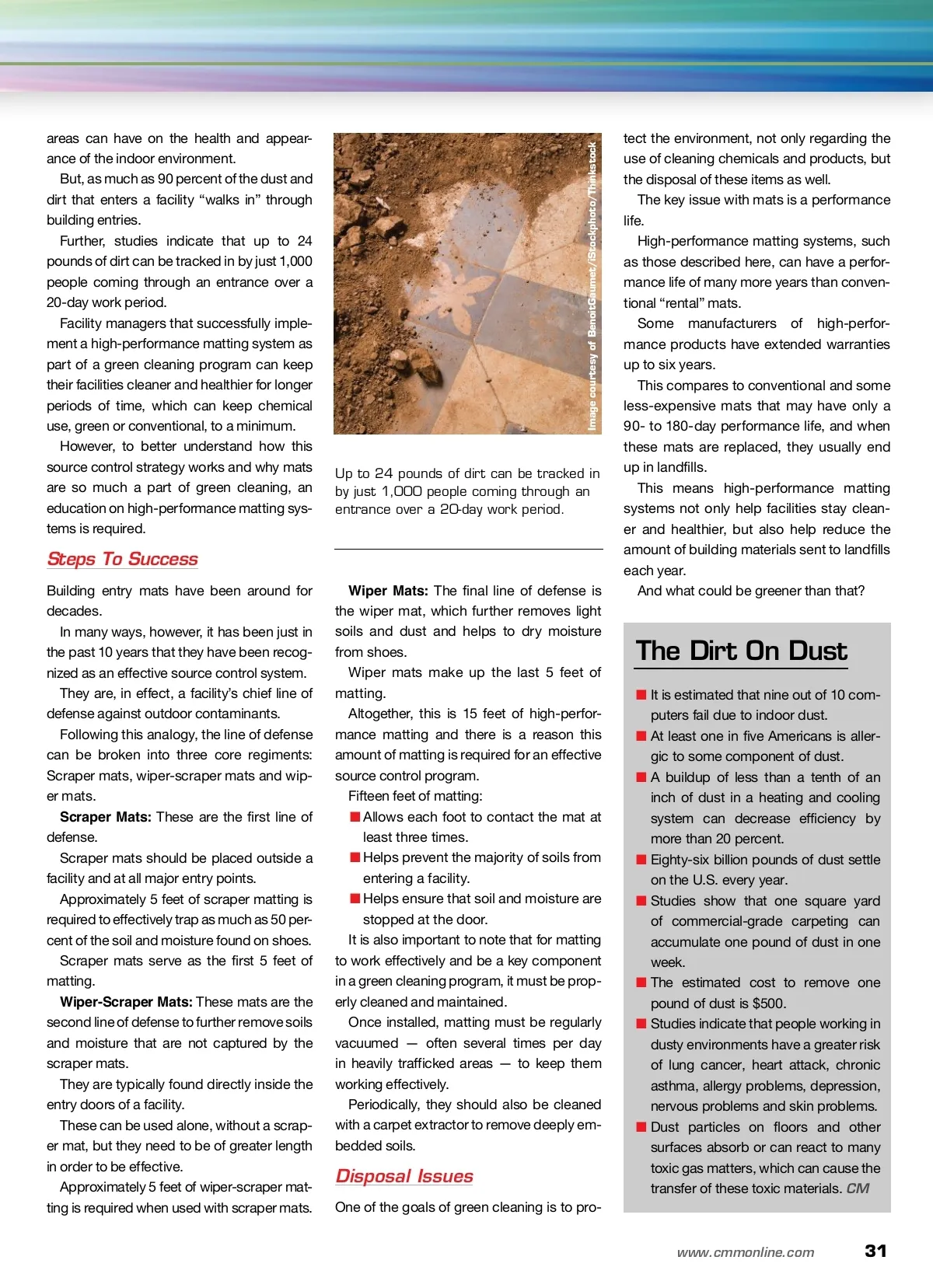
areas can have on the health and appear-ance of the indoor environment. But, as much as 90 percent of the dust and dirt that enters a facility “walks in” through building entries. Further, studies indicate that up to 24 pounds of dirt can be tracked in by just 1,000 people coming through an entrance over a 20-day work period. Facility managers that successfully imple-ment a high-performance matting system as part of a green cleaning program can keep their facilities cleaner and healthier for longer periods of time, which can keep chemical use, green or conventional, to a minimum. However, to better understand how this source control strategy works and why mats are so much a part of green cleaning, an education on high-performance matting sys-tems is required. Up to 24 pounds of dirt can be tracked in by just 1,000 people coming through an entrance over a 20-day work period. Steps To Success Building entry mats have been around for decades. In many ways, however, it has been just in the past 10 years that they have been recog-nized as an effective source control system. They are, in effect, a facility’s chief line of defense against outdoor contaminants. Following this analogy, the line of defense can be broken into three core regiments: Scraper mats, wiper-scraper mats and wip-er mats. Scraper Mats: These are the first line of defense. Scraper mats should be placed outside a facility and at all major entry points. Approximately 5 feet of scraper matting is required to effectively trap as much as 50 per-cent of the soil and moisture found on shoes. Scraper mats serve as the first 5 feet of matting. Wiper-Scraper Mats: These mats are the second line of defense to further remove soils and moisture that are not captured by the scraper mats. They are typically found directly inside the entry doors of a facility. These can be used alone, without a scrap-er mat, but they need to be of greater length in order to be effective. Approximately 5 feet of wiper-scraper mat-ting is required when used with scraper mats. Wiper Mats: The final line of defense is the wiper mat, which further removes light soils and dust and helps to dry moisture from shoes. Wiper mats make up the last 5 feet of matting. Altogether, this is 15 feet of high-perfor-mance matting and there is a reason this amount of matting is required for an effective source control program. Fifteen feet of matting: ■ Allows each foot to contact the mat at least three times. ■ Helps prevent the majority of soils from entering a facility. ■ Helps ensure that soil and moisture are stopped at the door. It is also important to note that for matting to work effectively and be a key component in a green cleaning program, it must be prop-erly cleaned and maintained. Once installed, matting must be regularly vacuumed — often several times per day in heavily trafficked areas — to keep them working effectively. Periodically, they should also be cleaned with a carpet extractor to remove deeply em-bedded soils. tect the environment, not only regarding the use of cleaning chemicals and products, but the disposal of these items as well. The key issue with mats is a performance life. High-performance matting systems, such as those described here, can have a perfor-mance life of many more years than conven-tional “rental” mats. Some manufacturers of high-perfor-mance products have extended warranties up to six years. This compares to conventional and some less-expensive mats that may have only a 90-to 180-day performance life, and when these mats are replaced, they usually end up in landfills. This means high-performance matting systems not only help facilities stay clean-er and healthier, but also help reduce the amount of building materials sent to landfills each year. And what could be greener than that? Image courtesy of BenoitGaumet/iStockphoto/Thinkstock The Dirt On Dust ■ It is estimated that nine out of 10 com-puters fail due to indoor dust. ■ At least one in five Americans is aller-gic to some component of dust. ■ A buildup of less than a tenth of an inch of dust in a heating and cooling system can decrease efficiency by more than 20 percent. ■ Eighty-six billion pounds of dust settle on the U.S. every year. ■ Studies show that one square yard of commercial-grade carpeting can accumulate one pound of dust in one week. ■ The estimated cost to remove one pound of dust is $500. ■ Studies indicate that people working in dusty environments have a greater risk of lung cancer, heart attack, chronic asthma, allergy problems, depression, nervous problems and skin problems. ■ Dust particles on floors and other surfaces absorb or can react to many toxic gas matters, which can cause the transfer of these toxic materials. CM Disposal Issues One of the goals of green cleaning is to pro-www.cmmonline.com 31
CMM – Archives August 2013: 31