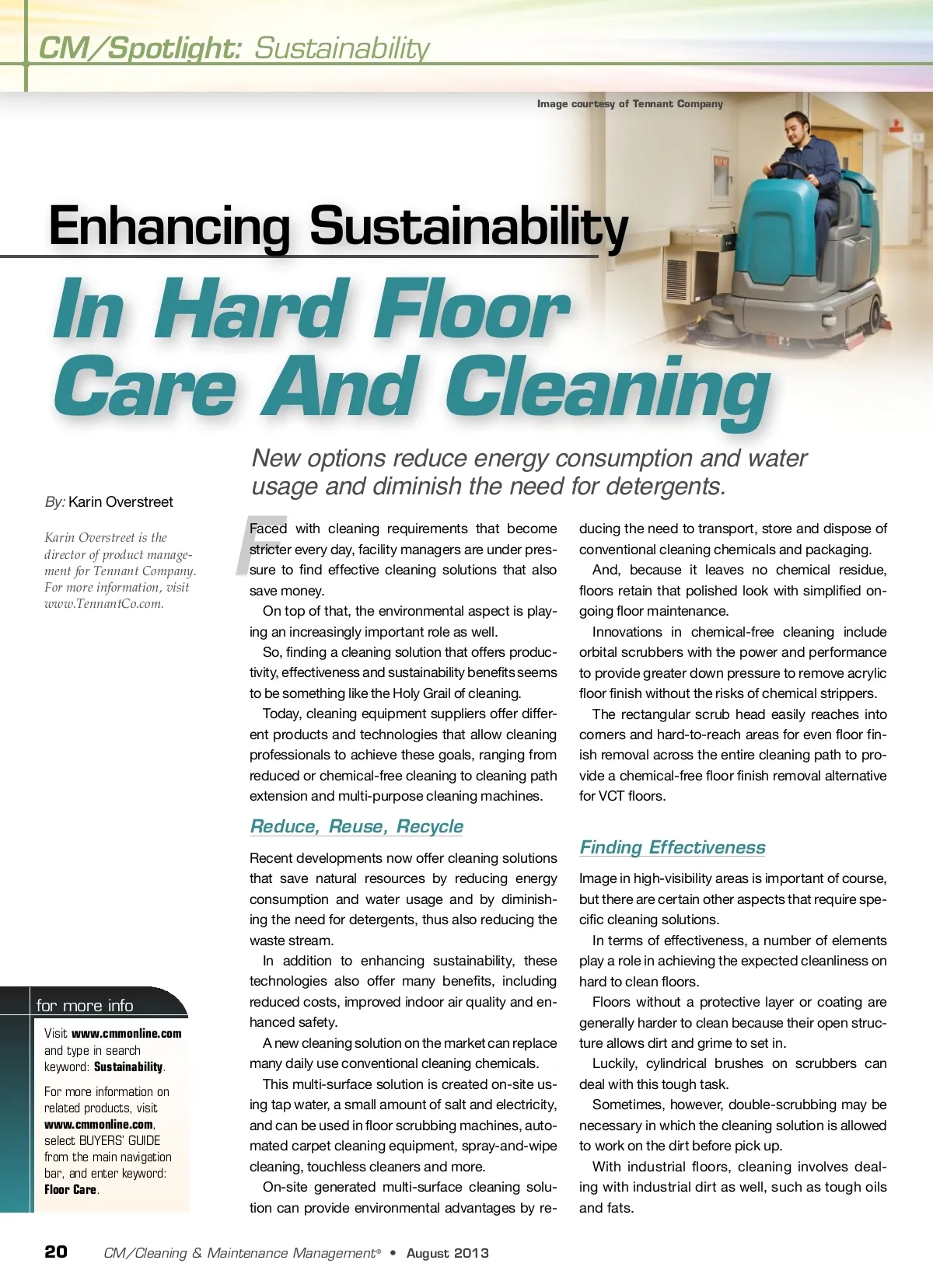
In food and beverage production or han-dling environments this will mean stubborn sugary or syrupy spillage. These challenging cleaning applications require robust and heavy-duty cleaning equipment such as scrubbers. Essential, however, is a systematic main-tenance in order to avoid large buildup of tough dirt. Cleaning regularly is always a better op-tion than having to do a deep scrub and re-store in terms of time and labor savings. In areas where tire marks are an issue (e.g. from forklift trucks in warehouses), even glossy finished floors might need something extra to remove the marks although “nor-mal” dirt is easily removed. When tire marks are burned into the floor, a more thorough approach is often needed with spot cleaning using the right chemical and aggressive disk brushes. In some extreme cases, this may not suc-ceed however, and then the only option is to strip and re-coat the floor. In more commercial flooring, grout cleaning is a challenge because residual detergents will build up in the grout lines and retain dirt. Also, old tile floors from which the top layer has been worn off, allow dirt to infiltrate the porous surface making it very hard to remove. Very often a protective wax or finish coat-ing is applied, but that only seals the dirt un-derneath a transparent layer and does noth-ing to make it look less old and worn. New chemical-free technologies are avail-able now that don’t leave behind chemical residue and so can help restore the floor’s original clean and bright appearance. floor is slip-resistant is one of the additional aims of a floor maintenance program. Obviously, it starts with daily cleaning that should include dust sweeping, wet cleaning and spot cleaning. In most cases a walk-behind or ride-on scrubber is used for the wet cleaning. Very often, chemicals are used to remove dirt from the floor. However, these chemicals involve a num-ber of extra steps in handling them that, if not properly managed, can have an impact on the health and safety of the cleaning staff and the facility residents. Chemical overdosing can leave a residue that can make the floor slippery. Mixing and manual dosing of chemicals will also present the operator with the risk of spillage and hand and/or eye contact if proper procedures are not followed. Some recent chemical-free technologies offer the advantage that little or no training is required, thus increasing operator confi-dence, productivity and safety. Indoor air quality greatly benefits from an appropriate cleaning program as well. Ensuring no dust particles become air-borne by effectively sweeping and scrub-bing the floor positively impacts workers’ and residents’ health. Apart from this aspect, avoiding unpleas-ant odors from dirt buildup or residue can also enhance building occupants’ feeling of well-being. Summary Although faced with a plethora of challenges in hard floor cleaning, facility managers now can choose from a wide range of flexible so-lutions tailored to their specific cleaning ap-plications. These allow them to still live up to rig-orous expectations of cleanliness, effec-tiveness and budget constraints all while enhancing sustainability without sacrificing image and safety. CM Health And Safety The implementation of an effective floor maintenance program is a very important step in the prevention of various health and safety issues. Not only do slippery floors present haz-ards, indoor air quality and noise can affect the well-being of operators, staff and resi-dents as well. Slip and fall accidents can account for a large number of lost days of work, high med-ical costs and even higher insurance rates. Besides actually cleaning, ensuring the FREE INFO: Reader Service 204 or CMMOnline.com/freeinfo www.cmmonline.com 21
CMM – Archives August 2013: 21