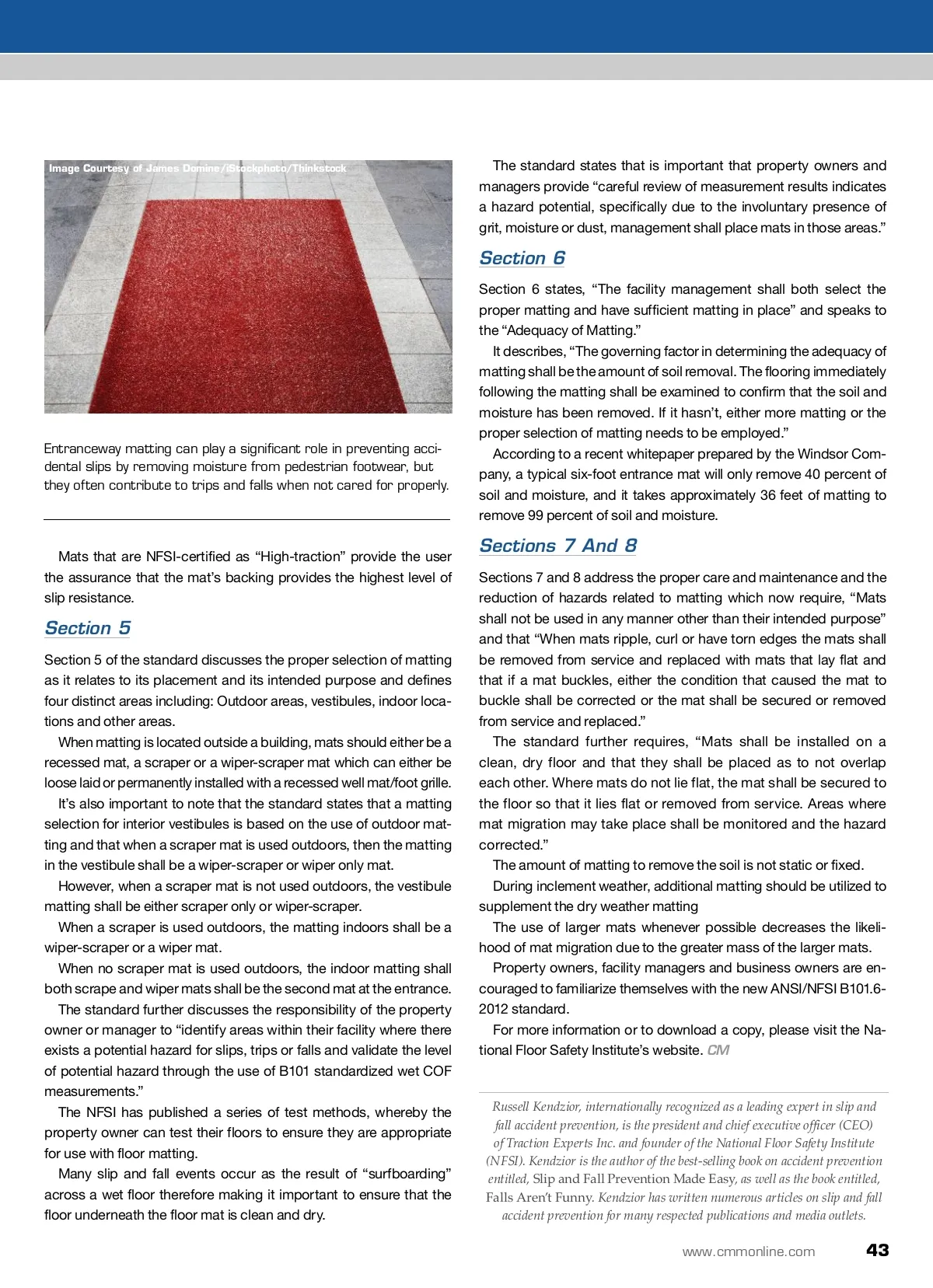
Image Courtesy of James Domine/iStockphoto/Thinkstock The standard states that is important that property owners and managers provide “careful review of measurement results indicates a hazard potential, specifically due to the involuntary presence of grit, moisture or dust, management shall place mats in those areas.” Section 6 Section 6 states, “The facility management shall both select the proper matting and have sufficient matting in place” and speaks to the “Adequacy of Matting.” It describes, “The governing factor in determining the adequacy of matting shall be the amount of soil removal. The flooring immediately following the matting shall be examined to confirm that the soil and moisture has been removed. If it hasn’t, either more matting or the proper selection of matting needs to be employed.” According to a recent whitepaper prepared by the Windsor Com-pany, a typical six-foot entrance mat will only remove 40 percent of soil and moisture, and it takes approximately 36 feet of matting to remove 99 percent of soil and moisture. Entranceway matting can play a significant role in preventing acci-dental slips by removing moisture from pedestrian footwear, but they often contribute to trips and falls when not cared for properly. Mats that are NFSI-certified as “High-traction” provide the user the assurance that the mat’s backing provides the highest level of slip resistance. Sections 7 And 8 Sections 7 and 8 address the proper care and maintenance and the reduction of hazards related to matting which now require, “Mats shall not be used in any manner other than their intended purpose” and that “When mats ripple, curl or have torn edges the mats shall be removed from service and replaced with mats that lay flat and that if a mat buckles, either the condition that caused the mat to buckle shall be corrected or the mat shall be secured or removed from service and replaced.” The standard further requires, “Mats shall be installed on a clean, dry floor and that they shall be placed as to not overlap each other. Where mats do not lie flat, the mat shall be secured to the floor so that it lies flat or removed from service. Areas where mat migration may take place shall be monitored and the hazard corrected.” The amount of matting to remove the soil is not static or fixed. During inclement weather, additional matting should be utilized to supplement the dry weather matting The use of larger mats whenever possible decreases the likeli-hood of mat migration due to the greater mass of the larger mats. Property owners, facility managers and business owners are en-couraged to familiarize themselves with the new ANSI/NFSI B101.6-2012 standard. For more information or to download a copy, please visit the Na-tional Floor Safety Institute’s website. CM Section 5 Section 5 of the standard discusses the proper selection of matting as it relates to its placement and its intended purpose and defines four distinct areas including: Outdoor areas, vestibules, indoor loca-tions and other areas. When matting is located outside a building, mats should either be a recessed mat, a scraper or a wiper-scraper mat which can either be loose laid or permanently installed with a recessed well mat/foot grille. It’s also important to note that the standard states that a matting selection for interior vestibules is based on the use of outdoor mat-ting and that when a scraper mat is used outdoors, then the matting in the vestibule shall be a wiper-scraper or wiper only mat. However, when a scraper mat is not used outdoors, the vestibule matting shall be either scraper only or wiper-scraper. When a scraper is used outdoors, the matting indoors shall be a wiper-scraper or a wiper mat. When no scraper mat is used outdoors, the indoor matting shall both scrape and wiper mats shall be the second mat at the entrance. The standard further discusses the responsibility of the property owner or manager to “identify areas within their facility where there exists a potential hazard for slips, trips or falls and validate the level of potential hazard through the use of B101 standardized wet COF measurements.” The NFSI has published a series of test methods, whereby the property owner can test their floors to ensure they are appropriate for use with floor matting. Many slip and fall events occur as the result of “surfboarding” across a wet floor therefore making it important to ensure that the floor underneath the floor mat is clean and dry. Russell Kendzior, internationally recognized as a leading expert in slip and fall accident prevention, is the president and chief executive officer (CEO) of Traction Experts Inc. and founder of the National Floor Safety Institute (NFSI). Kendzior is the author of the best-selling book on accident prevention entitled, Slip and Fall Prevention Made Easy , as well as the book entitled, Falls Aren’t Funny . Kendzior has written numerous articles on slip and fall accident prevention for many respected publications and media outlets. www.cmmonline.com 43
CMM – Archives September 2013: 43