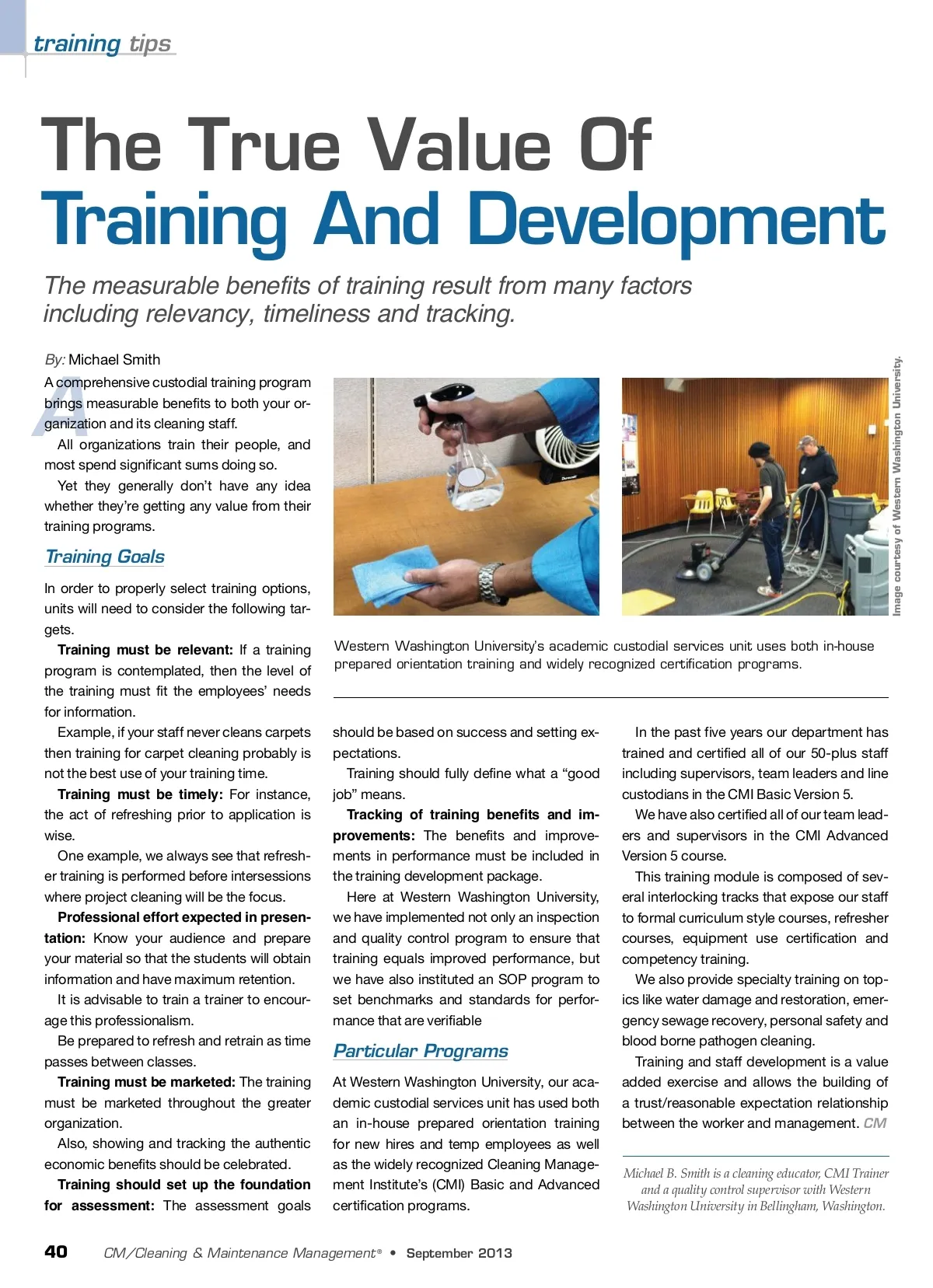
training tips The True Value Of Training And Development The measurable benefits of training result from many factors including relevancy, timeliness and tracking. A A comprehensive custodial training program brings measurable benefits to both your or-ganization and its cleaning staff. All organizations train their people, and most spend significant sums doing so. Yet they generally don’t have any idea whether they’re getting any value from their training programs. Training Goals In order to properly select training options, units will need to consider the following tar-gets. Training must be relevant: If a training program is contemplated, then the level of the training must fit the employees’ needs for information. Example, if your staff never cleans carpets then training for carpet cleaning probably is not the best use of your training time. Training must be timely: For instance, the act of refreshing prior to application is wise. One example, we always see that refresh-er training is performed before intersessions where project cleaning will be the focus. Professional effort expected in presen-tation: Know your audience and prepare your material so that the students will obtain information and have maximum retention. It is advisable to train a trainer to encour-age this professionalism. Be prepared to refresh and retrain as time passes between classes. Training must be marketed: The training must be marketed throughout the greater organization. Also, showing and tracking the authentic economic benefits should be celebrated. Training should set up the foundation for assessment: The assessment goals Western Washington University’s academic custodial services unit uses both in-house prepared orientation training and widely recognized certification programs. should be based on success and setting ex-pectations. Training should fully define what a “good job” means. Tracking of training benefits and im-provements: The benefits and improve-ments in performance must be included in the training development package. Here at Western Washington University, we have implemented not only an inspection and quality control program to ensure that training equals improved performance, but we have also instituted an SOP program to set benchmarks and standards for perfor-mance that are verifiable Particular Programs At Western Washington University, our aca-demic custodial services unit has used both an in-house prepared orientation training for new hires and temp employees as well as the widely recognized Cleaning Manage-ment Institute’s (CMI) Basic and Advanced certification programs. In the past five years our department has trained and certified all of our 50-plus staff including supervisors, team leaders and line custodians in the CMI Basic Version 5. We have also certified all of our team lead-ers and supervisors in the CMI Advanced Version 5 course. This training module is composed of sev-eral interlocking tracks that expose our staff to formal curriculum style courses, refresher courses, equipment use certification and competency training. We also provide specialty training on top-ics like water damage and restoration, emer-gency sewage recovery, personal safety and blood borne pathogen cleaning. Training and staff development is a value added exercise and allows the building of a trust/reasonable expectation relationship between the worker and management. CM Michael B. Smith is a cleaning educator, CMI Trainer and a quality control supervisor with Western Washington University in Bellingham, Washington. 40 CM/Cleaning & Maintenance Management ® • September 2013 Image courtesy of Western Washington University. By: Michael Smith
CMM – Archives September 2013: 40