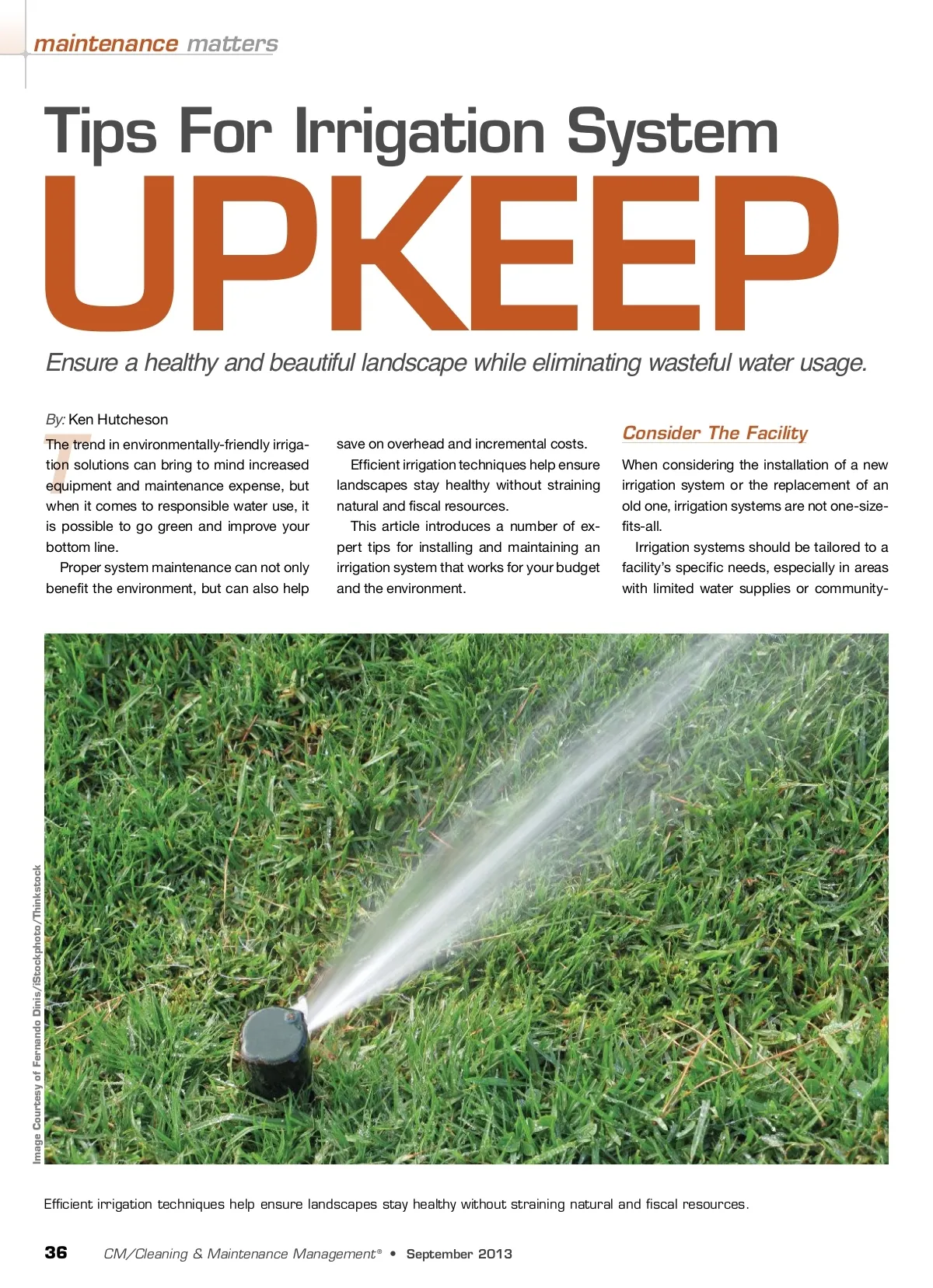
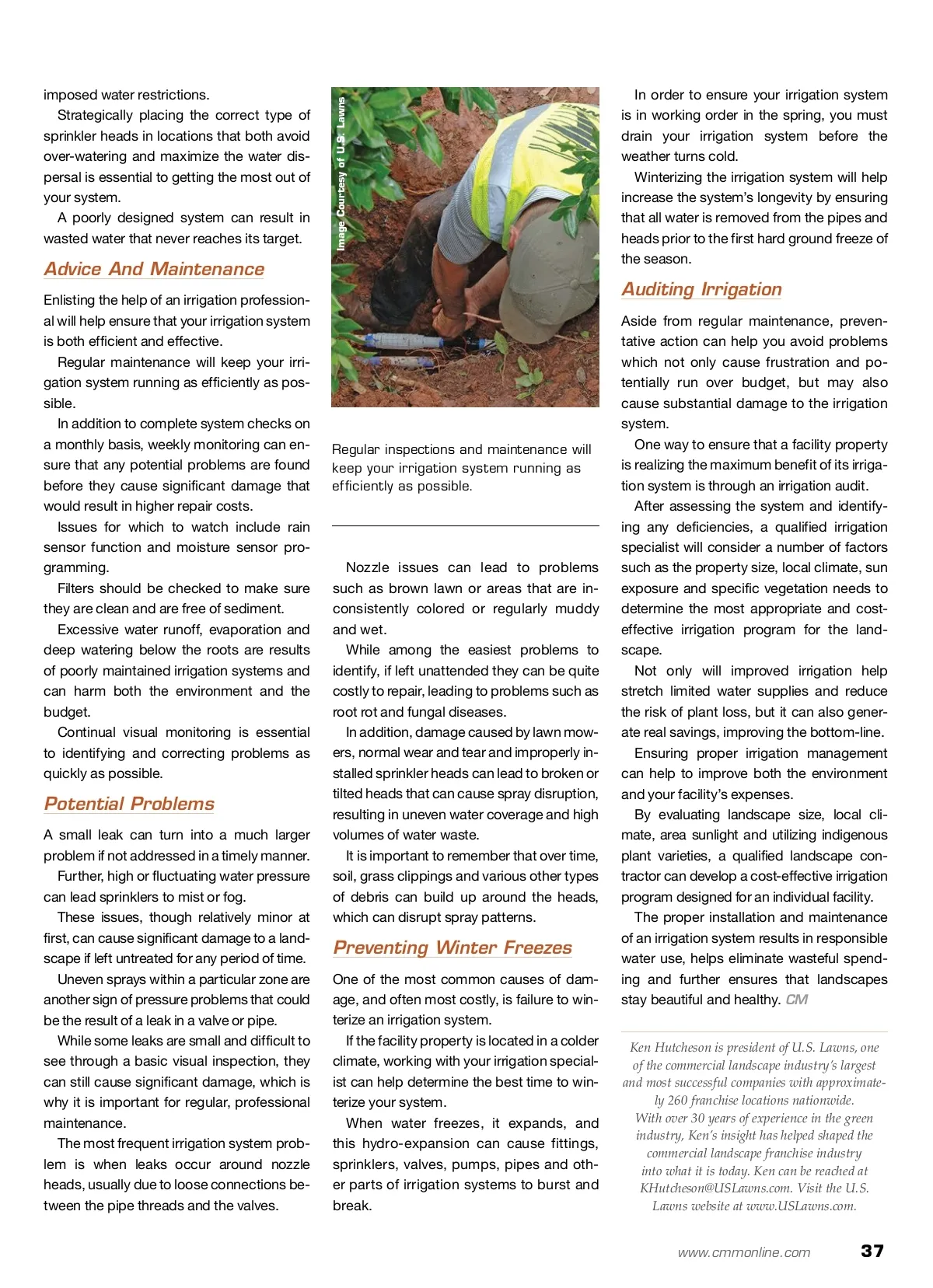
Advice And Maintenance Enlisting the help of an irrigation profession-al will help ensure that your irrigation system is both efficient and effective. Regular maintenance will keep your irri-gation system running as efficiently as pos-sible. In addition to complete system checks on a monthly basis, weekly monitoring can en-sure that any potential problems are found before they cause significant damage that would result in higher repair costs. Issues for which to watch include rain sensor function and moisture sensor pro-gramming. Filters should be checked to make sure they are clean and are free of sediment. Excessive water runoff, evaporation and deep watering below the roots are results of poorly maintained irrigation systems and can harm both the environment and the budget. Continual visual monitoring is essential to identifying and correcting problems as quickly as possible. Image Courtesy of U.S. Lawns imposed water restrictions. Strategically placing the correct type of sprinkler heads in locations that both avoid over-watering and maximize the water dis-persal is essential to getting the most out of your system. A poorly designed system can result in wasted water that never reaches its target. In order to ensure your irrigation system is in working order in the spring, you must drain your irrigation system before the weather turns cold. Winterizing the irrigation system will help increase the system’s longevity by ensuring that all water is removed from the pipes and heads prior to the first hard ground freeze of the season. Auditing Irrigation Aside from regular maintenance, preven-tative action can help you avoid problems which not only cause frustration and po-tentially run over budget, but may also cause substantial damage to the irrigation system. One way to ensure that a facility property is realizing the maximum benefit of its irriga-tion system is through an irrigation audit. After assessing the system and identify-ing any deficiencies, a qualified irrigation specialist will consider a number of factors such as the property size, local climate, sun exposure and specific vegetation needs to determine the most appropriate and cost-effective irrigation program for the land-scape. Not only will improved irrigation help stretch limited water supplies and reduce the risk of plant loss, but it can also gener-ate real savings, improving the bottom-line. Ensuring proper irrigation management can help to improve both the environment and your facility’s expenses. By evaluating landscape size, local cli-mate, area sunlight and utilizing indigenous plant varieties, a qualified landscape con-tractor can develop a cost-effective irrigation program designed for an individual facility. The proper installation and maintenance of an irrigation system results in responsible water use, helps eliminate wasteful spend-ing and further ensures that landscapes stay beautiful and healthy. CM Regular inspections and maintenance will keep your irrigation system running as efficiently as possible. Potential Problems A small leak can turn into a much larger problem if not addressed in a timely manner. Further, high or fluctuating water pressure can lead sprinklers to mist or fog. These issues, though relatively minor at first, can cause significant damage to a land-scape if left untreated for any period of time. Uneven sprays within a particular zone are another sign of pressure problems that could be the result of a leak in a valve or pipe. While some leaks are small and difficult to see through a basic visual inspection, they can still cause significant damage, which is why it is important for regular, professional maintenance. The most frequent irrigation system prob-lem is when leaks occur around nozzle heads, usually due to loose connections be-tween the pipe threads and the valves. Nozzle issues can lead to problems such as brown lawn or areas that are in-consistently colored or regularly muddy and wet. While among the easiest problems to identify, if left unattended they can be quite costly to repair, leading to problems such as root rot and fungal diseases. In addition, damage caused by lawn mow-ers, normal wear and tear and improperly in-stalled sprinkler heads can lead to broken or tilted heads that can cause spray disruption, resulting in uneven water coverage and high volumes of water waste. It is important to remember that over time, soil, grass clippings and various other types of debris can build up around the heads, which can disrupt spray patterns. Preventing Winter Freezes One of the most common causes of dam-age, and often most costly, is failure to win-terize an irrigation system. If the facility property is located in a colder climate, working with your irrigation special-ist can help determine the best time to win-terize your system. When water freezes, it expands, and this hydro-expansion can cause fittings, sprinklers, valves, pumps, pipes and oth-er parts of irrigation systems to burst and break. Ken Hutcheson is president of U.S. Lawns, one of the commercial landscape industry’s largest and most successful companies with approximate-ly 260 franchise locations nationwide. With over 30 years of experience in the green industry, Ken’s insight has helped shaped the commercial landscape franchise industry into what it is today. Ken can be reached at [email protected]. Visit the U.S. Lawns website at www.USLawns.com. www.cmmonline.com 37
CMM – Archives September 2013: 37