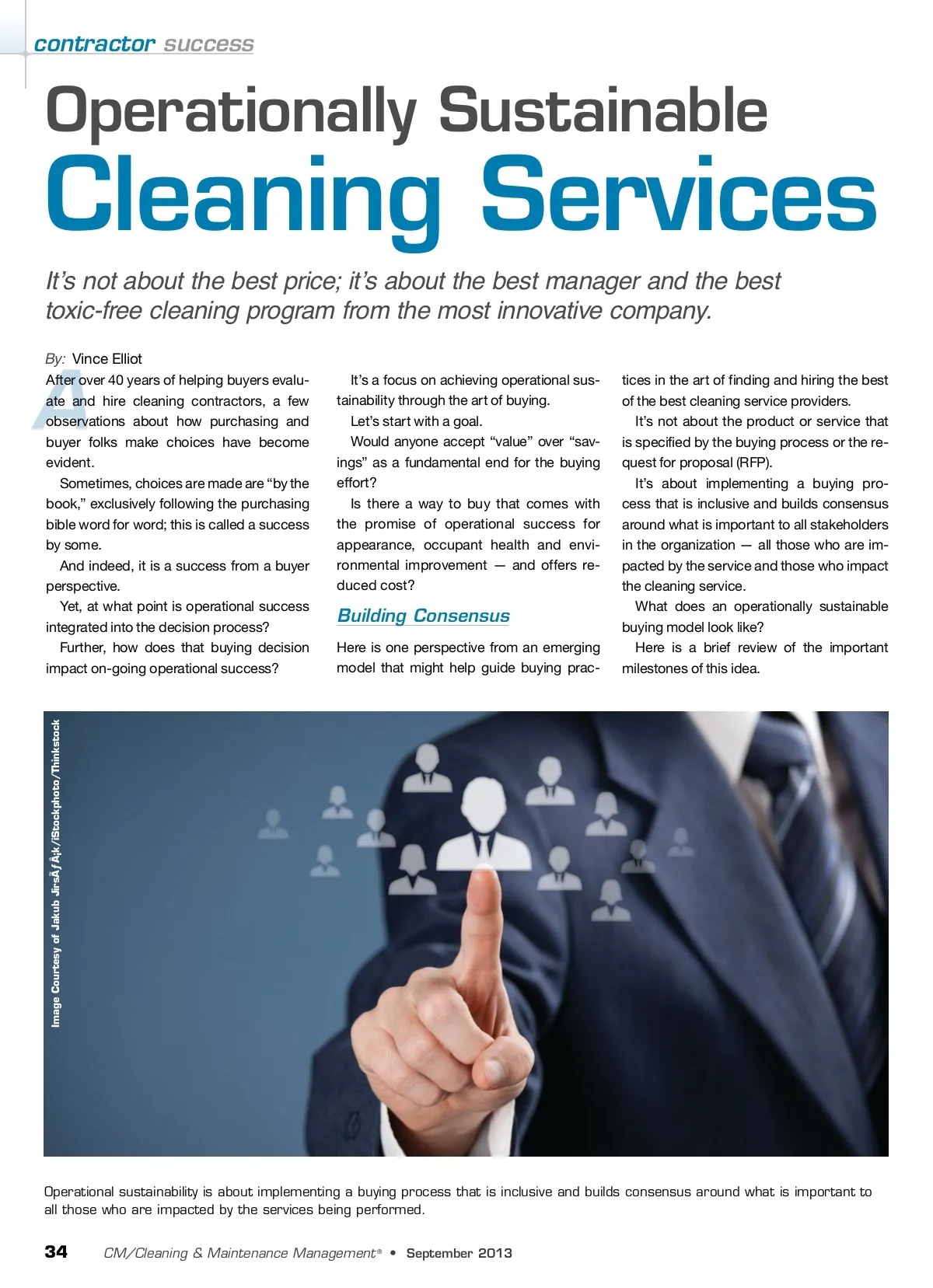
First, a little philosophy: This model fol-lows a long history in some countries of an extensive pre-qualification and study period with a shortened decision cycle. This idea means that there is a full under-standing of a product or service capability before any serious, official buying protocol. It can be done internally, or due to internal policies, it might be best to involve an advi-sor or consultant to facilitate the pre-qualifi-cation effort. Here’s a brief outline of the activities that represent this idea. Pre-qualification Pre-project planning: Hold a senior staff meeting with buyers, managers and c-level attendance. The goal of this meeting is to reach agree-ment on the project’s goals, strategy and stakeholder participation. A tentative schedule of activities is re-viewed at this time, and departmental and individual roles are defined. Stakeholder team: Identify and designate the company internal stakeholder team. This team will be the ultimate decision making authority for the final service pro-vider recommendation. Conduct a nominal group process: Bring the stakeholder team together to es-tablish buying goals, expectations and re-quirements. These will become the foundation of the company/contractor relationship and will be documented within the RFP requirements. Market pre-qualification: Not all poten-tial bidders are equally qualified, and it is un-fair to them and the organization to include them in a rigorous pre-qualification process. This process is time consuming and cost-ly for service providers and the stakeholder team. For example, if the contract would be worth $5 million a year, is a contractor do-ing $150,000 in revenue a year by a single owner/manager a good fit? Opening the bid process to anyone and everyone is a questionable policy and a dis-service to those who are clearly not capable of successfully meeting the needs of the buying organization. This step reduces the number of possible bidders, based on generally available finan-cial, reference, performance and manage-ment experience information. Scope of work: The scope of work docu-ment includes all of the requirements and relationship details needed by the potential bidders to prepare questions for a pre-qual-ification conference. Those service pre-qualified providers who have the potential for meeting the organiza-tion’s needs are invited to a pre-qualification conference. Pre-qualification conference and site tour: The pre-qualification conference is generally held on-site, with all previously screened service providers. The goal of the pre-qualification confer-ence is to review the needs, requirements and goals of the organization and to answer any questions from the service providers in attendance. The meeting is about creating clarity and understanding for all concerned. It is the opportunity for service providers to meet the stakeholder team and evaluate the physical plant. Capability documentation: Following the pre-qualification conference, service provid-ers are asked to document ideas and sug-gestions for a best practice cleaning model for the buyer’s buildings. Service providers can use this opportunity to demonstrate how they are different from their competitors and why they are the best choice for the organization. Stakeholder evaluation: Stakeholders meet to review and evaluate the best prac-tice ideas offered by the alternative service providers. A structured evaluation rating scale helps with this process and enables the stakehold-er team to create a numeric rating of each idea, best practice and innovation activity from each service provider. At the end of this process, the stakeholder team will identify the two or three best quali-fied service providers to participate in a co-development meeting. Co-development meeting: The two or three best qualified service providers are in-vited to present their service delivery system ideas and suggestions to the stakeholder team. There is a question and answer exchange, with all parties clarifying and emphasizing the importance of performance issues. At the conclusion of this clarification meeting, each service provider is invited to participate in the official RFP procurement process. Official RFP Process The official RFP buying process begins fol-lowing the co-development meeting and is subject to the rules and requirements of the buying organization. Service providers have a clear under-standing of the organization’s needs and re-quirements, and pricing is more realistically tied to these buyer expectations. So, what might be achieved through this buying model? Here are some of the results that have been tracked over the years: ■ Broad organizational support for the selected service provider ■ Dramatically improved cleanliness appearance ■ Increased occupant and customer sat-isfaction ■ Improved indoor air quality ■ Reduced environmental contamination ■ Cost reduction of up to 29 percent (in our experience) ■ Reduced operational administrative workload ■ Contractor empowerment to deliver results ■ Constant process improvement ■ A competitive environment for solution-focused management. Taken collectively, operationally sustain-able buying delivers what might loosely be called “value.” Operational results are delivered; per-formance is measured, managed and improved; innovation is valued; services are pro-active; stakeholder support is in-clusive; and, by the way, it all comes with cost reduction within the local provider market. CM Vince Elliott is the founder, president and chief executive officer (CEO) of Elliott Affiliates Ltd. of Hunt Valley, Maryland. For more information on consulting and performance-based measurement, visit www.EALtd.com. He is widely recognized as the leading authority in the design and utilization of best practice, performance-driven techniques for jani-torial outsourcing and ongoing management. Elliott is also the founder of the Chemical Free Cleaning Network (CFCN). More information about that ini-tiative can be found at www.CFCN.info. www.cmmonline.com 35
CMM – Archives September 2013: 35